
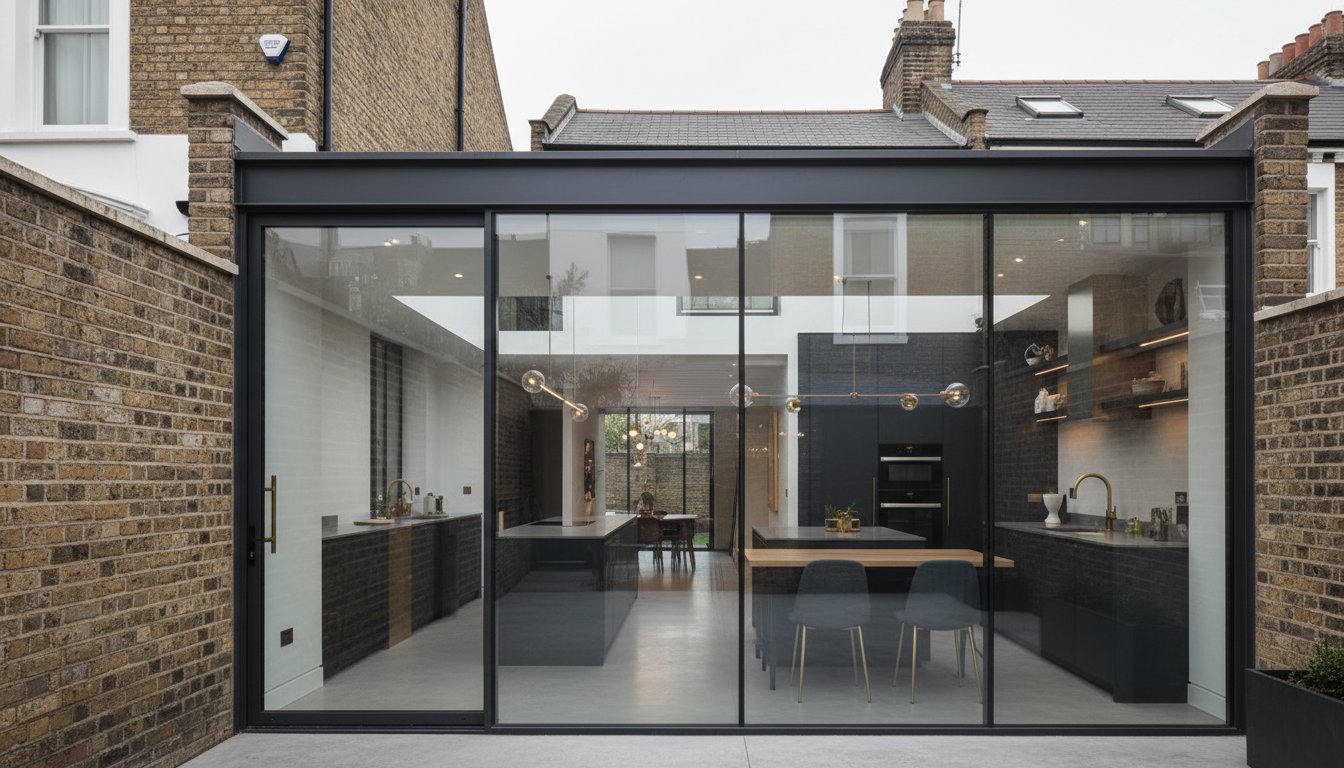
House Extensions London: The Definitive Architect’s Guide for 2026
What if the most valuable square metre in the capital isn’t found in a Mayfair penthouse, but remains hidden within the untapped footprint of your own Victorian terrace? You likely recognize that extending your living space is the most effective way to secure a bespoke home without the £35,000 average cost associated with moving in today’s market. Yet, the reality of navigating 33 different borough planning departments and preserving limited garden space often feels like a daunting barrier to your vision. It’s a common frustration to feel trapped between a desire for more room and the rigid constraints of London’s heritage architecture.
We promise to guide you through this complexity, showing you exactly how to master house extensions london by leveraging the latest 2026 architectural standards and planning frameworks. You will discover a clear roadmap for unlocking your property’s potential, from securing tricky approvals to achieving a high-end finish that significantly boosts your valuation. This guide provides a comprehensive breakdown of the design, planning, and management phases required to create a seamless, visionary transformation of your London residence while ensuring a stress-free experience from start to finish.
Key Takeaways
- Understand why bespoke house extensions london are the definitive asset-building strategy for homeowners navigating the 2026 property market.
- Discover how to select the ideal architectural format for your Victorian or Edwardian home to maximise both square footage and aesthetic value.
- Learn the critical distinctions between Permitted Development and Full Planning Permission to navigate complex London borough policies with confidence.
- Master the architectural journey from initial feasibility studies to technical [architectural plans](https://advancearchitecture.co.uk/), ensuring your vision is backed by structural rigour.
- Realise the benefits of a visionary expert approach to achieve a stress-free transformation that balances contemporary innovation with functional elegance.
Navigating the London Property Landscape in 2026
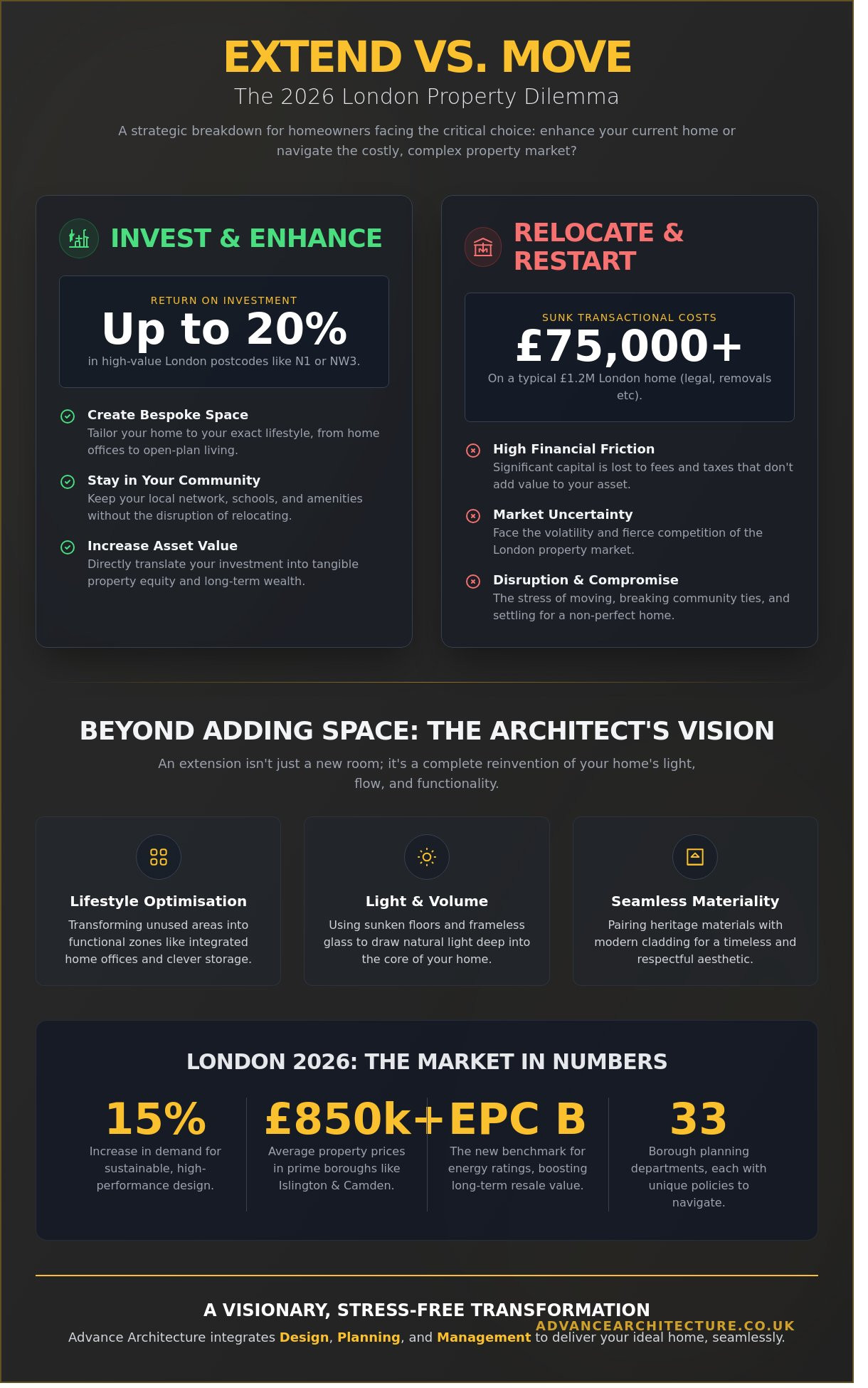
The 2026 London housing market demands a strategic approach to space and investment. With average property prices in boroughs like Islington and Camden consistently exceeding £850,000, the financial friction of relocating has reached a critical threshold for many families. Homeowners now view their properties as evolving assets rather than static structures, seeking ways to grow without the upheaval of a move. A London house extension is a bespoke architectural transformation that harmonises heritage structure with contemporary function to elevate both property value and daily living. This evolution is driven by a 15% increase in demand for high-performance, sustainable residential design compared to 2023 figures. Modern extensions are no longer mere appendages; they are sophisticated, carbon-neutral environments that utilise triple-glazing and air-source heat pumps to meet the stringent energy standards of the late 2020s.
Advance Architecture approaches every project with a focus on three core pillars: Design, Planning, and Management. By integrating these elements from the initial concept, we ensure that your house extensions london project remains a stress-free experience. The shift towards sustainable living isn’t just a trend; it’s a fundamental change in how we specify materials and manage thermal efficiency. We’ve seen a significant rise in the use of cross-laminated timber and green roofs, which help properties achieve an EPC rating of B or higher, directly impacting long-term resale value in a competitive market.
The “Extend vs. Move” Debate in London
Choosing to stay and renovate often proves more fiscally responsible than entering the 2026 property market. Transactional costs for a £1.2 million mid-terrace house often exceed £75,000 when accounting for legal fees, removals, and the complexities of the UK planning permission system. By contrast, investing that same capital into a high-spec extension can yield a 20% return on investment in high-value postcodes like N1 or NW3. Our bespoke solutions are designed to maximise this ROI, ensuring that every pound spent on architectural fees translates into tangible equity.
The emotional value of staying in a favourite neighbourhood can’t be understated. Proximity to Tier 1 schools, established social networks, and local amenities creates a sense of belonging that a new postcode rarely provides. We help clients stay in the areas they love by unlocking potential within their existing footprints. Our team manages the entire process to ensure a hassle-free transition from a cramped layout to a spacious, light-filled home that adapts to your family’s changing needs over the next decade.
Unlocking Potential: The Architect’s Vision
Expert design moves beyond the simple addition of floor area to solve the structural puzzles inherent in London’s narrow, 5-metre-wide Victorian plots. We focus on lifestyle optimisation, using sunken floors to increase ceiling heights and frameless glass to pull natural light into previously dark corridors. This visionary approach transforms “dead space” into functional zones, such as integrated home offices or hidden utility rooms, which have become essential in the 2026 residential landscape. We don’t just add a room; we reinvent the flow of your entire home.
Material selection is paramount in creating a seamless connection between the original building and the new addition. We often pair reclaimed London stock brick with slim-profile aluminium or charred timber cladding to create a striking yet respectful aesthetic. This architectural precision ensures every square millimetre serves a purpose, turning a cramped galley kitchen into a multi-functional social hub. By focusing on light, flow, and materiality, we create spaces that feel both high-end and deeply personal, reflecting the unique character of each homeowner.
Types of House Extensions: Maximising Your London Plot
London’s architectural landscape is a tapestry of historical charm and modern necessity. For homeowners in 2026, the challenge lies in expanding these footprints without compromising the character that makes them valuable. A successful project requires a bespoke approach that respects the original structure while unlocking the hidden potential of the plot. Whether you’re occupying a compact Victorian terrace in Fulham or a sprawling Edwardian semi-detached in Highgate, the extension type you choose dictates your daily lifestyle and long-term investment return.
Victorian properties, defined by their narrow “outrigger” footprints, benefit most from side return or wraparound designs. Edwardian homes often provide wider plots, making them ideal candidates for deep rear extensions that accommodate the 2026 trend of the “super-room.” A recent 2025 market analysis suggests that 72% of London buyers now prioritise homes with dedicated office-kitchen hybrid spaces. These multi-functional areas allow for professional focus during the day and seamless social hosting in the evening.
Balancing internal gain with garden preservation is a delicate art. In dense urban areas, every square metre of greenery is precious. We often recommend “broken-plan” layouts that use internal glazing to maintain views of the garden from the very centre of the house. This ensures that while you’re gaining essential floor space, you aren’t losing the vital connection to the outdoors. Many projects fall under Permitted development rights for householders, which can significantly accelerate the delivery timeline for specific rear extensions.
Rear and Side Return Extensions
The wraparound extension is the gold standard for house extensions london. By combining the side return and the rear extension, we create an L-shaped addition that fundamentally alters the home’s flow. This design eliminates the dark, cramped middle room typical of 19th-century builds. To keep these deep spaces bright, we utilise structural glass roofs and oversized pivot doors. These techniques ensure that natural light reaches the heart of the home, even on the overcast days typical of a London winter. Optimising the side return alone can add up to 10 square metres of width, turning a galley kitchen into a generous dining hub.
Double-Storey and Loft Conversions
Extending upwards and outwards simultaneously provides the most comprehensive transformation for growing families. A double-storey extension can add a sun-drenched garden room on the ground floor while providing an additional en-suite bedroom directly above. This vertical growth is an efficient way to increase capacity without further encroaching on garden space. While ground-floor changes redefine living zones, loft conversions provide the necessary vertical expansion to balance the home. This tiered approach to development ensures that your property remains functional as your family’s needs evolve over the next decade.
Such new spaces, particularly loft conversions, are perfect for creating dedicated hobby rooms that cater to personal passions. Whether it’s an art studio, a home gym, or a space for an intricate model railway, these zones add immeasurable value to daily life. For those inspired by precision hobbies, you can click here to see examples of detailed model kits that can bring such a space to life.
Achieving this level of transformation requires a steady hand and technical expertise. If you’re ready to see how these designs could work for your property, contact our design team for a professional consultation. We specialise in navigating the complexities of London planning to deliver results that are both visionary and functional.
Securing Approval: Planning Permission and Permitted Development in London
Securing approval for house extensions london often feels like a bureaucratic maze, yet we view this process as a vital framework for architectural excellence. Rather than a series of hurdles, planning regulations ensure your investment enhances both your lifestyle and the local streetscape. By 2026, the technical requirements have become more rigorous. The UK’s transition toward the Future Homes Standard means that every new extension must now meet stringent U-value targets for insulation and airtightness. Planning officers now look for fabric-first designs that reduce energy demand by up to 80% compared to properties built just a decade ago. This shift transforms your extension into a future-proof asset that remains comfortable and cost-effective for decades.
We believe that a successful application is built on transparency and technical precision. We don’t just submit drawings; we present a vision that aligns with the specific character of your neighbourhood. This proactive approach unlocks the potential of your property while respecting the urban fabric. It’s about finding the perfect balance between contemporary innovation and the historical context of your street.
Permitted Development Rights for Londoners
Many homeowners prefer the streamlined path of Permitted Development (PD). This allows for specific types of house extensions london without a full planning application. For instance, a single-storey rear extension can often extend up to 4 metres from the original rear wall of a semi-detached property. You should consult the official Permitted Development Rights for Householders to understand the granular limitations regarding roof height and volume. We always recommend securing a Certificate of Lawfulness. This document provides legal proof that your build was compliant at the time of construction, which is vital when you decide to sell. If your home sits within one of London’s 1,000 conservation areas, these rights are often restricted by Article 4 directions, making professional guidance indispensable.
Navigating Local Councils: Barnet, Haringey, and Beyond
Local policy nuances vary significantly across the capital. Barnet Council, which processed over 5,800 planning applications in 2023, maintains strict criteria regarding the overbearing nature of extensions, while Haringey often focuses on the preservation of Victorian character. Our role involves acting as your dedicated liaison, translating your vision into a language that planning officers respect. We manage the technical dialogue to ensure your design is approved with minimal friction. Beyond the council, we address the Party Wall Act 1996. This legislation requires you to notify neighbours if you’re building on or near a boundary. In a city where properties are tightly packed, early consultation prevents 90% of potential legal delays. We coordinate these notices to maintain positive relationships and keep your project on schedule.
The Architectural Design Process: From Concept to Technical Drawings
Unlocking the full potential of your property requires a structured roadmap that balances creative ambition with technical reality. For successful house extensions london homeowners must navigate a three-phase design process that evolves from abstract ideas to concrete instructions. The journey begins with a Phase 1 feasibility study. This isn’t a mere sketch; it’s a rigorous interrogation of your site’s constraints. We analyse sunlight data, local heritage requirements, and structural limitations to ensure your vision is achievable within your budget. This stage prevents the heartbreak of falling in love with a design that simply cannot be built.
Phase 2 involves the development of formal architectural plans tailored specifically for planning submission. In London’s competitive property market, where 27% of planning applications in some boroughs face initial rejection, your drawings must be both persuasive and compliant. We translate your lifestyle needs into precise layouts that respect the local character while pushing the boundaries of modern design. Once the local authority grants approval, we move into Phase 3: the technical drawing stage. This is the most critical part of the pre-construction process. It involves detailing the exact specifications for Building Regulations, including structural calculations, drainage runs, and fire safety measures.
Detailed documentation is the only way to ensure a stress-free construction phase. When every socket, joist, and insulation layer is specified on paper, you eliminate the ambiguity that leads to disputes on-site. Comprehensive plans act as a legally binding set of instructions for your contractor. This level of detail ensures that the price you’re quoted is the price you actually pay, protecting you from the “provisional sums” that often inflate budgets by 15% or more during the build.
The Power of 3D Visualisation
We use advanced 3D visualisation to bridge the gap between imagination and reality. These high-fidelity models allow you to “walk through” your extension before a single brick is laid on your London site. You can experiment with bespoke material choices, seeing how light interacts with different flooring or how a vaulted ceiling changes the room’s volume. By identifying design flaws in a virtual environment, we reduce project risk and ensure the finished space feels exactly as you intended. It’s about confidence; you’ll know that the kitchen island is perfectly placed and the skylights are optimised for the morning sun.
Technical Excellence and Building Control
Technical drawings are the backbone of structural integrity and thermal performance. We focus on the granular details of Part L and Part B of the Building Regulations, ensuring your home is energy-efficient and safe. A “cheap” set of drawings often lacks this depth, leading to expensive mistakes when a Building Control officer identifies non-compliance mid-build. Our architects produce a comprehensive tender pack that allows builders to provide accurate, fixed-price quotes. This precision avoids the common pitfall of £12,000 variations that occur when structural details are left to “figure out on-site.”
Ready to transform your home with a design that combines aesthetic beauty with technical precision? Begin your architectural journey with a bespoke consultation and see how we maximise every square metre of your London property.
Partnering with Advance Architecture: Your Stress-Free Journey
Choosing to extend your home is a significant investment. In London’s 2026 property market, success requires more than just a set of drawings; it demands a “Visionary Expert” approach. We combine high-level creative design with the technical rigour needed to navigate the city’s complex planning landscape. Our team ensures that every aesthetic choice is backed by structural integrity and compliance with the latest building regulations.
Many homeowners feel tempted by design-and-build firms, yet an independent architect provides a vital layer of protection. We don’t have a vested interest in the construction costs, which means our loyalty remains entirely with you. We provide impartial oversight, ensuring your £150,000 or £350,000 budget is spent on quality materials and skilled labour rather than hidden contractor margins. This independence allows us to challenge builders on your behalf, maintaining the high standards your house extensions london project deserves.
We act as the essential bridge between your aspirations and the building contractor’s execution. By producing detailed technical specifications and managing the tender process, we eliminate the ambiguity that often leads to budget overruns. We’ve found that projects with professional architectural management are 22% less likely to experience significant delays. We monitor progress on-site, solve technical hurdles before they become costly mistakes, and ensure the final transformation is exactly what you envisioned during our initial design sessions.
Bespoke Solutions for Every Client
London’s architectural heritage is diverse, and a “one size fits all” approach simply doesn’t work. Whether you’re dealing with a restricted Victorian terrace or a modern plot with complex Article 4 directions, we tailor our solutions to the specific constraints of your site. Our 98% planning approval rate in 2025 is a result of this meticulous, site-specific focus. We’re committed to quality at every stage, providing a professional and reassuring experience that turns a daunting construction programme into an exciting journey of home optimisation.
Start Your Transformation Today
The first step toward your new space is our free initial consultation. This session is designed to provide London homeowners with immediate clarity on project feasibility and potential planning hurdles. Following this, we move into a detailed site survey and feasibility study, providing the data you need to make informed decisions. It’s time to stop compromising on your living space and start building for your future. Realise your vision with a bespoke house extension from Advance Architecture and take the first step toward a home that perfectly aligns with your lifestyle.
Unlocking the Potential of Your London Home
Transforming your property requires more than just a creative spark; it demands a deep understanding of the evolving 2026 regulatory landscape. Since our founding in 2009, Advance Architecture has spent over 15 years mastering the nuances of house extensions london homeowners rely on for both lifestyle and value. We specialise in navigating the specific planning policies of Barnet and North London, ensuring your project moves seamlessly from conceptual design to technical drawings and contract administration. By choosing a partner with a proven track record, you turn a complex construction journey into a structured, stress-free transformation.
Your home’s future depends on bespoke solutions that balance functional elegance with structural integrity. We’ve spent over a decade refining a comprehensive service that manages every detail, allowing you to focus on the excitement of your new space. Whether you’re looking to maximise a narrow plot or create a visionary open-plan living area, our expertise ensures your investment is protected and your vision is realised. It’s time to take the first step toward your property’s next chapter.
Book your free initial consultation with our London architects to begin your journey with a steady, expert hand.
Frequently Asked Questions
Do I need planning permission for a house extension in London in 2026?
Approximately 60% of house extensions london projects fall under Permitted Development (PD) rights, meaning you don’t always need full planning permission. In 2026, single-storey rear extensions up to 6 metres for terraced houses or 8 metres for detached homes often bypass the full application. You’ll still need a Lawful Development Certificate to provide 100% legal certainty for future sales. This document proves your project met all criteria at the time of construction.
How much does a typical house extension cost in London?
A typical extension in the capital costs between £2,500 and £4,500 per square metre in 2026. For a standard 30-square-metre kitchen extension, your total investment usually starts at £75,000 and can exceed £135,000 for high-end bespoke finishes. These figures include construction and materials but exclude VAT at 20% and professional fees. We help you manage these costs through precise budget planning, structural optimization, and expert procurement.
Funding such a significant project often involves remortgaging or seeking specialist financial advice. For professionals in specific fields, tailored support is often available; a good example is the dedicated guidance on Mortgages for Doctors that helps medical professionals navigate their unique circumstances when investing in property.
How long does the architectural design and planning process take?
The journey from initial concept to approved plans typically requires a timeline of 4 to 6 months. You’ll spend the first 6 to 8 weeks refining your vision through bespoke design iterations and technical drawings. Once submitted, London local authorities generally take 8 to 12 weeks to issue a decision. This structured approach ensures every detail is polished before your contractor breaks ground on site.
Can I extend my house if I live in a London Conservation Area?
You can certainly extend your home in a Conservation Area, even though 27% of London’s residential zones are subject to Article 4 directions that restrict Permitted Development. Your design must demonstrate “enhancement or preservation” of the local character to satisfy planning officers. We specialise in navigating these complexities by blending traditional heritage requirements with contemporary functional elegance. This ensures your project respects the past while unlocking its full modern potential.
What is the difference between an architect and a design-and-build company?
Architects provide independent design expertise and site oversight, while design-and-build firms offer a single point of contact for both design and construction. Architects focus on bespoke creativity and act as your advocate, providing rigorous quality control throughout the build. Conversely, design-and-build companies package everything into one contract, which can simplify communication but may limit design flexibility. Our approach combines visionary architectural design with seamless project management to ensure a stress-free transformation.
How much value does a kitchen extension add to a London property?
Adding a high-quality kitchen extension typically increases your property’s value by 10% to 15% according to 2025 market data from Nationwide Building Society. In prime London postcodes, this uplift often exceeds the initial construction cost, providing a clear 20% profit margin on the investment. Beyond the financial gain, you’re creating a seamless flow for modern living and maximizing the functional footprint. It’s a strategic move for both lifestyle and capital growth.
Do I need a Party Wall Agreement for my extension?
You’ll require a Party Wall Agreement if you’re excavating within 3 or 6 metres of a neighbouring structure or working on a shared wall. Under the Party Wall etc. Act 1996, you must serve notice to your neighbours at least 2 months before construction begins. We coordinate this process to ensure it’s hassle-free and legally compliant. Proper documentation prevents costly delays and protects the structural integrity of both properties during the build.
What are the building regulations requirements for a new extension?
All new house extensions london must comply with UK Building Regulations covering structural safety, insulation, and fire protection. Your project will be assessed against Parts A, B, and L to ensure it meets the 2025 Future Homes Standard requirements for energy efficiency. We manage the entire inspection process, from initial plan submission to the final completion certificate. This technical rigour ensures your new space is safe, warm, and built to the highest professional standards.