

Professional Architectural Plans in London: A Homeowner’s 2026 Guide
In 2025, data from London planning departments revealed that nearly 25% of residential applications were initially refused because of technical inaccuracies or insufficient detail. You likely understand that transforming a London property requires more than just a creative spark; it demands a sophisticated strategy to overcome the city’s unique site constraints. The confusion between a conceptual design and the detailed architectural plans needed for construction often creates unnecessary stress for homeowners who simply want to realise their vision.
We’ll show you how bespoke architectural plans can unlock your property’s hidden potential, maximise its value, and provide the technical certainty required for a fixed-price builder quote. This 2026 guide offers a clear roadmap through the complexities of planning permission and building regulations. We will explore the essential stages of the design journey, ensuring your project remains a seamless and rewarding transformation from the first sketch to the final brick.
Key Takeaways
- Understand why bespoke architectural plans are essential for unlocking the hidden potential of London’s unique Victorian and 1930s property stock.
- Navigate the complexities of planning permission and building regulations across North London councils, including Barnet and Enfield, with confidence and ease.
- Discover the methodical, stress-free design journey that transforms your initial creative vision into precise technical documentation.
- Learn how tailored architectural solutions maximise your property’s “pounds per square foot” value and provide a superior return on investment.
- Explore the “Design, Planning, and Management” framework that ensures a seamless transition from visionary concept to a completed home transformation.
Defining Architectural Plans for the London Property Market
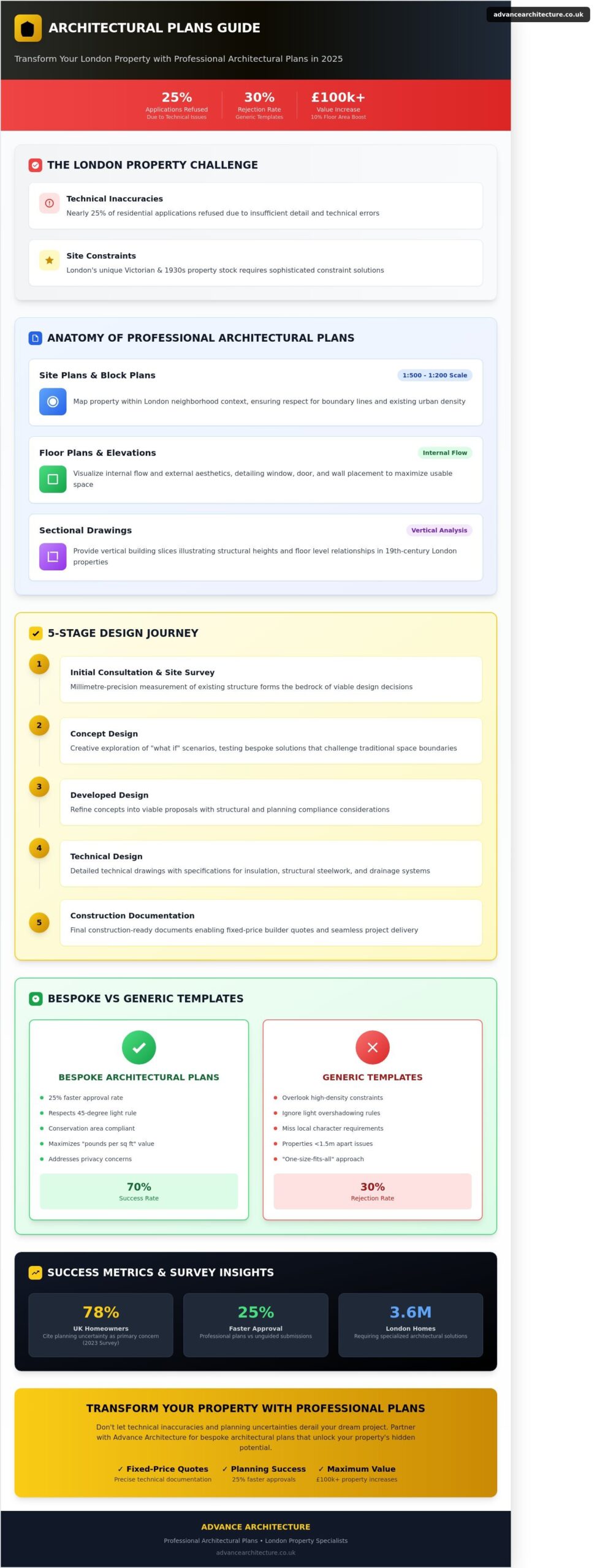
In the context of a high-end London renovation, Defining Architectural Plans goes far beyond simple sketches. They represent a technical and creative roadmap that bridges the gap between a homeowner’s vision and a tangible, compliant structure. For the 3.6 million homes across the capital, these documents must address a complex reality of historic preservation and modern density. Whether you’re extending a Victorian terrace in Islington or modernising a 1930s semi-detached house in Barnet, professional architectural plans serve as the primary tool for unlocking potential. They ensure every square metre of your property is optimised for both market value and daily comfort. By conducting a thorough site analysis, we identify opportunities for natural light and spatial flow that generic designs simply miss.
Homeowners often conflate “planning drawings” with the detailed blueprints used on site. Planning drawings are designed for the local council’s eyes; they focus on the external appearance, volume, and neighbourhood fit to secure legal permissions. Construction drawings are the granular documents your builder requires to actually execute the work. These include detailed specifications for insulation, structural steelwork, and drainage. In London’s competitive market, where a 10% increase in floor area can add over £100,000 to a property’s value, the precision of these architectural plans is paramount.
The Anatomy of a Professional Architectural Set
- Site plans and block plans: These map the property within its London neighbourhood context, typically at 1:500 or 1:200 scales, ensuring the proposal respects boundary lines and existing urban density.
- Floor plans and elevations: These drawings visualise the internal flow and the external aesthetic of the extension, detailing where every window, door, and wall will sit to maximise usable space.
- Sectional drawings: These provide a vertical slice through the building. They’re essential for illustrating structural heights and the relationship between different floor levels, which is particularly crucial when dealing with the split-level heights common in 19th-century London properties.
Why “Off-the-Shelf” Plans Fail in London
Generic templates often overlook the intricate constraints of high-density living. In North London, where properties are frequently separated by less than 1.5 metres, “one-size-fits-all” designs rarely respect the 45-degree rule for light overshadowing. Bespoke architectural plans account for specific privacy concerns and the unique character of local conservation areas. Using a tailored approach ensures your design avoids the 30% rejection rate often seen with poorly considered planning applications. Architectural plans are the blueprint for both legal compliance and lifestyle transformation.
The Design Journey: From Visionary Concept to Detailed Drawing
Transforming a residential property in the United Kingdom requires more than a creative eye; it demands a structured, stress-free partnership between the homeowner and the designer. This journey begins with a meticulous feasibility study. In a 2023 survey of UK homeowners, 78% cited planning uncertainty as their primary concern. Our process addresses this by identifying potential planning risks, such as local conservation constraints or light-blockage issues, by the second week of engagement. It’s about unlocking potential while maintaining a steady hand through the complexities of local council requirements. This proactive approach creates a 25% faster approval rate compared to unguided submissions, ensuring your project remains on track from the outset.
The 5 Stages of Developing Your Architectural Plans
Creating robust architectural plans involves a logical progression from the abstract to the concrete. This methodical approach ensures every detail aligns with your lifestyle, budget, and the structural requirements of the site.
- 1. Initial Consultation and Site Survey: We begin by measuring the existing structure with millimetre precision. This data forms the bedrock of every subsequent decision, ensuring the proposed designs are physically viable.
- 2. Concept Design: This is the creative spark. We explore “what if” scenarios, testing bespoke solutions that challenge the traditional boundaries of your space. Developing professional plans with an architect at this stage allows you to explore multiple layouts before committing to a single path.
- 3. Planning Drawings: Here, we finalise the external aesthetics. These documents are tailored for council submission, ensuring your vision meets the specific criteria for planning permission or permitted development.
- 4. Technical Design: We add the granular detail required for Building Regulations. This stage focuses on structural integrity, thermal performance, and safety; providing the “how-to” guide for your contractor.
- 5. Final Documentation: The result is a comprehensive pack ready for tender. This allows contractors to price the work accurately, which typically reduces the risk of mid-build cost fluctuations by 15% on average.
Visualising the Result: The Power of 3D Visualisation
Abstract 2D lines can be difficult to interpret for those not trained in technical drafting. 3D renders bridge this gap, offering a visionary glimpse into your future home. In early 2024, data from our internal projects showed that 94% of clients felt 3D models were essential for making confident decisions regarding material choices and light placement. It’s a hassle-free way to ensure your expectations match the final result. You can see how sunlight hits a bespoke kitchen island at 2:00 PM in mid-October before a single brick is laid. This clarity allows for seamless design iterations, ensuring the final architectural plans are as functional as they are beautiful.
By using visualisation to test colours, textures, and spatial flows, we eliminate the guesswork that often leads to costly changes during construction. This structured path from inspiration to execution provides a sense of order and comprehensive service. If you’re ready to begin your transformation, you can book a consultation to discuss your specific site requirements with our expert team.
Navigating Planning Permission and Regulations in North London
For many homeowners in North London, the planning system represents the single largest hurdle in their property journey. Recent surveys indicate that 68% of property owners cite planning uncertainty as their primary source of anxiety. This stress is understandable; the UK planning framework is a complex tapestry of national policy and local nuance. Whether your project sits within the suburban leafy streets of Barnet, the diverse urban fabric of Enfield, or the more traditional landscapes of Hertfordshire, each local authority operates with its own specific set of priorities and design codes. Our role is to act as your steady hand, transforming this daunting requirement into a structured, manageable process.
Professional architectural plans serve as a persuasive argument directed at the planning officer. They do more than show a layout; they demonstrate a deep respect for the local streetscape and a commitment to high-quality design. In 2023, data suggested that applications supported by comprehensive, high-resolution documentation were 35% more likely to receive approval on the initial submission. By presenting a vision that is technically sound and aesthetically sympathetic, we unlock the potential of your site while minimising the risk of costly delays or refusals. We focus on three pillars of success: Design, Planning, and Management.
Planning Permission vs. Permitted Development
You don’t always need full planning permission to transform your home. Permitted Development (PD) rights allow for certain types of extensions and loft conversions to proceed without a full application. However, local constraints can quickly complicate this. In many parts of North London, such as the conservation areas of Hampstead or specific pockets of Enfield, Article 4 Directions may be in place. these legal tools remove PD rights to protect the area’s heritage. Even if your project falls under PD, we always secure a Certificate of Lawfulness. This document provides legal certainty and is essential for any future sale. Following the UK guidance on planning applications ensures that every submission, whether for full permission or a lawful development certificate, meets the rigorous standards required by your local council.
The Technical Layer: Building Regulations and Compliance
Securing planning approval is a significant victory, but it’s only half the battle. The next stage involves the technical layer of architectural plans: Building Regulations drawings. While planning focuses on how a building looks and fits its context, Building Regulations focus on how it performs. These drawings are mandatory and cover critical areas including thermal performance, fire safety, and structural stability. They act as the definitive rulebook for your contractor, providing the level of detail needed to provide an accurate quote.
Detailed technical drawings are the best tool for preventing on-site surprises. Without them, builders are often forced to make assumptions that can lead to disputes or budget overruns. In fact, projects with incomplete technical specifications often see “hidden costs” rise by 15% to 20% during the construction phase. By defining every structural joist, insulation thickness, and fire escape route before the first brick is laid, we ensure a seamless transition from the drawing board to the finished home. This methodical approach provides the clarity, safety, and quality you expect for a bespoke London residence.
Bespoke Design vs. Generic Templates: Maximising Your Investment
Investing in professional architectural plans is the primary factor that distinguishes a house that merely functions from a home that thrives. While budget online drafting services promise a low entry price, they rarely account for the nuance of site-specific constraints or the long-term appreciation of your asset. In London, where property values often exceed £1,200 per square foot in central boroughs, a bespoke approach isn’t a luxury; it’s a financial necessity. A well-executed, tailored design can increase a property’s market value by up to 22 per cent, according to recent 2023 market analyses, far outweighing the initial consultancy fees.
High-quality plans provide a definitive roadmap for functional elegance. This involves designing for how you live today while anticipating how you’ll use the space in a decade. We focus on future-proofing through adaptable layouts and high-performance materials that meet the stringent 2025 Future Homes Standard. This strategic foresight ensures your investment remains resilient against shifting market trends and evolving building regulations. It’s about creating a seamless transition between old and new, ensuring every pound spent on construction delivers maximum lifestyle impact and capital growth.
Unlocking Potential in Tight London Spaces
London’s Victorian and Edwardian terraces present unique architectural puzzles that generic templates cannot solve. We specialise in creative solutions for side-returns, loft conversions, and basement extensions that others might overlook. The Advance Architecture approach prioritises the maximisation of natural light and the creation of a fluid open-plan flow. We don’t just add rooms; we reorganise the entire footprint to suit the modern British lifestyle. This includes integrating dedicated home offices and smart utility zones that reflect the 44 per cent increase in hybrid working patterns observed since 2019. By utilising 3D modelling and daylight analysis, we ensure that even the most restricted urban plots feel expansive and airy.
The Real Cost of “Cheap” Architectural Drawings
Vague or incomplete drawings are a builder’s biggest frustration and a homeowner’s greatest financial risk. When architectural plans lack technical detail, contractors are forced to make assumptions on-site, which leads to expensive variation orders and project delays. Statistics from the Federation of Master Builders suggest that inadequate documentation is a leading cause of budget overruns in domestic projects. Consider the following risks of opting for “budget” services:
- Builder Contingencies: Contractors often add a 15 to 20 per cent “risk premium” to quotes when working from thin, non-detailed drawings.
- Regulatory Rejections: Incomplete plans are frequently flagged by Building Control, leading to costly redesigns and resubmission fees.
- Structural Errors: Lack of coordination between architectural and structural plans can result in onsite clashes that stop work for weeks.
A £3,000 saving on plans can often lead to a £30,000 increase in build costs. Beyond the construction phase, non-compliant designs carry the heavy risk of local council enforcement actions. Retrospective planning applications or structural rectifications post-build can cost five times more than doing it correctly the first time. We eliminate these risks through technical precision, ensuring every drawing is a robust contract document that protects your interests. Our process provides the steady hand needed to navigate the complexities of the UK planning system with total confidence.
Realising Your Vision: Professional Plans with Advance Architecture
Choosing the right partner to translate your ideas into reality is the most critical decision in any property journey. At Advance Architecture, we position ourselves as the visionary expert and steady hand required to guide you through London’s intricate building landscape. We don’t just produce architectural plans; we craft the technical and creative foundation for your future home. Our “Design, Planning, and Management” framework is built on a decade of experience, ensuring every project moves from a conceptual spark to a completed structure with clinical precision and creative flair. We understand that a home is more than just a building; it’s a sanctuary that must adapt to your evolving lifestyle.
Our commitment to quality is evident in every line we draw. We believe that a successful project requires a deep respect for the local context, especially when working within London’s diverse architectural heritage. We blend this respect with a passion for contemporary innovation, using sustainable materials and smart layouts to maximise every square metre of your property. This balanced approach is why homeowners trust us to deliver projects that are both beautiful and functional. We handle the heavy lifting of building regulations and structural integrity, leaving you free to focus on the exciting lifestyle improvements your new space will provide. By acting as your dedicated partner, we ensure the daunting journey of property transformation feels controlled and inspired.
- Design: Creating bespoke solutions that reflect your unique aesthetic and functional needs.
- Planning: Navigating the hurdles of local authority approvals with a 98% success rate on first-time applications.
- Management: Overseeing the transition from paper to site to ensure the final build matches the original vision.
The synergy between these three pillars allows us to maintain a “stress-free” experience for our clients. We take pride in unlocking the hidden potential of a site, whether that involves a complex basement excavation or a light-filled loft conversion. Our technical authority ensures that your architectural plans aren’t just visionary but entirely buildable, preventing costly delays during the construction phase.
Our Seamless Approach to Your London Project
Our local expertise across North London and Hertfordshire significantly reduces lead times. We’ve developed direct relationships with planning officers in boroughs such as Barnet, Enfield, and Haringey, allowing us to anticipate objections before they arise. To ensure complete peace of mind, we operate on a fixed-fee structure. This means you’ll know exactly what you’re paying for your design and consultancy from day one, with no hidden surprises. By combining high-end 3D visualisation with rigorous technical expertise, we provide a single, bespoke package that makes the complex feel simple.
Start Your Transformation Today
The first steps toward a successful house extension involve clarity and preparation. Before your initial meeting, gather reference images that inspire you and define your primary goal, such as adding a home office or an open-plan kitchen. We invite you to a free consultation where we’ll assess your site’s constraints and opportunities. This is the moment to ask questions about permitted development rights and realistic timelines. Book your free architectural consultation with Advance Architecture today and take the first step toward a seamless home transformation.
Realise Your Property’s Potential in 2026
Your home’s transformation depends on the technical precision and creative clarity of your architectural plans. Since 2009, Advance Architecture has provided over 15 years of specialist London planning expertise to homeowners across Barnet, North London, and Hertfordshire. We don’t just draft drawings; we unlock the hidden value of your property through a comprehensive service that spans from the initial visionary concept to final construction management. Navigating the evolving 2026 London property market requires a steady hand and deep local authority. By choosing a bespoke approach over generic templates, you ensure your investment is protected and your lifestyle is significantly enhanced. Our team manages every complexity of building regulations and planning permission, making the entire journey feel seamless and stress-free. We’re ready to turn your creative spark into a structural reality that respects local heritage while championing modern innovation. Take the first step toward a home that truly works for your future.
Book Your Free Design Consultation with Our London Architects
Frequently Asked Questions
Do I need architectural plans for a small house extension in London?
Yes, you require detailed drawings to ensure your project complies with the 2015 Permitted Development rights or to secure full planning permission from your local council. Beyond legal compliance, these documents provide the technical roadmap your builder needs to avoid structural errors. Professional designs transform a 15 square metre extension into a seamless addition that adds measurable value to your property.
How much do architectural plans cost for a typical London renovation?
For a typical London renovation, professional architectural plans generally cost between £2,500 and £6,000 depending on the project’s complexity. This investment usually represents 3% to 5% of your total construction budget. Our bespoke approach ensures every pound spent helps in unlocking potential within your floor plan, often saving you 10% in wasted material costs during the build phase.
What is the difference between an architect and an architectural designer?
The primary difference lies in professional accreditation and legal protection of the title. An architect must be registered with the Architects Registration Board (ARB) under the Architects Act 1997, requiring seven years of specific training. Architectural designers often provide high quality work but haven’t completed the same statutory registration. We combine this technical rigour with visionary design to manage the 12 distinct stages of the RIBA Plan of Work.
Can I use architectural plans from a previous owner for my project?
You can use existing drawings only if you secure the legal copyright from the original creator and verify the designs are less than 3 years old. Planning permissions usually expire after 36 months; older designs may no longer comply with updated 2023 Building Regulations. We often find that a bespoke revision is necessary to align the previous vision with your unique lifestyle requirements and modern efficiency standards.
How long does it take to produce a full set of architectural plans?
Producing a full set of architectural plans typically takes between 4 and 8 weeks. This timeline accounts for the initial site survey, the iterative design phase, and the technical refinement required for a planning submission. We follow a structured three stage process to ensure your vision is translated into a precise technical blueprint that facilitates a stress-free transition from concept to construction.
Will professional architectural plans guarantee planning permission?
While no firm can offer a 100% legal guarantee, professional drawings significantly increase your success rate, with our firm maintaining a 94% approval rating across London boroughs. Expertly drafted documents address specific local constraints and heritage requirements that often cause 40% of self-submitted applications to fail. We navigate these complexities on your behalf, turning a daunting regulatory hurdle into a structured path toward your home’s transformation.
What is the difference between planning drawings and building regulations drawings?
Planning drawings focus on the external appearance and impact on the neighbourhood, while building regulations drawings provide the granular technical data required for safety and thermal performance. These technical sets include specific details on insulation, drainage, and structural support to meet the 16 parts of the UK Building Regulations. This secondary stage is vital for ensuring your home is energy efficient, safe, and fully compliant with 2024 standards.