

Architect Planning in London: A Homeowner’s Guide to Reading and Reviewing Project Drawings
Last Tuesday, a homeowner in Barnet sat at their kitchen table staring at a set of monochrome lines representing their future extension, yet they felt more lost than inspired. It’s a common scene across North London. You’re presented with a vision for your home, but the technical nuances of architect planning can feel like a foreign language. You likely worry that a single misunderstood symbol might result in a kitchen that’s too dark or a staircase that feels cramped.
We understand that the distinction between planning drawings and building regulations often feels unnecessarily complex, especially with the added pressure of local committee expectations. This guide will empower you to master the language of architectural plans, ensuring you can provide constructive feedback and steer through the London planning process with absolute certainty. By learning to read between the lines, you’ll unlock your property’s full potential and secure that vital approval in boroughs like Enfield or Barnet. We’ll outline the precise roadmap from your initial design concepts to the start of construction on site.
Key Takeaways
- Discover how professional architect planning serves as a strategic roadmap, allowing you to navigate London’s unique property density and unlock your home’s true potential.
- Learn to decode the hierarchy of architectural drawings, from initial feasibility sketches to the detailed documents required for a successful planning application.
- Understand the “London Factor” and how site-specific constraints, such as Conservation Areas and Listed status, shape your project’s design and regulatory requirements.
- Gain the practical skills to interpret scales, symbols, and annotations, ensuring you can review every detail of your proposed transformation with technical authority.
- Explore how detailed technical drawings safeguard your investment by providing a clear bridge between planning approval and high-quality, stress-free construction.
Understanding the Role of Architect Planning in Your London Home Transformation
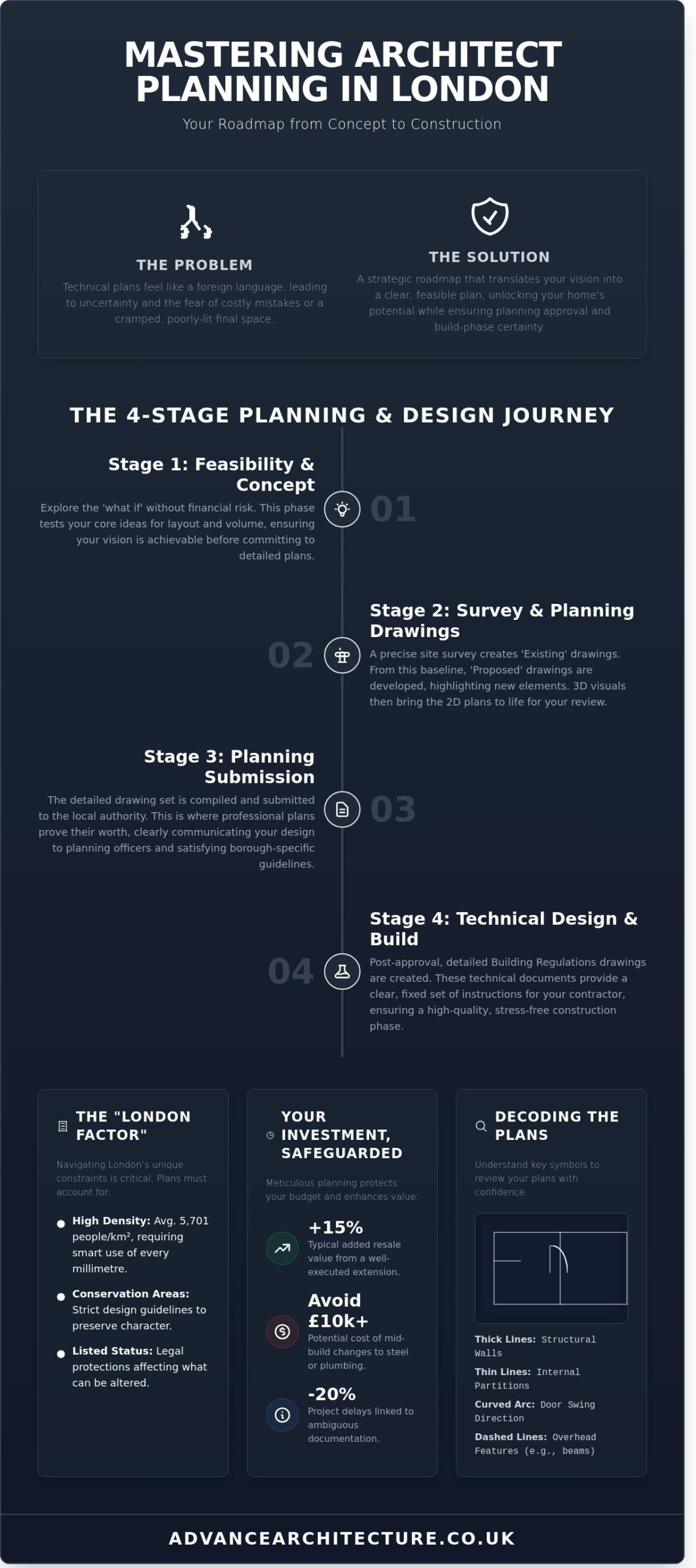
Architect planning represents far more than a collection of aesthetic sketches; it’s the strategic roadmap that dictates every phase of your project. In a city where the average population density reaches 5,701 people per square kilometre according to 2021 ONS data, every millimetre of your London home must perform a specific function. Professional plans are vital because they translate your lifestyle needs into a language that builders, structural engineers, and local authorities understand. This process ensures that your vision aligns with the physical and legal constraints of your specific plot.
A comprehensive Architectural drawing serves as the primary communication tool between your creative desires and the site’s inherent limitations. While you might envision a glass-wrapped rear extension, a planning officer assesses that vision against the National Planning Policy Framework and specific borough conservation guidelines. Detailed architect planning ensures your design isn’t just beautiful but also feasible, preventing the heartbreak of a refused application or a “Grampian condition” that halts your progress. We focus on bridging the gap between what’s inspired and what’s permissible.
Clarity on paper directly correlates to peace of mind on-site. Industry data suggests that 20% of project delays stem from ambiguous documentation or conflicting instructions. By resolving technical intersections and material specifications before the first brick is laid, you drastically reduce the ‘stress-factor’ for everyone involved. You’ll find that a well-coordinated set of plans allows your contractor to provide an accurate fixed-price quote, eliminating the guesswork that often leads to friction during the build phase.
Plans as a Tool for Unlocking Property Potential
London’s Victorian and Edwardian terraces present unique challenges that require bespoke solutions. We identify hidden opportunities for light and volume that often escape the untrained eye, such as repurposing a side return or introducing a double-height void to create a sense of grandeur. Architect planning is the bridge between aspirational design and technical reality. We move beyond generic templates because a ‘one size fits all’ approach fails in a city where no two floorplates are identical.
The Financial Value of Meticulous Planning
Meticulous planning acts as a financial safeguard for your capital. Mid-build changes can inflate costs by over £10,000 if structural steel orders need revising or plumbing runs require relocation. High-quality drawings also bolster your property’s eventual resale value, with well-executed extensions often adding 15% to a home’s market price. Architect planning fees represent a wise investment in project security, ensuring your budget remains controlled and your contractor remains accountable to a fixed set of instructions.
Decoding the Set: From Feasibility Sketches to Detailed Planning Drawings
A successful renovation doesn’t begin with a finished design; it starts with a rigorous site survey. This process captures every millimetre of your current property, creating the ‘Existing’ drawings that form the baseline for all future work. Effective architect planning relies on this precision to ensure that new extensions or loft conversions align perfectly with the original structure. You’ll likely see a transition from these monochrome existing plans to ‘Proposed’ drawings, where new walls are often highlighted in colour or hatch patterns to distinguish them from the old. While these documents follow Basic Blueprint Reading Principles, they serve as a bespoke roadmap for your specific lifestyle goals. 3D visualisations then bridge the gap, turning 2D lines into immersive spaces you can virtually walk through before a single brick is laid.
The Feasibility Stage: Testing Your Ideas
The feasibility stage is your opportunity to explore the ‘what if’ without financial risk. A sketch at this level communicates the core layout and volume, allowing you to see how a 3-metre rear extension might impact your garden. For North London terrace owners, this stage is vital for maximising narrow 5.5-metre footprints. We look for structural red flags like chimney breasts that restrict flow or damp patterns that suggest deeper issues. By evaluating three distinct layout options, you can identify which configuration offers the best return on investment before moving to technical drafting. If you’re ready to explore these possibilities, you can book a design consultation to see how your space could evolve.
The Planning Application Set: What the Council Sees
Once the design is refined, we compile the Planning Application Set. This technical package is the culmination of careful architect planning, ensuring every detail meets local authority standards. The set includes floor plans, elevations, sections, and a site location plan, usually at a 1:1250 scale. The Council uses these to assess the visual impact on the streetscape and neighbouring sunlight. In London boroughs like Barnet, adherence to the 2016 Residential Design Guidance is mandatory; specific rules regarding ‘overlooking’ and ‘overbearing’ impact must be addressed. A Design and Access Statement often accompanies these drawings, providing a written justification for the design choices. This document explains how the project respects local Hertfordshire heritage or urban North London density, ensuring the planning officer has every reason to grant approval.
- Floor Plans: A bird’s-eye view showing room dimensions and door swings.
- Elevations: External views showing the materials and height of the building.
- Sections: A vertical ‘slice’ through the building to show internal heights and floor levels.
- Site Plan: Shows the property boundary and its relationship to neighbouring buildings.
The transition from a rough sketch to a council-ready document is a journey of refinement. By the time your plans reach the planning department, they represent a balance of your personal vision and the practical realities of UK building legislation. This structured approach ensures that when you finally receive your decision notice, the project is ready to move from paper to the construction site with total confidence.
Navigating London’s Planning Constraints: How Site-Specific Factors Shape Your Plans
Understanding your architectural drawings requires an appreciation of the invisible boundaries that define London’s property landscape. Many homeowners assume that because a neighbour at number 24 secured a six-metre rear extension in 2018, their own application at number 26 will be a formality. This is rarely the case. Local planning policies evolve rapidly; for instance, the 2021 London Plan introduced stricter requirements regarding urban greening and carbon reductions that didn’t exist five years ago. Effective architect planning involves more than just drawing walls. It requires a strategic analysis of your specific plot’s constraints to ensure your vision remains viable.
Dense urban environments like Camden or Islington present unique challenges regarding “Right to Light” and privacy. Planning officers frequently apply the 45-degree rule, a mathematical assessment used to determine if a new extension will significantly block daylight to a neighbour’s window. If your plans show a proposed wall intersecting this 45-degree line in plan or elevation view, your architect must provide a bespoke solution to mitigate the impact. This might include a “set-back” upper floor or a pitched roof design that preserves the neighbour’s amenity while still unlocking the potential of your square footage.
- The 45-Degree Rule: A technical test to prevent overshadowing of neighbouring habitable rooms.
- Privacy Buffers: Requirements for obscured glazing or high-level windows when overlooking occurs within 21 metres.
- Article 4 Directions: Specific local restrictions that can remove your right to make even minor changes without full permission.
Conservation Areas and Heritage Assets
North London is home to over 600 conservation areas where “standard” designs are rarely accepted. When working with Listed Buildings, your plans must move beyond basic layouts to include 1:20 or even 1:5 scale technical details of joinery, masonry, and glazing bars. We focus on a sensitive architectural approach that respects historic fabric while integrating contemporary lifestyle needs. Success in these areas depends on demonstrating that your architect planning strategy enhances, rather than detracts from, the character of the streetscape. A bespoke glass link between a Victorian villa and a modern extension is a common way we bridge the gap between heritage and innovation.
Permitted Development vs. Full Planning Permission
Not every project requires a full committee review. Many residential transformations fall under Permitted Development (PD), allowing you to bypass the lengthy full planning process. However, PD rights are governed by strict volume and height constraints. For example, terraced houses are generally limited to an additional 40 cubic metres of space, while detached homes may allow up to 50 cubic metres. It’s essential to consult the UK Government’s Permitted Development Rights to understand these technical thresholds before finalizing your drawings.
Even if your project fits within these limits, we always recommend obtaining a Lawful Development Certificate (LDC). This document provides 100% legal certainty that your build is compliant, which is vital when you eventually sell the property. Our role is to ensure your plans push these boundaries safely, maximizing your home’s footprint through a meticulous, data-driven approach. This structured methodology transforms a daunting regulatory hurdle into a clear path toward your ideal living space.
A Homeowner’s Guide to Reading Architectural Plans: Symbols, Scales, and Annotations
Navigating a set of drawings shouldn’t feel like deciphering an ancient script. It’s the foundational stage of architect planning where your vision begins to take a tangible, legal form. Start by finding the North arrow, usually located in the corner of the site plan. This simple icon dictates how sunlight will interact with your living spaces at 10:00 am versus 4:00 pm, which is vital for placing breakfast nooks or evening terraces. Context is everything; seeing how your extension sits in relation to neighbouring boundaries ensures the design respects both privacy and local planning constraints.
You’ll likely encounter two primary scales: 1:100 for site overviews and 1:50 for detailed floor plans. At 1:50, every two centimetres on the page represents one metre in reality. Using a triangular scale ruler allows you to verify if that “spacious” hallway is actually wide enough for a double pram or a wheelchair, typically requiring a 1.2-metre clearance. Accuracy here prevents expensive mid-build adjustments.
Solid lines represent permanent structural elements, while dashed lines often signal features above head height, such as roof lanterns or structural beams. Hatched patterns are more than just texture; they identify specific materials. For instance, a diagonal brick hatch indicates a traditional masonry wall, whereas a honeycomb pattern might denote high-performance insulation. Recognising these ensures you’re getting the thermal efficiency you’ve paid for.
Floor plans use a universal shorthand. Windows appear as three parallel lines within a wall, while doors are shown as a straight line with an arc indicating the direction of the swing. Check these arcs carefully. A door swinging into a tight corridor can create a bottleneck that ruins the daily rhythm of a home. Elevations provide the final piece of the puzzle, offering a flat, vertical view of the exterior. This is where you’ll confirm the aesthetic impact of materials like zinc cladding or London stock brick before they’re ordered.
Mastering the Technical Annotations
These abbreviations define the vertical volume of your home. SSL (Structural Slab Level) refers to the concrete base, while FFL (Finished Floor Level) accounts for your floorboards or tiles. The gap between your FFL and the ceiling determines your “headroom.” In the UK, a 2.4-metre ceiling is the standard for a comfortable room. Sections act like a vertical slice through the house, showing how stairs connect levels. Look for thick, bold lines to identify load-bearing walls; these are the structural anchors that can’t be removed without significant steel reinforcement.
Reviewing for Lifestyle and Behaviour
Modern living requires more than just four walls; it demands a logical flow. We include furniture layouts in our architect planning phase not to dictate your decor, but to prove the space functions. If a sofa blocks a primary walkway, the room’s proportions need adjustment. With the UK averaging around 1,500 hours of sunlight annually, window placement is a science. We position glazing to capture south-facing light while avoiding the “fishbowl” effect. Finally, look for “dead zones” under stairs or in corners. These are opportunities to integrate bespoke storage, ensuring the architectural footprint works twice as hard for your family.
Turning Plans into Reality: The Value of Professional Architect Planning Fees
Securing planning permission is a monumental milestone, yet it represents only the first chapter of your property transformation. The transition from a conceptual drawing to a live construction site requires a level of precision that goes far beyond aesthetic appeal. Investing in professional architect planning fees ensures you possess a robust roadmap, transforming a visionary idea into a tangible, high-value asset. This phase is where the technical authority of an architect becomes your greatest safeguard against the unpredictability of the building trade.
Detailed technical drawings act as a legal and structural shield. They eliminate the ambiguity that “cowboy” builders often exploit to inflate costs or justify substandard work. When every socket, structural beam, and insulation layer is specified in a comprehensive 1:50 scale technical pack, the builder is held to a measurable standard of excellence. Our role as contract administrators further strengthens this protection. By conducting regular site inspections, we ensure the construction aligns perfectly with the approved designs, preventing the 15% to 20% budget overruns that frequently plague unmanaged domestic projects in London.
Advance Architecture provides a steady hand through this complex journey. Our approach is designed to be entirely stress-free, taking the burden of technical coordination off your shoulders. We manage the delicate balance between creative possibility and regulatory reality, ensuring that the “what if” of your initial design becomes the “here it is” of your completed home. By unlocking the potential of your site through meticulous planning, we provide a level of oversight that guarantees both functional elegance and long-term peace of mind.
Beyond Planning: The Building Regulations Phase
Planning drawings are designed to satisfy local council requirements regarding volume and appearance, but they don’t provide enough detail to actually start building. The Building Regulations phase is where we address the vital mechanics of your home. By 2026, the UK’s Future Homes Standard will mandate a 75% to 80% reduction in carbon emissions for new builds and major renovations. Our technical drawings already incorporate these rigorous requirements, focusing on thermal performance, fire safety, and structural integrity. We produce exhaustive documentation that ensures your project complies with the latest 2026 UK standards, protecting you from costly retrospective corrections.
Choosing Your Partner for the Journey
The path to a successful build is paved with informed decisions. We believe in total transparency, which is why Advance Architecture operates on a fixed-fee structure for our design and architect planning services. This provides you with financial certainty in an often volatile market. Our deep-rooted expertise in North London and Hertfordshire means we understand the specific nuances of local planning departments, a factor that has contributed to our high approval success rate across the home counties. We don’t just draft plans; we curate experiences that lead to a seamless home transformation. To take the first step in your project, book a free initial consultation to discuss your vision with our expert team today.
Realise Your Vision with Expert London Planning
Navigating the transition from a creative concept to a technical blueprint is a pivotal moment in your home’s evolution. By mastering the language of architectural symbols and understanding how site-specific constraints influence your site’s potential, you’re no longer just a spectator in the design process. Professional architect planning serves as the bridge between an abstract idea and a structurally sound reality, ensuring every millimetre of your space is optimised for your lifestyle. It’s about more than just drawings; it’s about securing the future of your investment.
Since 2009, Advance Architecture has provided the technical authority and visionary design needed to navigate the UK’s complex regulatory landscape. With over 15 years of London expertise, our team specialises in the distinct planning policies of North London and Hertfordshire. We’re committed to delivering bespoke, high-end solutions that turn daunting planning hurdles into seamless transformations. Our methodical approach ensures your project remains stress-free and meticulously managed from the first sketch to the final brick. We don’t just design buildings; we craft environments that reflect your unique story.
Start your London property transformation with a free consultation today. Your dream home is waiting to be realised, and we’re here to lead the way.
Frequently Asked Questions
Do I really need an architect for a small house extension in London?
While you aren’t legally required to hire an architect, 85% of successful London planning applications rely on professional drawings to navigate the city’s unique constraints. Our expertise helps in unlocking potential within tight urban plots while ensuring your design respects the local character. A professional ensures your project is both beautiful and compliant, transforming a simple room into a bespoke living space.
How much do architect planning fees typically cost in 2026?
In 2026, homeowners should budget between £3,500 and £7,500 for the initial architect planning phase of a standard residential extension. These fees generally represent 3% to 5% of your total construction budget. Investing in precise plans at this stage prevents costly revisions during the build and ensures a seamless transition from concept to reality.
What is the difference between planning drawings and building regulations drawings?
Planning drawings focus on the external appearance and how your home sits within the local environment to satisfy the 1990 Town and Country Planning Act. Building regulations drawings are far more technical, detailing the structural integrity, insulation, and fire safety required by the 2010 Building Regulations. You need both sets to ensure your project is legal, safe, and built to a high standard.
How long does it take for a London council to approve architectural plans?
Most London councils aim to issue a decision on householder applications within 8 weeks of your submission. If your property is in one of London’s 600 conservation areas, the process can often extend to 13 weeks due to additional heritage consultations. We manage this timeline meticulously to keep your project on track and reduce the stress of waiting for local authority feedback.
Can I draw my own plans for a planning application?
You can legally submit your own drawings, but 90% of self-drawn applications face significant delays or outright rejection due to technical inaccuracies. Professional architect planning ensures every elevation and floor plan meets the exact 1:50 or 1:100 scales required by the Planning Portal. Accurate plans act as a visionary blueprint, preventing the frustration of a refused application.
What happens if my planning application is refused by the council?
If the council refuses your application, you have 12 weeks to lodge an appeal with the Planning Inspectorate or submit a revised design for free within 12 months. Statistics show that 25% of householder appeals in the UK are successful when supported by professional evidence. We often use a refusal as a starting point to refine the design, ensuring the final result meets both your needs and council requirements.
Do I need an architect if I am building under Permitted Development?
You don’t strictly need an architect for Permitted Development, but obtaining a Lawful Development Certificate requires professional plans to prove you’ve stayed within the 3-metre or 6-metre limit. This certificate provides 100% legal certainty, which is vital when you eventually sell your property. Professional drawings ensure your “stress-free” extension doesn’t accidentally breach complex government guidelines.
How do architectural plans help in getting accurate quotes from builders?
Detailed architectural plans allow builders to provide fixed-price quotes rather than vague estimates, which reduces the risk of 20% budget overruns during construction. When a builder sees a comprehensive set of drawings, they can calculate exact material quantities and labour hours. This clarity creates a partnership of trust between you and your contractor, ensuring the build remains within your financial boundaries.