
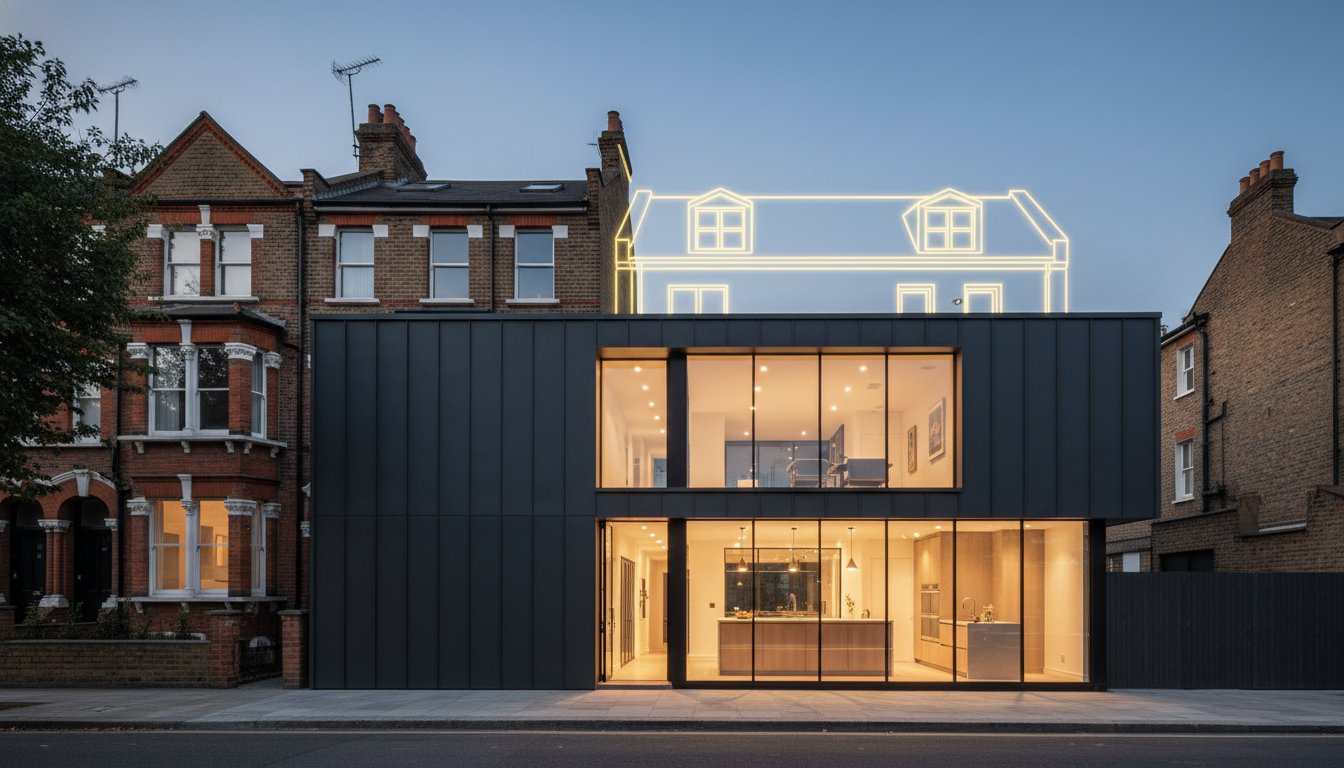
Permitted Development Side Extension: The 2026 London Homeowner’s Guide
What if you could add a bespoke kitchen diner to your London home without the four-month wait or the uncertainty of a full planning application? For many homeowners in boroughs like Barnet or Islington, the fear of a council enforcement notice often stalls the dream of more space. You likely already know that London’s dense urban landscape makes every square metre of garden precious; conflicting online advice only adds to the frustration. At Advance Architecture, we believe that expanding your footprint should be an inspiring journey, not a regulatory battle.
This guide will show you how to master the 2026 regulations for a permitted development side extension, allowing you to unlock your property’s hidden potential with absolute confidence. You’ll gain a clear understanding of the mandatory 50% width rule and discover how to verify your specific PD rights to avoid costly legal errors. By the end of this article, you will have a comprehensive roadmap for a stress-free build that transforms your living space while maintaining complete technical compliance and architectural integrity.
Key Takeaways
- Understand how to bypass the uncertainty of local council discretion by leveraging national rights for a more predictable and stress-free project timeline.
- Master the essential “half-width” and height restrictions to ensure your permitted development side extension remains legally compliant while maximising your floor plan.
- Learn why complex “wrap-around” designs often trigger full planning requirements and how to navigate the specific constraints of London’s Conservation Areas.
- Discover the impact of Article 4 Directions and how to identify if your specific borough has restricted your right to extend without formal consent.
- Uncover the value of a professional feasibility study in transforming technical regulatory hurdles into a visionary, bespoke architectural solution.
What is a Permitted Development Side Extension in London?
Unlocking the architectural potential of a London residence requires a clear understanding of the UK planning permission system. Permitted Development (PD) rights function as a national grant of planning permission, issued by the government rather than the local borough council. This framework allows you to bypass the subjective discretion of planning officers, replacing uncertainty with a set of objective, measurable rules. A permitted development side extension is often the most technical project a homeowner can undertake because it demands absolute precision regarding site boundaries and original building widths.
Planning authorities measure your allowance against the “original house.” This is defined as the property as it stood on 1st July 1948, or as it was first built if constructed after this date. Identifying this baseline is the first step in our bespoke design process, ensuring your vision remains within legal boundaries while maximising every square inch of available space. We focus on three core pillars for these projects:
- Technical compliance with the General Permitted Development Order.
- Structural integrity and aesthetic continuity.
- Optimisation of internal flow and natural light.
The Visionary Benefit of Bypassing Full Planning
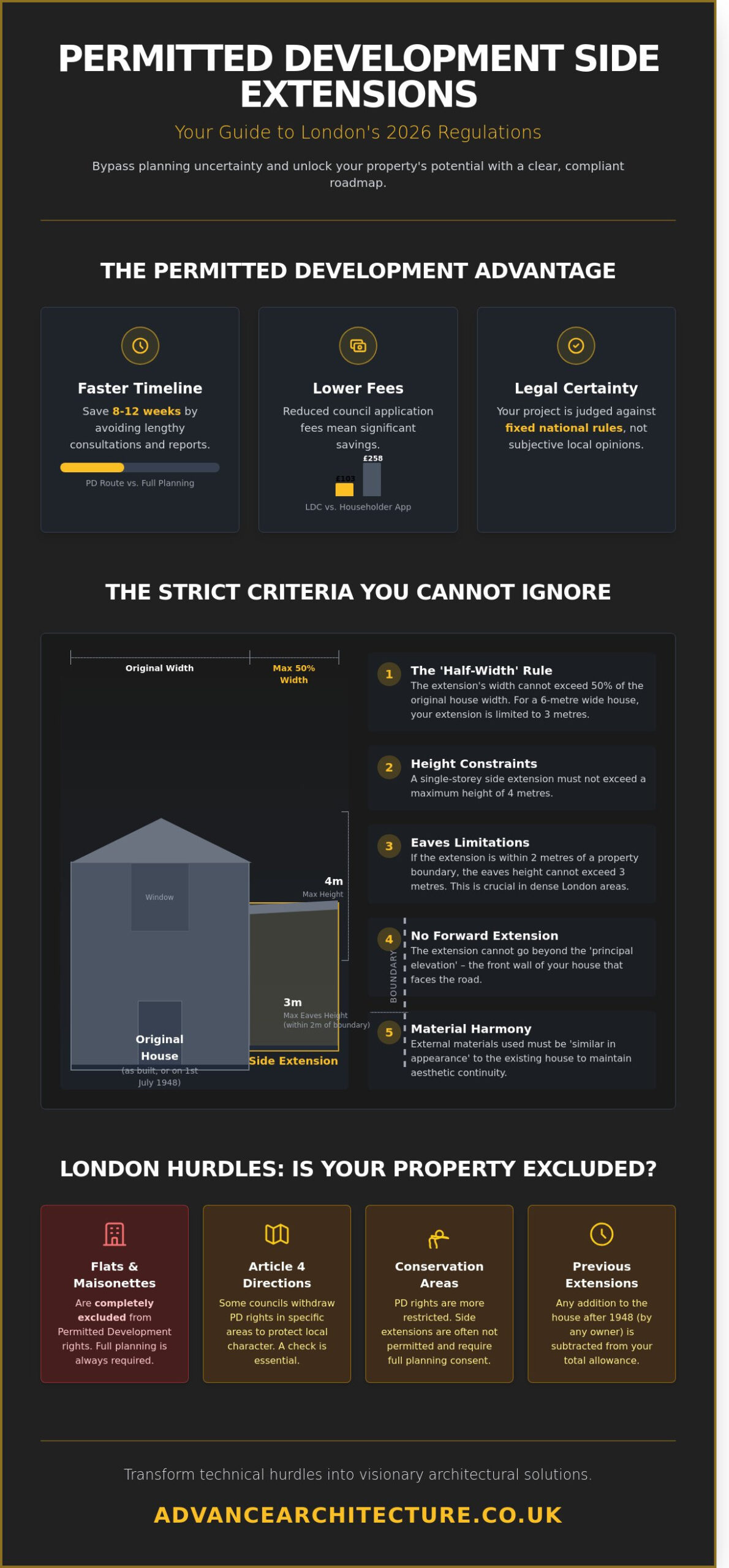
Bypassing the full planning route offers a strategic advantage for those seeking a stress-free transformation. You can expect to save between 8 and 12 weeks by avoiding the public consultation and officer report phases. This efficiency reduces council application fees, with a Lawful Development Certificate currently costing £103 compared to the £258 fee for a standard householder application. It creates a seamless transition from design to construction, allowing you to focus on the aesthetic optimisation of your new living space without the fear of a subjective refusal.
Is Your London Property Eligible for PD Rights?
Not every London property qualifies for these rights. Flats and maisonettes are entirely excluded from the PD regime, meaning 100% of these homes require full planning permission for any external change. We also monitor “Article 4 Directions” in specific North London neighbourhoods, where councils have withdrawn PD rights to protect local heritage. Your remaining allowance is also affected by history. If a previous owner added a structure after 1948, that volume is subtracted from what you can build today. We provide a steady hand through this regulatory maze, ensuring your project is built on a foundation of legal certainty.
The Strict Criteria: Rules for Side Extensions You Cannot Ignore
Navigating the legalities of a permitted development side extension requires surgical precision. The rules aren’t suggestions. They’re rigid boundaries that define the feasibility of your project. To ensure your build remains lawful, you must adhere to the official government technical guidance which sets out specific dimensional limits. These regulations protect the character of the local area while providing a framework for your home’s transformation.
- The ‘Half-Width’ Rule: Your extension’s total width cannot exceed 50% of the original house width. If your property is 6 metres wide, your extension is limited to 3 metres.
- Height Constraints: Single-storey additions are capped at a maximum height of 4 metres to avoid overbearing neighbouring properties.
- Eaves Limitations: If any part of the extension sits within 2 metres of a boundary, the eaves height must not exceed 3 metres. This is a common hurdle in dense London boroughs.
- The ‘Principal Elevation’ Trap: You cannot extend beyond the front wall of the house. Side extensions must stay behind the line of the main facade that faces the highway.
Materials and Aesthetic Harmony
Standard rules dictate that external materials must be ‘similar in appearance’ to the existing dwelling. This requirement ensures the historic character of London’s streets remains intact. We focus on matching brick bonds, mortar colours, and roof pitches to create a seamless transition. While the shell must look familiar, we can still introduce bespoke glazing or contemporary internal finishes to modernise the space. Our team creates bespoke solutions that balance these strict visual requirements with your personal design goals, ensuring the project feels both fresh and respectful.
Dimensional Precision in Dense London Boroughs
Measurements are always taken from the ‘original’ house, defined as the property’s footprint on 1 July 1948. If previous owners added structures after this date, your remaining allowance shrinks. A professional site survey is non-negotiable in narrow London side-returns. In Victorian terraces, where every 10mm counts, guessing is a risk you shouldn’t take. We use high-precision tools to map every boundary. This level of detail ensures your permitted development side extension is designed with millimetre accuracy to avoid the stress of future legal disputes or enforcement notices. Unlocking potential in tight spaces is a technical challenge that demands a steady, expert hand.
Side vs. Rear Extensions: Navigating the PD Differences
Choosing between a rear or side extension depends on your specific London plot and your lifestyle goals. While rear extensions typically allow for a 3-metre depth on terraced properties or 4 metres on detached ones, a permitted development side extension operates under a different set of constraints. The most critical rule is the width restriction: the extension cannot exceed 50% of the width of the original dwelling. This ensures the new structure remains subordinate to the primary house, maintaining the architectural balance of the street.
Strategic placement is vital for garden preservation. In boroughs like Richmond or Wandsworth, where outdoor space is a premium asset, a side extension utilises the often-underused “side-return” alley. This approach unlocks the potential of a traditional L-shaped floorplan without encroaching on the lawn. It transforms a cramped, galley-style kitchen into a wide, social hub, effectively removing the structural bottlenecks common in Victorian architecture. It’s a bespoke way to improve the flow of your home while keeping the garden footprint intact.
The Wrap-around Complexity
Many homeowners envision a “wrap-around” project that joins a side and rear extension into one continuous space. While this creates a stunning internal volume, it’s a complex area for planning. Local councils view the combined footprint as a single, larger mass. According to the Permitted development rights for householders: technical guidance, these projects almost always require full planning permission rather than falling under PD. To navigate this, we often design solutions that maintain a technical “step” or distinction between the two elements. This careful planning ensures the project remains a compliant permitted development side extension while still achieving a seamless interior feel.
Optimising Natural Light and Side Access
Side extensions must respect the privacy and “Right to Light” of your neighbours. We strictly follow the 45-degree rule to ensure adjacent windows aren’t overshadowed. Any side-facing windows must be obscure-glazed and non-opening, unless the opening parts are at least 1.7 metres above the floor. To brighten these traditionally dark areas, we use high-end glazing solutions:
- Structural glass ribbons: These run along the boundary to pull light deep into the floorplan.
- Roof lanterns: A 15-degree pitch lantern can transform a flat roof into a source of constant daylight.
- Internal courtyards: Small, glazed cut-outs that bring greenery and air into the heart of the extension.
Maintaining a clear side access path of at least 1 metre is also a practical priority. This ensures you don’t lose the ability to move bicycles or garden equipment to the rear without passing through the main living areas. It’s about creating a home that’s as functional as it is beautiful.
London Hurdles: Article 4 Directions and Conservation Areas
London’s architectural landscape is a tapestry of history, but this heritage often restricts a permitted development side extension. While the national framework is generous, local authorities frequently exercise their power to issue Article 4 Directions. These legal instruments effectively “turn off” your standard rights, forcing a requirement for full planning permission even for modest additions. It’s a common occurrence in areas where councils aim to preserve the rhythmic character of a street or prevent over-development in high-density zones. Our expertise lies in unlocking potential within these constraints, delivering bespoke solutions that honour the past while embracing contemporary living.
Identifying Local Planning Restrictions
Success starts with a deep dive into your borough’s planning portal. In North London, the approach varies significantly between neighbours, and a design that works in one street might be prohibited in the next. Consider these local variations:
- Barnet: Manages 28 distinct Conservation Areas where Article 4 is frequently applied to protect Victorian and Edwardian facades.
- Enfield: Oversees 22 protected zones with specific aesthetic requirements regarding materials and roof pitches.
- Haringey: Maintains 28 areas where side additions are heavily scrutinised to maintain the gap between semi-detached properties.
We’ve seen cases where side extensions were approved in one Enfield ward but faced strict resistance just two streets away due to localised density rules updated as recently as October 2023. Working with architects who understand this granular heritage context is vital to avoid costly delays.
The Essential Certificate of Lawfulness
Building your extension is only half the battle; proving it’s legal is the other. A Lawful Development Certificate (LDC) is the only document that provides absolute certainty your project meets all criteria for a permitted development side extension. It isn’t a legal requirement to build, but it’s an essential safeguard for your investment.
Without an LDC, you risk significant complications when selling your property. Data from the 2022 UK property market suggests that up to 15% of London sales face delays or price renegotiations due to missing planning paperwork. We handle the entire LDC application process, transforming a complex bureaucratic exercise into a stress-free milestone. This proactive step ensures your visionary home remains a liquid asset and provides total peace of mind for the future.
Unsure if your property is affected by local restrictions? Consult our North London planning experts for a bespoke assessment of your site’s potential.
Unlocking Potential: How Advance Architecture Realises Your Vision
A permitted development side extension isn’t just a box attached to your home; it’s a strategic enhancement of your daily lifestyle. At Advance Architecture, we adopt a “Visionary Expert” approach to ensure every millimetre of your property works harder for you. We don’t just follow the rules. We use them as a framework for innovation. Before a single brick is laid, we conduct a comprehensive feasibility study. This crucial step identifies constraints early on, preventing the 15% budget overruns often seen in poorly planned London projects. We bridge the gap between a functional addition and a bespoke architectural statement that adds genuine market value.
Our Bespoke Design and Planning Process
Our methodology is structured to provide clarity and confidence at every stage of the journey. We move methodically from the abstract spark of an idea to the concrete reality of a finished build.
- Step 1: The Free Initial Consultation. We assess your home’s PD potential at no cost, identifying immediate opportunities for growth and spatial optimization.
- Step 2: High-End 3D Visualisations. You won’t have to guess how the light hits your new kitchen. Our renders provide a precise representation of the finished space, allowing for adjustments before construction begins.
- Step 3: Rigorous Technical Documentation. We produce detailed drawings that ensure 100% compliance with Building Regulations, protecting your investment and ensuring structural integrity.
Your Partner in Stress-Free Home Transformation
London’s architectural landscape is a delicate balance of Victorian heritage and bold, contemporary needs. We act as your steady hand, managing the intricate details so you don’t have to worry about the red tape. Our designs respect the local context while introducing modern energy efficiency and functional elegance. Whether it’s a sleek glass-roofed side return or a traditional brick-matched permitted development side extension, our commitment to quality remains absolute.
We’ve helped hundreds of London homeowners navigate these complexities, turning daunting builds into seamless successes. We believe that your home should be as unique as your signature. By blending technical authority with aspirational design, we unlock the hidden potential in every terrace, semi-detached, or detached property we touch. Your dream home is already there; it’s just waiting for the right experts to reveal it.
Book your free London consultation today and start your journey toward a more spacious, beautiful home.
Realise Your Vision: Unlocking Your London Home’s Potential
Navigating the technicalities of a permitted development side extension requires a precise blend of architectural vision and regulatory expertise. Since our founding in 2009, Advance Architecture has specialised in North London property transformations; we ensure every project respects the strict PD criteria while pushing the boundaries of contemporary design. You’ve seen that success hinges on understanding local constraints like Article 4 directions and the specific requirements for listed building consent. We handle the entire process from the first bespoke sketch to final construction management so you don’t have to navigate the planning portal alone. Our team’s deep knowledge of the 2026 London housing market ensures your project adds genuine value and functional elegance to your daily life. It’s about more than just adding square footage; it’s about creating a seamless flow that works for your family. We’ve spent over 15 years turning complex planning hurdles into stunning residential realities. Your dream home is waiting to be built.
Start your stress-free home transformation with Advance Architecture
Frequently Asked Questions
Can I build a two-storey side extension under Permitted Development in London?
No, you cannot build a two-storey side extension under Permitted Development rules as these rights only apply to single-storey structures. To achieve a multi-level addition, you’ll need to secure full planning permission from your local London council. This process allows for a bespoke architectural design that respects your street’s character while unlocking the potential for new bedrooms or study spaces. Our team manages the entire submission to ensure a seamless transition from visionary concept to site approval.
What is the maximum width allowed for a side extension under PD rules?
The maximum width for a permitted development side extension is exactly 50% of the width of the original dwelling house. If your existing property measures 8 metres across, your extension cannot exceed 4 metres in width. This regulation ensures the transformation remains proportionate to the original plot. Adhering to this specific percentage is vital for maintaining the structural harmony of your home and ensuring your project remains within lawful parameters without a full planning application.
Do I need a Party Wall Agreement for a side extension on the boundary?
You’ll likely need a Party Wall Agreement if your side extension sits on the boundary or involves excavating within 3 or 6 metres of a neighbouring structure. Under the Party Wall etc. Act 1996, you must serve notice to your neighbours at least 60 days before construction begins. This legal framework protects both parties, providing a clear, professional path to resolve disputes. We coordinate this process to keep your project stress-free, ensuring every technical detail is documented and agreed upon.
Does a side extension affect my future rights to build a loft conversion?
A side extension can impact your future loft conversion rights because Permitted Development volume allowances are often cumulative. For terraced houses, the limit is 40 cubic metres, while semi-detached and detached homes have a 50 cubic metre threshold. If your side extension uses a portion of this allowance, you might have less space for a visionary loft transformation later. We calculate these precise volumes during the design phase to ensure you maximise your property’s total footprint effectively.
How much does a Certificate of Lawfulness cost in London for 2026?
A Lawful Development Certificate for a residential side extension is projected to cost approximately £150 in London by 2026, following standard inflationary adjustments to local authority fees. This fee is typically 50% of the cost of a full planning application, which currently sits at £258. Investing in this certificate provides the legal certainty you need when selling your property. It proves your permitted development side extension was built legally, protecting your investment and ensuring a smooth, hassle-free future sale.
Can I use different coloured bricks for my side extension under PD?
You can’t use different coloured bricks because PD rules require materials to be of a similar appearance to the existing house. This condition ensures that any new addition feels like a seamless extension of the original architecture rather than a disjointed attachment. To maintain the aesthetic integrity of your London home, we source high-quality materials that match the texture, tone, and bond of your current masonry. This meticulous approach creates a refined, high-end finish that adds genuine value.
What happens if I build a side extension without checking Article 4 directions?
Building a side extension in an area covered by an Article 4 direction without planning permission results in a planning breach and potential enforcement action. Local authorities in boroughs like Camden or Islington use these directions to withdraw Permitted Development rights to protect local heritage. If you bypass these rules, you may be forced to demolish the structure at your own expense. We always conduct a thorough site appraisal to identify these restrictions early, ensuring a secure and compliant build.
How long does it take to get a Lawful Development Certificate in North London?
Obtaining a Lawful Development Certificate in North London boroughs like Barnet or Enfield typically takes 8 weeks from the date your application is validated. While the statutory period is fixed, the total timeline depends on the quality of your initial architectural drawings and technical documentation. Our highly organised team ensures that every submission is comprehensive and accurate on the first attempt. This methodical approach minimises delays, allowing you to begin your home transformation with confidence and speed.