
Loft Conversion Cost in London: The Definitive 2026 Price Guide
While national averages suggest a modest investment, a London loft conversion in 2026 carries a 35% capital premium that standard online calculators often fail to mention. You likely recognize that calculating a realistic loft conversion cost is the essential first step toward unlocking your home’s hidden potential, yet the fear of hidden structural fees or complex planning hurdles often stalls the creative process. It’s frustrating to receive a generic quote only to discover that structural integrity requirements or heritage constraints in boroughs like Kensington or Camden can add £15,000 to your initial estimate.
We understand that a successful project requires a sophisticated blend of technical precision and financial clarity. This definitive guide provides a transparent budget framework that covers architectural design, structural engineering, and construction management. You’ll discover how a bespoke mansard or dormer transformation can yield a 22% increase in property value, far outweighing the initial capital outlay. We’ll provide a seamless roadmap from your first visionary sketch to the final building regulations sign-off, ensuring your journey is as stress-free as it is rewarding.
Key Takeaways
- Gain a clear understanding of why the unique London market and 2026 inflation trends drive the average loft conversion cost 25% higher than the national average.
- Compare the functional benefits of entry-level Velux options against expansive Dormer conversions to select the bespoke configuration that best suits your family’s lifestyle.
- Navigate the essential regulatory landscape, including planning permissions and structural engineering, to ensure a seamless and compliant transformation of your home.
- Identify potential technical hurdles like structural reinforcements and service relocations to proactively manage your budget and avoid unexpected expenses.
- Discover how a visionary architectural approach can maximize every millimetre of space, unlocking significant property value through the strategic addition of a new bedroom.
Understanding the London Premium: Loft Conversion Cost in 2026
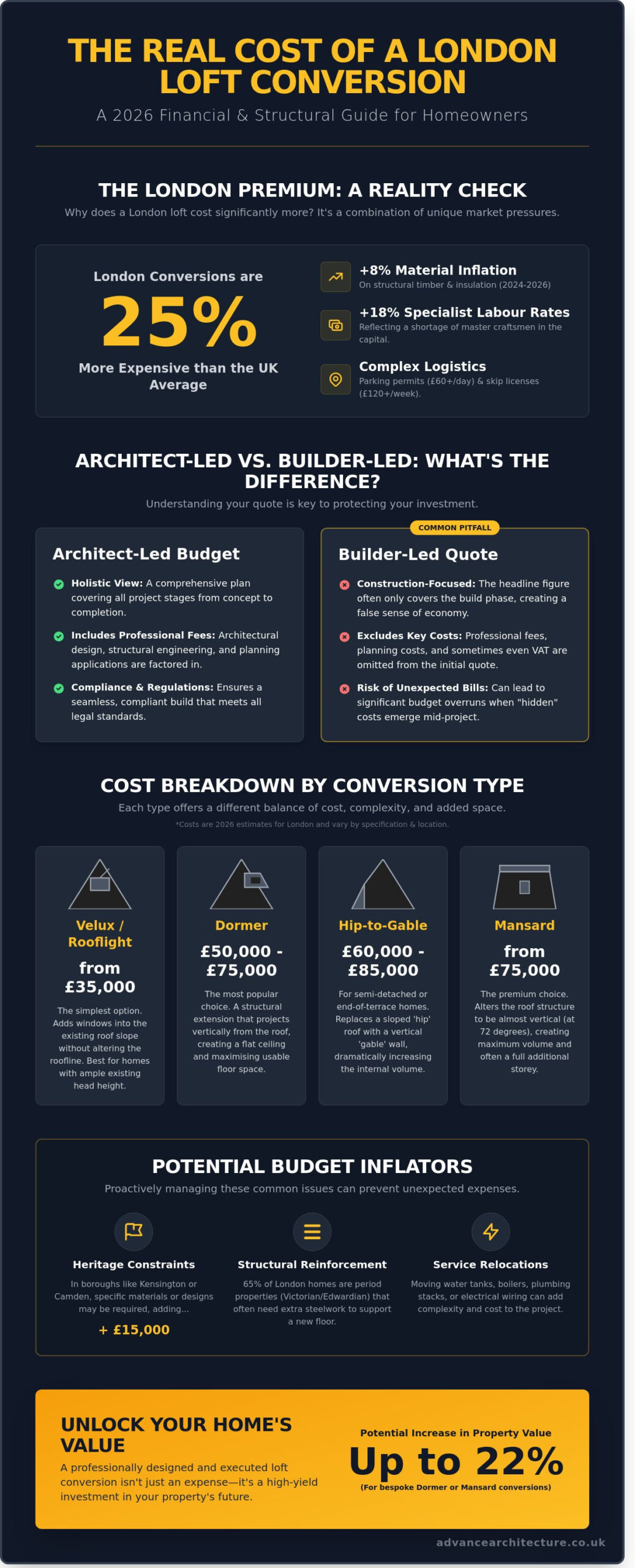
Unlocking the hidden potential of a London rooftop requires more than just a creative vision; it demands a clear-eyed understanding of the current financial landscape. By 2026, the baseline loft conversion cost in the capital has solidified at a starting point of £55,000 for a basic internal shell. This figure represents a 25% premium over the UK national average, a gap driven by the unique pressures of the London market. While a builder-led quote might tempt you with a lower headline figure, these often overlook the comprehensive design, planning, and structural oversight provided by an architect-led budget. Choosing a professional partnership ensures your investment is protected through every stage of the transformation.
The 2026 economic environment has introduced new variables for homeowners. Material inflation, particularly for high-grade structural timber and insulation, rose by 8% between 2024 and 2026. Simultaneously, a persistent shortage of master craftsmen in the capital has pushed specialist labour rates to new heights. You aren’t just paying for materials; you’re securing the expertise required to navigate the intricate building regulations and structural demands of London’s unique property stock.
- Builder-led quotes: Often focus on the construction phase only, excluding professional fees and VAT.
- Architect-led budgets: Provide a holistic view including design, structural engineering, and planning compliance.
- 2026 Minimums: Expect a £55,000 entry point for a simple Velux conversion in most London boroughs.
London vs. The Rest of the UK: The Reality Check
Operating in the capital introduces logistical hurdles that don’t exist in more rural areas. Parking permits for trade vehicles can cost upwards of £60 per day in boroughs like Islington or Camden; skip licences often exceed £120 per week in 2026. Structural complexity also plays a major role. Victorian and Edwardian terraces, which dominate 65% of the London residential landscape, require intricate steelwork to support modern living standards. Labour rates for specialist trades in North London and Hertfordshire now sit 18% higher than the 2024 baseline, reflecting the scarcity of qualified site managers and structural experts.
The 2026 Economic Outlook for Homeowners
Homeowners are increasingly choosing to “improve rather than move” as 2026 interest rates remain steady around 4.25%, making the cost of relocation less attractive than capital investment. For a high-end residential development in London, expect a loft conversion cost per square metre to range between £2,900 and £3,600. The London Premium is the aggregate of logistics, labour, and regulatory complexity. This strategic investment doesn’t just create a bespoke living space; it secures long-term equity in a city where square footage is the ultimate currency. By focusing on visionary design and seamless execution, you can transform a dusty attic into a sophisticated sanctuary that adds significant value to your home.
Cost Breakdown by Conversion Type: From Velux to Mansard
Every Victorian terrace or 1930s semi-detached home holds untapped potential. Unlocking this space requires a strategic choice between four main conversion types, each influencing the final loft conversion cost based on structural complexity and 2026 market rates for materials. Your choice dictates not just the budget, but the ultimate volume and lifestyle quality of the new floor.
- Velux (Roof Light) Conversions: This is the entry-level option for London terraces with ample existing head height. It involves installing high-performance windows into the original roof slope without altering the roofline. Prices typically start at £35,000.
- Dormer Loft Conversions: This remains the most popular choice for North London family homes. By extending vertically from the slope of the roof, it creates a flat ceiling and maximizes usable floor area. A standard rear dormer provides a seamless transition from the original house.
- Hip-to-Gable: This is a transformative solution for end-of-terrace and semi-detached properties. It replaces a sloping “hip” roof with a vertical “gable” wall, significantly increasing the internal footprint to accommodate a spacious double bedroom.
- Mansard Conversions: The premium choice for maximum volume. Often required in sensitive heritage locations, the Mansard involves a 72-degree slope that blends into the existing architecture while creating a space that feels like a full additional storey.
Standard vs. Bespoke: Where the Money Goes
A basic dormer in 2026 typically ranges between £55,000 and £75,000 for a shell and core finish. If you envision a visionary master suite with a high-spec ensuite and bespoke floor-to-ceiling glazing, the investment often exceeds £80,000. The price of light is a major variable; standard roof lights are cost-effective, but custom structural glass units can add £10,000 to the budget. Your staircase design also plays a critical role. A basic timber flight is functional, but a bespoke, architectural staircase optimizes the flow of the lower floors and acts as a central design feature. You can consult our design experts to explore how these bespoke elements impact your specific layout.
Property Type Variables
Terraced houses in London present specific logistical constraints. You’ll likely need to navigate two party wall agreements, which can add £2,500 to £5,000 to the total project. Detached and semi-detached homes offer more freedom for larger footprints, but they also require more extensive structural steelwork. In conservation areas like Barnet or Islington, planning officers frequently mandate Mansard profiles and traditional materials like slate or lead. These regulatory requirements and heritage considerations often increase construction costs by 18% compared to projects under standard permitted development. Professional management ensures these complexities don’t derail your vision or your budget.
The “Hidden” Professional Fees and Regulatory Costs
Budgeting for a project requires looking beyond the price of timber and steel. Professional fees typically represent 10% to 15% of your total loft conversion cost. These aren’t mere administrative burdens; they are the strategic investments that ensure your project is legal, safe, and value-optimised. Architectural design fees for a bespoke London loft generally range from £2,500 to £5,000. This expertise is what transforms a cramped attic into a light-filled sanctuary, often adding 20% more to your property value than a standard “off-the-shelf” build.
Structural engineering is equally vital for London’s ageing housing stock. A specialist engineer will charge between £1,200 and £2,000 to provide the calculations required for 19th-century brickwork to support modern living loads. Without these precise figures, you risk structural movement or even total project failure. Additionally, the Party Wall Act 1996 necessitates formal agreements if you share walls with neighbours. You should budget approximately £1,000 per neighbour if they appoint their own surveyor. It’s a necessary step to protect your liability and maintain local harmony.
- Architectural Design: Creative layouts that maximise head height and natural light.
- Structural Engineering: Essential calculations for steel beam placement and floor strengthening.
- Party Wall Surveyors: Legal protection and neighbourly dispute resolution.
- Building Control: Mandatory site inspections to certify fire safety and thermal efficiency.
Navigating the London Planning Maze
Choosing between Permitted Development (PD) and Full Planning Permission significantly impacts your timeline. PD is often faster, requiring a Lawful Development Certificate which costs approximately £129 in local authorities like Barnet, Enfield, and Haringey. If your home is a flat or located in a Conservation Area, such as Muswell Hill, you’ll need Full Planning Permission at a cost of £258. Obtaining these certificates is crucial for unlocking potential during future resales; 94% of buyers’ solicitors now demand this documentation before completing a purchase.
Technical Documentation Costs
The transition from a visionary concept to a physical build requires meticulous Building Regulations drawings. These technical blueprints cost between £1,500 and £3,000 and prevent expensive errors during the construction phase. Before work begins, a comprehensive site survey costing £500 to £900 identifies structural hurdles like hidden chimney breasts or plumbing redirects. Investing in these details early ensures a stress-free transformation and keeps your loft conversion cost from spiralling due to unforeseen site conditions.
Factors That Can Inflate Your Loft Conversion Budget
While baseline estimates offer a useful starting point, the reality of a London project involves navigating specific technical hurdles that dictate the final loft conversion cost. Most period properties require significant structural reinforcement because original 100mm ceiling joists cannot support the weight of a new living space. We typically specify 200mm floor joists and strategically placed steel beams to ensure long term structural integrity and safety.
Relocating services is another frequent budget driver. Moving a traditional water tank or a legacy boiler system often adds £2,500 to £4,500 to the plumbing bill. To future-proof your home for 2026 energy standards, we recommend investing in high-performance PIR insulation. This goes beyond the minimum Building Regulations, potentially reducing heat loss through the roof by 42% compared to basic mineral wool. It’s a strategic investment that pays dividends in comfort and reduced utility bills.
Optimizing a small footprint requires bespoke joinery. Integrated wardrobes and eaves storage aren’t just luxuries; they’re essential tools for unlocking potential in tight spaces. Custom cabinetry typically accounts for 5% to 8% of a premium budget but adds significant functional value by utilizing every square centimeter of the new room.
The Impact of Interior Specification
Bathrooms and ensuites introduce plumbing complexity, especially in high-rise London lofts where soil pipe routing requires surgical precision. Choosing high-end finishes like natural stone or designer brassware can increase the final project bill by 18%. Additionally, modern homeowners are increasingly budgeting for smart home integration. Installing Cat6 cabling and automated lighting scenes provides the seamless connectivity required for contemporary living and remote work.
Unforeseen Site Conditions
Older London terraces often conceal historical structural movement, damp, or dry rot that only becomes visible once the roof is opened. We advise clients to maintain a 12% contingency fund to handle these discoveries without stress. A contingency fund is a non-negotiable part of a professional London budget because it protects your investment from the inevitable surprises found within century-old masonry.
Unlocking Value: The ROI of a Professional Loft Conversion
Investing in your home requires a clear understanding of the financial return. In London’s 2026 property market, a well-executed loft conversion typically adds between 20% and 25% to a property’s total valuation. For a mid-terrace home in a desirable postcode, this often translates to a capital gain exceeding £160,000. While the initial loft conversion cost represents a significant commitment, the equity gain frequently outweighs the expenditure by a ratio of 2:1. It’s a strategic move that secures your financial future while solving immediate space constraints.
Advance Architecture adopts a design-led approach that focuses on millimetre-perfect optimization. We don’t just add a room; we curate an environment. Our team utilizes fixed-fee architectural services rather than percentage-based models. This provides you with absolute budget certainty. Percentage-based fees often fluctuate if construction costs rise, but our fixed structure ensures your financial planning remains robust from the initial concept to the final building regulations sign-off. We prioritize structural integrity and aesthetic elegance to ensure every pound spent translates into tangible market value.
The benefits extend beyond the balance sheet. A bespoke loft conversion transforms your daily lifestyle by providing a sanctuary away from the bustle of the lower floors. Whether it’s a sun-drenched master suite or a sophisticated home office, the intangible value of light, air, and privacy is profound. We focus on “unlocking potential” in spaces others might overlook, ensuring your loft conversion cost yields a home that feels both expansive and intimately tailored to your needs.
For many homeowners, creating a dedicated home office is a key driver for such a project, often signaling a growing business. As a business expands, so do its responsibilities as an employer. UK-based consultancies like Pioneer HR provide the strategic support needed to manage this growth effectively.
Maximising Your Investment
Quality is the primary driver of resale value. In early 2025, a North London project we designed added £155,000 in equity to a Victorian property by incorporating a seamless dormer and high-spec ensuite. “Cheap” builds often fail to meet modern thermal standards or feature awkward head height, leading to disappointing valuations during resale. You can explore our approach to North London extensions and conversions to see how we maintain these high standards.
Next Steps for Your Project
Your transformation begins with a structured project roadmap. We guide you through conceptual design, planning applications, and detailed technical drawings with a focus on a stress-free experience. Our visionary experts are ready to help you navigate the complexities of London’s planning landscape. Realise your vision with a bespoke loft conversion consultation and take the first step toward a home that truly reflects your aspirations. We’ll ensure your project is as sturdy and well-planned as the designs we produce.
Transform Your London Home and Maximise Your Investment
Navigating the 2026 property market requires a strategic approach to home improvement. Understanding your loft conversion cost is the first step toward a successful transformation that can increase your home’s market value by up to 20% according to Nationwide Building Society data. Whether you’re opting for a streamlined Velux installation starting at £45,000 or a bespoke Mansard design, the key to success lies in meticulous planning and expert oversight. Since 2009, Advance Architecture has provided over 15 years of London architectural expertise to help homeowners navigate complex planning applications and building regulations with ease. We believe in total transparency; our fixed-fee structures ensure your project stays on budget from the initial sketch to the final inspection. Our comprehensive approach covers Design, Planning, and Management, removing the traditional stresses of construction. You don’t have to face the complexities of the London planning system alone. We’re ready to help you unlock the hidden potential within your rafters and create a space that truly reflects your lifestyle. Book your free loft conversion consultation with Advance Architecture today and take the first step toward your visionary home transformation.
Frequently Asked Questions
How much does a simple loft conversion cost in London in 2026?
A simple Velux loft conversion cost in London for 2026 typically ranges from £55,000 to £70,000. This entry-level price point covers the structural reinforcement, floor installation, and basic internal finishes for a standard mid-terrace property. You’ll find that bespoke staircase integration and high-quality insulation ensure your new master suite feels like a seamless extension of your home rather than an afterthought.
Do I need planning permission for a loft conversion in London?
You won’t need full planning permission if your project falls under Permitted Development rights, which apply to approximately 75% of London loft projects. These rights allow for additions up to 40 cubic meters in terraced houses or 50 cubic meters in semi-detached homes. However, if you live in one of London’s 27 conservation areas or a listed building, you’ll definitely require a formal application to the local council.
How much value does a loft conversion add to a house in North London?
A professionally executed loft conversion adds between 20% and 25% to the total market value of a North London property. For a typical £800,000 home in Islington or Muswell Hill, this equates to a value uplift of £160,000 to £200,000. By unlocking potential in your roof space, you’re creating a high-yield asset that significantly outperforms standard savings accounts or traditional investments.
What are the typical architect fees for a loft conversion?
Architect fees usually represent a percentage of the total loft conversion cost, typically ranging from 7% to 15% of the construction budget. For a standard project, this usually translates to a fixed fee between £3,500 and £7,500 for the full design, planning, and building regulations package. Investing in expert architectural guidance ensures your vision is technically sound and maximizes every square inch of available floor area.
How long does a loft conversion take to complete in London?
The physical construction of a loft conversion takes between 8 and 12 weeks to reach completion. You can expect the initial structural phase, including steel beam installation and roof alterations, to occupy the first 4 weeks of the schedule. The remaining 6 to 8 weeks are dedicated to internal fit-outs, electrical plumbing, and the final bespoke finishes that define your new living space.
Is my loft suitable for a conversion, and what is the minimum head height?
Your loft is suitable for conversion if it maintains a minimum head height of 2.2 meters from the top of the existing ceiling joists to the underside of the ridge timber. This height is essential to accommodate the new structural floor and fire-rated ceiling while still meeting the 2.0-meter clearance required by UK Building Regulations. We’ve successfully transformed spaces with lower heights by lowering the ceilings on the floor below.
What is the Party Wall Act, and how much will it cost me?
The Party Wall Act 1996 is a legal framework designed to prevent disputes by requiring you to notify neighbors about shared structural work. You should budget between £1,200 and £2,800 for each neighbor who requires a formal Party Wall Award. While simple written consent costs nothing, professional surveyor fees are a necessary investment to ensure the structural integrity and legal protection of both properties.
Can I stay in my house during the loft conversion construction?
You can absolutely stay in your home during construction, as 90% of our clients choose to remain in residence throughout the build. Our teams utilize external scaffolding to access the roof, which means the heavy structural work happens above your head without disturbing your daily routine. We only create the internal staircase opening in the final 10 days of the project to ensure a stress-free transformation.