
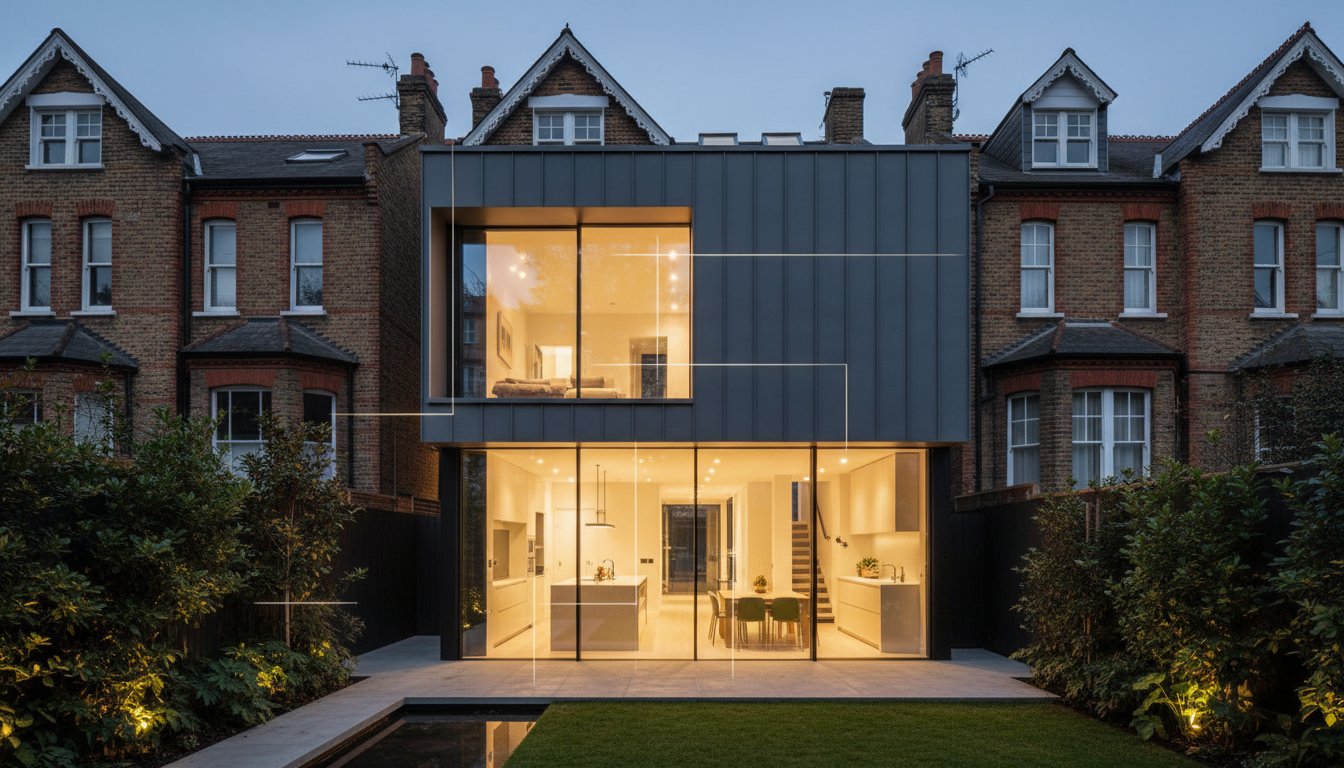
Two Storey Extension Planning Permission: The London Homeowner’s 2026 Guide
What if the only thing standing between your current home and a bespoke, high-end sanctuary isn’t your budget, but the complexity of securing two storey extension planning permission? You likely understand that adding vertical space is the most efficient way to increase your property’s value, yet the fear of a planning rejection or a dispute over overshadowing often keeps these visionary projects on hold. According to 2024 Ministry of Housing statistics, nearly 20% of residential applications in dense London boroughs face initial refusal, making the path to approval feel like a daunting bureaucratic maze.
We’re here to change that narrative. This guide provides a definitive roadmap to navigating London’s evolving planning laws in 2026, ensuring you maximize your living space while staying firmly within the latest regulatory frameworks. You’ll learn how to distinguish between Permitted Development and Full Planning, discover strategies to mitigate neighbour objections through intelligent design, and see how a partnership with an expert can make the entire transformation feel seamless and stress-free. It’s time to stop wondering “what if” and start unlocking the hidden potential within your London home.
Key Takeaways
- Master the nuances of London’s high-density landscape to ensure your double-storey transformation seamlessly integrates with your existing home and surroundings.
- Clarify the specific criteria for Permitted Development, including the 3-metre depth limit and roof pitch requirements, to streamline your two storey extension planning permission.
- Navigate complex design constraints such as the 45-degree rule and privacy regulations to protect neighbourly “Right to Light” while optimising your new living space.
- Follow a professional roadmap from feasibility study to final approval, ensuring every design detail meets the rigorous standards of London planning authorities.
- Unlock the full potential of your property with bespoke architectural solutions that turn regulatory hurdles into visionary design opportunities.
Understanding Two Storey Extension Planning Permission in London
A two-storey extension represents the ultimate architectural evolution for a London residence. It involves adding vertical and horizontal volume to your home, typically extending the rear or side across two levels to create a cohesive living environment. In a city where square footage is the ultimate currency, this transformation does more than add space. It unlocks potential, enhances lifestyle, and secures your financial future. Understanding Planning Permission is the essential first step because the capital’s unique density requires a sophisticated approach to design and regulation.
London properties face distinct challenges that suburban homes rarely encounter. High-density terraced and semi-detached streets mean that overshadowing, privacy, and the “45-degree rule” are critical factors in any two storey extension planning permission application. Local councils prioritize the protection of residential amenity. They ensure new structures don’t block essential sunlight or overlook neighboring gardens. We approach these hurdles as opportunities for innovation, using clever glazing and strategic setbacks to satisfy planners while achieving your vision.
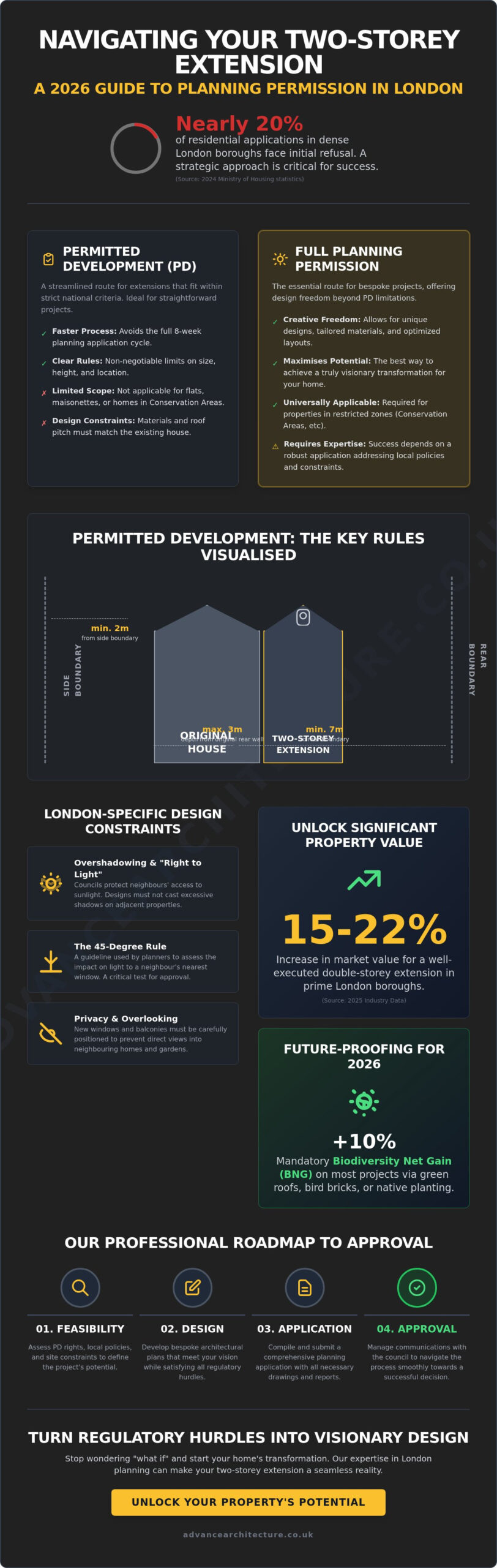
The impact on property value is substantial. Industry data from 2025 indicates that a well-executed double-storey addition in prime London boroughs can increase a property’s market value by 15% to 22%. This isn’t just about adding a bedroom; it’s about Design, Planning, and Management coming together to create a home that feels entirely new. It’s a seamless way to adapt your current house to a growing family without the stress and cost of relocating in a competitive market.
Planning Permission vs. Permitted Development (PD)
Permitted Development (PD) offers a streamlined path for some homeowners. It allows for certain two-storey rear extensions up to 3 metres in depth, provided the addition is at least 7 metres from the rear boundary. However, the London reality is often more restrictive. Most flats, maisonettes, and homes within Conservation Areas or Article 4 zones are excluded from these rights entirely. If your property falls into these categories, you’ll need Full Planning Permission. This route is actually preferable for those seeking bespoke solutions. It allows for greater creative freedom, tailored materials, and optimized layouts that PD simply can’t accommodate.
The 2026 Regulatory Landscape for London Homeowners
In 2026, the planning process is more data-driven and environmentally focused than ever. A significant shift is the mandatory requirement for Biodiversity Net Gain (BNG). Most residential applications must now demonstrate a 10% improvement in the site’s natural value through green roofs, integrated bird bricks, or native planting. Additionally, local frameworks like the Barnet Local Plan 2021-2036 or the Southwark Plan 2022 often override national guidelines. These local policies focus on “gentle density” and character preservation. Success requires a partner who understands these granular details, ensuring your project is compliant, sustainable, and visionary.
Permitted Development Rules for Double Storey Extensions
Unlocking the hidden potential of a London terrace or semi-detached home often begins with Permitted Development (PD) rights. These rights provide a streamlined pathway to expansion without the traditional two storey extension planning permission process, provided your design adheres to strict national criteria. For a double-storey addition, the most critical constraint is the 3-metre depth limit. This measurement is taken from the rear wall of the original dwelling, ensuring the new structure doesn’t overbear neighbouring properties or negatively impact local density.
Boundary restrictions are equally rigid. To maintain PD rights, any part of the extension that is more than one storey high must be at least 2 metres away from the property boundary. This gap is a non-negotiable requirement designed to prevent issues with overshadowing and privacy. Additionally, the roof pitch and eaves height of the new addition must match the existing house as closely as possible. This technical requirement ensures a seamless architectural transition rather than a disjointed bolt-on. All external materials must maintain a similar appearance to the original house, preserving the visual harmony of the streetscape.
Before committing to a build, reviewing the Official Government Guidance is a vital step in your due diligence. Our team uses these technical parameters to craft bespoke solutions that maximize space while remaining strictly within the law.
The “Original House” Constraint
The original house is defined as the footprint existing on July 1st, 1948. This date serves as the universal baseline for all London properties. If your home was built after 1948, the “original” state refers to how it was first constructed. It’s vital to investigate the property’s history because any extensions added by previous owners since 1948 will consume your current PD allowance. If a 2-metre rear extension was added in 1995, for instance, you may only have 1 metre of depth remaining under PD rights today.
When PD is Off the Table
Permitted Development is a privilege, not a right, and it can be withdrawn. In North London, heritage is a priority, meaning Conservation Areas and Listed Buildings often have these rights stripped away. Article 4 Directions are another common hurdle; these are specific local planning tools used by councils to remove PD rights on certain streets or entire neighbourhoods to protect architectural character. This is particularly prevalent in boroughs like Islington and Camden where Victorian aesthetics are protected.
Even if your project appears to fit every rule, you shouldn’t build without a Lawful Development Certificate (LDC). This document proves your two storey extension planning permission wasn’t required and that the build is legal. It’s a cornerstone of a stress-free experience, providing the necessary paperwork for future buyers or lenders. Our role is to navigate these complexities, ensuring your visionary transformation is built on a solid regulatory foundation.
Navigating London-Specific Design Constraints for Approval
Securing two storey extension planning permission in a city as dense as London requires a surgeon’s precision. Local councils prioritize the “Right to Light” through the 45-degree rule, a geometric assessment used to ensure your new structure doesn’t plunge a neighbor’s primary living space into darkness. If your extension intercepts a 45-degree line drawn from the center of a neighbor’s window, rejection is almost certain. This is why the orientation of your London garden dictates your extension’s footprint. A north-facing garden already struggles with light; adding a tall mass can create permanent overshadowing that planners will not ignore.
Privacy remains a non-negotiable factor in the capital’s narrow terrace streets. To prevent overlooking, we often utilize strategic window placement or high-level obscured glazing. By 2026, the London Plan’s urban greening requirements have become even more stringent for residential projects. You must now demonstrate how your design incorporates permeable surfaces or integrated planting to manage rainwater runoff. Moving away from solid concrete patios toward sustainable drainage systems (SuDS) is no longer optional; it’s a core requirement for a successful application.
You can find the foundational rules for these boundaries in the UK government’s technical guidance, though London boroughs frequently apply even tighter local interpretations.
Respecting the Streetscape and Character
Subordination is the golden rule for two storey extension planning permission in conservation-heavy areas. Your extension should look like a secondary, “junior” element to the main house. We achieve this by setting the new front wall back at least 500mm from the original facade and keeping the roof ridge slightly lower. Recent approvals we’ve secured in Barnet and Islington show that councils favor architectural harmony over exact duplication. Pairing traditional London stock brick with slim-profile contemporary glazing creates a clear distinction between old and new while respecting the neighborhood’s historical fabric.
The Role of Professional Architectural Plans
Precision is your greatest asset when dealing with skeptical planning officers. High-quality architectural plans act as a technical bridge between your lifestyle goals and the council’s strict criteria. We utilize advanced 3D visualisations to simulate sun paths and sightlines, providing visual proof that your project won’t overshadow a neighbor’s garden or peer into their bedroom. These documents do more than just show layout; they confirm your project complies with the rigorous 2026 Building Regulations regarding thermal performance and structural integrity. Detailed plans reduce friction, minimize requests for additional information, and accelerate your journey from concept to construction.
The Step-by-Step Planning Application Process
Securing two storey extension planning permission follows a precise, regulated sequence. It begins with a comprehensive feasibility study and site survey. Your architect captures the exact dimensions of your plot and identifies any structural constraints that could influence the design. This stage is about unlocking potential while respecting the physical limits of your property. It’s the foundation of a bespoke solution tailored to your lifestyle.
Detailed design drawings follow this initial assessment. These plans don’t just show walls and windows; they provide a visionary look at how the transformation integrates with the existing structure. The path to securing two storey extension planning permission is a methodical process that rewards this level of thorough preparation. Once the designs are finalized, we submit them to your Local Planning Authority (LPA) through the Planning Portal, the central hub for UK planning applications.
The statutory 8-week decision window starts once the LPA validates your application. During this time, the council triggers a 21-day public consultation period. Planning officers visit the site and assess the proposal against local development frameworks. If they grant permission, it often comes with specific conditions. These are requirements, such as matching specific brickwork or window styles, that you must satisfy to ensure structural integrity and aesthetic harmony. Following this, you’ll move toward Building Regulations approval to ensure the project meets all safety and energy standards.
Preparing Your Design & Access Statement
This document is the persuasive narrative that supports your drawings. It functions as a professional sales pitch, explaining how the design responds to the site’s unique context. By addressing local policy directly, we pre-empt council objections before they arise. It’s helpful to understand how these requirements differ from permitted development in London, which offers a different route for specific types of home improvements. A well-crafted statement bridges the gap between your aspirations and the council’s expectations.
Managing Neighbour Relations and Objections
Proactive communication with those living next door is a hallmark of a stress-free project. We recommend pre-application consultations to explain the vision and mitigate fears about a loss of light or overshadowing. While a loss of view isn’t a valid planning ground for objection, maintaining good relations is vital for the separate legal process of the Party Wall Act 1996. This act ensures that any work on shared boundaries is handled with technical precision and mutual respect, preventing delays during the construction phase.
Unlocking Your Property’s Potential with Advance Architecture
Securing two storey extension planning permission in London requires more than just standard drawings. It demands a strategic partner who understands the intersection of creative ambition and strict regulatory frameworks. A specialist residential architect in London serves as your strongest asset during this journey. Since 2009, Advance Architecture has transformed North London homes by turning complex planning constraints into bespoke design opportunities. We don’t just draw extensions; we unlock the latent value within your property.
Our “Visionary Expert” approach is designed to eliminate the stress typically associated with the planning process. We take full responsibility for your project from concept to completion. This end-to-end service integrates three essential pillars: Design, Planning, and Technical Management. By handling the difficult conversations with council officers and structural engineers on your behalf, we ensure your project remains a source of excitement rather than a burden. Planning is a hurdle. We are the bridge.
We believe every home deserves a unique solution. Whether you’re looking to add a master suite or a spacious home office, our team ensures the addition feels like a natural evolution of your home. We focus on seamless integration, ensuring that your two storey extension planning permission application is backed by a design that respects the original architecture while providing modern functional elegance.
Our Proven Success in North London Councils
Local knowledge is the difference between an approval and a refusal. We’ve spent over 15 years mastering the specific nuances of Barnet, Enfield, and Haringey planning departments. In Barnet, we navigate the strict residential design guidance regarding “overbearing” structures with precision. In Enfield, we focus on maintaining the architectural rhythm of the street. Our strategy involves working within the “spirit” of local policy to maximize your square footage. We ensure every square metre is optimized for your lifestyle, creating high-end spaces that enhance your daily life and your property’s market value.
Start Your Journey with a Free Consultation
Your transformation begins with a clear, honest feasibility discussion. During this initial consultation, we assess your property’s specific constraints and opportunities. We’ll determine immediately whether your goals can be met through Permitted Development rights or if a full planning application is the superior path for your ambitions. Many homeowners are surprised to find that a full application often yields far more impressive results than the “standard” routes. We provide the data and design insight you need to make an informed decision. Don’t leave your home’s future to chance. Realise your vision with a bespoke house extension in London that stands the test of time.
Realise Your Vision: Securing Your London Home’s Future
Navigating the complexities of two storey extension planning permission requires more than just a blueprint; it demands a strategic understanding of London’s evolving 2026 regulatory landscape. You’ve seen how Permitted Development rights offer a streamlined path for some, while others must master the intricate design constraints specific to North London boroughs. Success lies in balancing technical compliance with visionary design to ensure your property reaches its full market and lifestyle potential.
At Advance Architecture, we’ve spent over 15 years securing planning success for homeowners across the capital. Our team specializes in the nuanced policies of North London councils, providing a comprehensive service that spans from initial concept design to detailed technical drawings. We don’t just draft plans; we manage the entire journey to make your transformation stress-free and efficient.
Book your free feasibility consultation with Advance Architecture today
Your home’s next chapter is waiting to be written. Let’s build something extraordinary together.
Frequently Asked Questions
How far can a two-storey extension project from the original house in London?
A two-storey extension can typically project up to 3 metres from the rear wall of the original house, provided it remains at least 7 metres from the rear boundary. For detached properties, this limit sometimes extends to 4 metres depending on the specific borough’s local plan. These dimensions ensure your design maintains a respectful distance from neighbouring boundaries. Our team balances these technical constraints with visionary design to ensure your project feels spacious yet compliant with local London guidelines.
Do I need planning permission for a two-storey extension under Permitted Development?
You can build a two-storey extension under Permitted Development rights if the project meets strict criteria, such as not exceeding a 3-metre depth or 7-metre distance from the rear boundary. However, many London homeowners find these restrictions too limiting for a bespoke transformation. Obtaining formal two storey extension planning permission offers greater creative freedom. It allows for more ambitious designs that truly unlock the potential of your property while providing the legal certainty of a Lawful Development Certificate.
Can my neighbours stop me from building a two-storey extension?
Neighbours cannot unilaterally stop your project, though they have the right to submit formal objections during the statutory 21-day consultation period. Local planning authorities only consider material considerations like loss of light or privacy rather than personal grievances. We manage this process by creating sensitive designs that respect the 45-degree rule. This proactive approach minimises friction and increases the likelihood of a seamless approval for your London home.
How much does planning permission for a two-storey extension cost in 2026?
The standard statutory fee for a householder planning application in England is £258, though you should budget for potential inflationary increases by 2026. This fee covers the council’s administrative costs for processing your two storey extension planning permission request. Beyond the application fee, you’ll need to invest in professional architectural drawings and structural reports. These documents are essential for demonstrating the technical integrity and aesthetic value of your proposed development to the local authority.
What is the 45-degree rule in London planning applications?
The 45-degree rule is a spatial assessment tool used by London planners to protect the daylight and outlook of your neighbours. Planners draw a line at a 45-degree angle from the centre of the nearest neighbouring window. If your proposed extension crosses this line in both plan and elevation views, it’s often rejected. We use precise 3D modelling to ensure your extension maximises internal space without infringing on these vital light requirements, ensuring a smoother path to approval.
Is it harder to get planning permission for a two-storey extension in a Conservation Area?
Securing permission in one of London’s 600+ Conservation Areas is more complex because Permitted Development rights are often restricted or removed entirely via Article 4 directions. You’ll need to demonstrate that your extension preserves or enhances the character of the local area. This requires a sophisticated design approach that uses traditional materials and proportions. Our expertise in heritage contexts ensures your modern lifestyle needs are met while respecting the historical fabric of your neighbourhood.
How long does the planning permission process take for a double extension?
Local authorities aim to reach a decision on householder applications within 8 weeks of the submission being validated. This statutory period includes a 21-day window for public consultation and site visits by the planning officer. To ensure a stress-free experience, we recommend allowing an additional 4 to 6 weeks for the initial design and pre-application stages. A well-prepared application reduces the risk of delays or requests for further information from the council planners.
Will a two-storey extension add more value than it costs to build?
A well-executed two-storey extension typically adds between 15% and 25% to the total market value of a London property. According to data from the Nationwide Building Society, adding an extra bedroom and bathroom provides one of the highest returns on investment for homeowners. By doubling your floor space, you’re not just creating a more functional home; you’re making a strategic investment that often exceeds the initial construction and professional fees.