
The RIBA Work Stages: A London Homeowner’s Guide to the Architectural Process in 2026
What if the success of your £200,000 London renovation was decided months before a builder even stepped on site? You likely feel that balancing visionary design with the strict building regulations of boroughs like Barnet is a daunting prospect. It’s a common anxiety for homeowners who worry that hidden costs or planning delays will derail their dream property. Mastering the eight riba work stages is your definitive strategy for a seamless, compliant, and stress-free transformation that avoids these pitfalls entirely.
You deserve a process that feels as refined and considered as the architecture itself. This guide provides a clear roadmap for your project, ensuring you understand exactly when planning permission occurs and how building control integrates into your timeline. We’ll explore how this structured approach empowers you to hire with confidence and manage your budget effectively. From the initial creative spark to the final handover, you’re about to learn how to unlock the full potential of your home with professional precision and total peace of mind.
Key Takeaways
- Understand the industry standard for architectural excellence to ensure your London home transformation is both visionary and fully compliant with modern safety regulations.
- Navigate the eight critical riba work stages from initial concept to final completion, providing you with a structured and transparent roadmap for your project.
- Discover how to effectively manage London-specific planning hurdles, such as securing consent within North London’s prestigious Conservation Areas.
- Identify the vital differences between a comprehensive architectural service and a basic draftsperson to mitigate risk and protect your property investment.
- Learn how a bespoke, stage-by-stage approach can unlock the hidden potential of your space while ensuring a seamless and hassle-free construction experience.
What are the RIBA Work Stages and Why Do They Matter in London?
The RIBA Plan of Work represents the definitive UK standard for managing the architectural process. Since its inception in 1963, this framework has evolved to meet the rigorous demands of modern construction. The latest 2020 update specifically integrated the Building Safety Act 2022 requirements and the RIBA 2030 Climate Challenge goals. This ensures that every project prioritises sustainability and structural integrity from the very first concept. For London homeowners, these stages provide a vital structure. They ensure your architectural plans aren’t just aesthetic dreams but buildable, compliant realities that respect the city’s unique heritage.
Navigating the 32 diverse London boroughs requires more than just design talent. It demands a methodical approach to planning and execution. Whether you’re dealing with the strict conservation rules of Kensington and Chelsea or the innovative urban density of Hackney, the riba work stages offer a clear path forward. This framework translates complex regulatory requirements into a logical sequence of milestones. It provides a common language for clients, architects, and contractors, ensuring everyone remains aligned on the project’s trajectory.
The Visionary Expert: Your Guide Through the Process
We view the riba work stages as the foundation of a deep partnership between the client and the architect. This framework removes the fear of the unknown by mapping out a predictable lifecycle for your property investment. In a market where the average London property value exceeded £500,000 in 2023, professional oversight is a necessity for protecting your equity. We act as a steady hand, providing a visionary perspective while managing the granular details of the project. This structured oversight reduces stress and ensures that the final result reflects your lifestyle aspirations perfectly.
Organising Success from Day One
Success in a high-stakes environment requires meticulous organisation. By adhering to stages 0 through 7, we actively prevent the scope creep that causes roughly 30% of independent builds to exceed their initial budgets. This methodology achieves three critical goals:
- Design, Planning, and Management: A unified approach to project delivery.
- Technical Alignment: Ensuring creative vision meets the realities of London’s infrastructure.
- Bespoke Solutions: Tailoring the framework to the specific constraints of your site.
Our approach delivers a stress-free experience by unlocking the hidden potential of your home. We bridge the gap between abstract ideas and concrete results, providing a seamless transition through each phase of the transformation.
The 8 RIBA Work Stages: A Step-by-Step Roadmap for Your Project
Understanding the riba work stages is the first step toward a successful property transformation. This framework provides a logical sequence for your project, ensuring every decision is made at the right time to avoid costly revisions later. It acts as a professional bridge between your initial vision and the final, physical structure.
Stages 0-2: Briefing and Concept Design
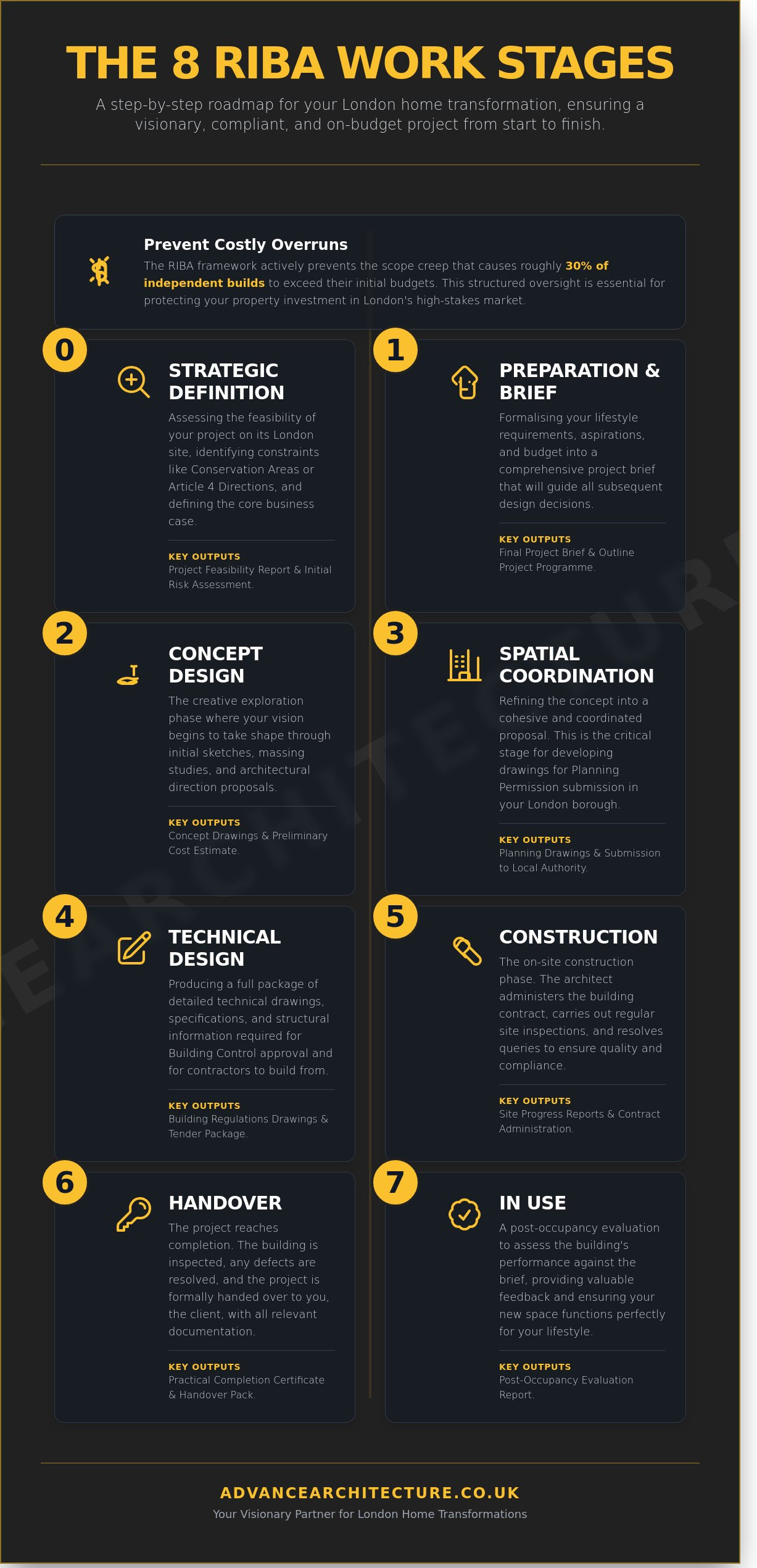
The journey begins with Stage 0, Strategic Definition. Here, we assess the feasibility of your London site, considering local constraints such as Conservation Area status or Article 4 directions. We move quickly into Stage 1, Preparation and Brief, where your budget and lifestyle requirements are formalised into a project programme. This is about unlocking potential before a single line is drawn.
Stage 2, Concept Design, is where your vision starts to take physical shape. Your architect will produce initial sketches and massing studies. You should expect a set of concept drawings and a preliminary cost estimate at this juncture. These deliverables allow you to review the architectural direction and provide essential approvals before the design becomes too rigid. This phase is about creative exploration and testing the limits of your site.
Stages 3-4: Planning and Technical Design
Stage 3, Spatial Coordination, involves refining the design into a cohesive proposal. This is the critical point for architect planning in London, as these drawings form the basis of your planning application. We navigate the 8-week statutory determination period with the local council, ensuring the design respects the urban grain while meeting your specific needs.
Once permission is secured, we enter Stage 4, Technical Design. We prepare the detailed drawings required for Building Regulations and contractor pricing. Utilizing 3D visualisation during this phase helps lock in material choices and interior finishes, preventing mid-build changes that can inflate budgets. The primary deliverable here is a comprehensive construction pack that includes structural details and mechanical specifications. This is where building regulations drawings become essential, ensuring every technical detail meets the latest 2026 compliance standards for thermal performance and structural integrity.
This is also the stage where specialist consultants are engaged for critical aspects like soundproofing. For instance, teams like Focus Acoustics provide expert analysis to ensure modern living spaces meet stringent acoustic standards, a key consideration in dense urban environments.
Stages 5-7: Construction to Completion
Stage 5, Manufacturing and Construction, is the build phase. Your architect may act as a contract administrator, visiting the site to ensure the work aligns with the technical specifications. The focus shifts from the drawing board to the reality of structural steel and masonry. It’s a period of intense activity where professional oversight ensures the integrity of the design is maintained through every site inspection.
Stages 6 and 7 represent the culmination of the riba work stages. Stage 6, Handover, concludes the building contract and includes the rectification of any minor defects. Finally, Stage 7, In Use, is a post-occupancy phase. We check that the building performs as expected, from energy efficiency to daily functionality. If you’re ready to begin this journey, our team can help you optimise your London home with a bespoke design strategy.
RIBA Architect vs. Basic Draftsperson: Why the Framework Wins
Many homeowners view the full riba work stages as a luxury reserved for multi-million pound developments. This is a costly misconception. A basic draftsperson provides a drawing; an architect provides a strategy. Choosing a “plans only” service often leaves you vulnerable to structural oversights and budget creep. By following the RIBA framework, you aren’t just buying lines on a page. You’re investing in a rigorous process of spatial coordination that ensures your vision is both buildable and beautiful. It’s about protecting your capital in a market where every square millimetre carries a premium price tag.
The Problem with “Cutting Corners” in London
Cheap plans frequently disintegrate when they meet the reality of London’s complex planning landscape. In boroughs like Camden or Islington, where 25% of applications in 2023 faced initial pushback due to conservation constraints, a surface-level drawing isn’t enough. We’ve seen projects where “budget” plans failed building control because they lacked detailed thermal bridge analysis or fire safety specifications. Rectifying these errors during the construction phase can inflate your build costs by 15% to 20%. Getting the technical foundations right in Stage 2 prevents these expensive mid-build pivots. Expert handling at the start is the only way to navigate the hurdles of North London’s Victorian and Edwardian terraces successfully.
Maximising Value and Minimising Stress
The real magic happens during Stage 4, where technical drawings transform a concept into a precise instruction manual. This level of detail is what creates a truly stress-free experience for the homeowner. When a builder receives a comprehensive Stage 4 pack, their quote is fixed and accurate. There’s no room for “provisional sums” or unexpected £5,000 variations because the ironmongery, lighting circuits, and joinery details are already defined. This rhythmic progression through the riba work stages offers more than just technical security. It provides the psychological benefit of knowing your project is under control.
- Accurate Tendering: Detailed specifications mean builders can’t hide costs in vague estimates.
- Spatial Optimisation: Rigorous Stage 3 coordination ensures structural pillars don’t ruin your kitchen layout.
- Regulatory Peace of Mind: Every detail is pre-checked against the latest 2024 Building Regulations.
A structured approach allows us to focus on unlocking the potential of your home. We look beyond the immediate walls to see how light, movement, and material choices will impact your daily life. This bespoke level of care is the difference between a house that’s simply bigger and a home that’s fundamentally better. By adhering to a proven framework, we transform the daunting journey of property transformation into a seamless, visionary experience.
Navigating London-Specific Hurdles Within the RIBA Stages
London’s architectural landscape presents a unique set of challenges that require a surgical approach to the riba work stages. While the framework remains consistent across the UK, the density of North London and the historic character of Hertfordshire demand extra diligence during the early phases of design. You aren’t just building; you’re negotiating with history and proximity. The capital’s unique constraints mean that local factors often dictate the pace and complexity of the core tasks within the RIBA Plan of Work.
London Planning and Heritage Constraints
Success in Stage 3 often hinges on the groundwork laid during Stages 1 and 2. For properties in strict boroughs like Barnet or Camden, where approximately 27% of the land is designated as a Conservation Area, a standard application won’t suffice. We integrate heritage statements and listed building consents into the very first sketches to manage expectations early. Your architect acts as a vital bridge, liaising with local planning authorities on your behalf to ensure your vision aligns with strict preservation guidelines. This proactive stance prevents costly delays and ensures a smoother path to approval.
Technical Compliance in Urban Environments
As we move into Stage 4, the technical reality of house extensions in London becomes the primary focus. High-density living means shared structures are the norm, not the exception. We manage the intricacies of the Party Wall etc. Act 1996 and secure Thames Water build-over agreements for any work within 3 metres of a public sewer. Our technical designs prioritise fire safety and structural integrity, especially when merging modern glass and steel with the fragile brickwork of a period home. This meticulous detail ensures your project is both visionary and fully compliant.
Unlocking the potential of a constrained urban site requires more than just creativity; it demands a deep understanding of local regulatory nuances. We’ve refined our process to handle these hurdles with quiet confidence, turning potential obstacles into design opportunities. Every step of our riba work stages is calibrated to protect your investment and elevate your lifestyle. We ensure the seamless integration of modern functionality into the most sensitive of period environments.
Partnering with Advance Architecture: Your Visionary London Experts
Advance Architecture has served as a steady hand for homeowners across North London since our founding in 2009. We specialise in translating the formal riba work stages into a clear, manageable roadmap for ambitious residential projects. Our team understands that a home is more than a structure; it’s a personal sanctuary and a significant financial investment. By applying our deep local knowledge of London’s specific planning environment, we ensure your project moves through the gears without the common friction of delays or regulatory hurdles. We provide bespoke solutions that prioritise your lifestyle while maintaining the highest standards of technical excellence.
Our commitment to a hassle-free experience means we take the weight of the process off your shoulders. We navigate the inherent complexities of the UK construction landscape with a quiet confidence, ensuring every stage of the journey feels like a creative partnership rather than a technical chore. Whether you are looking to modernise a Victorian terrace or embark on a contemporary new build, our 14 years of expertise allow us to anticipate challenges before they arise.
Our Approach to Design, Planning, and Management
We bridge the gap between technical authority and aspirational storytelling. Our team manages house extensions, loft conversions, and new builds by applying a clear, fixed-fee structure. This transparency is vital within the riba work stages framework; it provides you with cost certainty as we move from Stage 2 concept designs to Stage 4 technical specifications. We find that removing financial ambiguity allows for a more focused and creative design phase.
Our methodology combines structural integrity with functional elegance. We don’t just draft plans; we look for ways to maximise the potential of your space. This involves a meticulous look at:
- Optimising natural light through strategic glazing and orientation.
- Enhancing flow between living areas to suit modern family life.
- Integrating sustainable materials that respect the local North London heritage.
Realise Your Vision Today
The journey to a transformed home begins at our Barnet office. We invite you to book a free initial consultation to kickstart Stage 0 of your project. This is where we listen to your ideas, assess the site, and begin the process of unlocking your property’s hidden value. To make the most of this first meeting, please bring any existing floor plans, site photos, or a simple list of your lifestyle goals. Having these details ready allows us to provide more specific insights into what is achievable under current planning constraints.
Property transformation is a significant undertaking, but it doesn’t have to be overwhelming. We’ve spent over a decade turning cramped layouts into flowing, light-filled spaces that reflect the unique visions of our clients. Your home deserves the expertise of a team that values innovation and functional elegance in equal measure. Reach out to us today to begin your roadmap to a better home and a more inspired way of living.
Turn Your Architectural Vision into a London Reality
Navigating a major renovation or new build in London requires more than just a creative spark; it demands a rigorous, proven framework. By following the riba work stages, you ensure your project moves from an initial concept to a completed home with technical precision and significantly reduced risk. Since 2009, our team of expert architects in North London has guided homeowners through these complex phases, turning ambitious visions into functional realities.
We specialise in managing the intricate requirements of Barnet and Hertfordshire planning applications, ensuring your design respects local constraints while maximising every square metre. You don’t have to worry about spiralling costs or hidden surprises. Our fixed-fee architectural services provide total budget transparency from the very first sketch. Whether you’re extending a Victorian terrace or designing a contemporary masterpiece, this structured roadmap is the key to a stress-free transformation. We’re here to provide the steady hand and visionary expertise your property investment deserves.
Realise Your Vision: Book Your Free London Architectural Consultation
Frequently Asked Questions
Do I really need all 8 RIBA stages for a small house extension?
You don’t necessarily need every stage, as approximately 92% of residential extensions focus on Stages 1 through 6. While Stage 0 (Strategic Definition) is vital for large commercial builds, most homeowners find their journey starts at Stage 1 to define the project’s core goals. Our role is to guide you through the riba work stages that matter most, ensuring a bespoke result without unnecessary administrative layers.
At which RIBA stage do I apply for planning permission in London?
You’ll typically submit your planning application at the end of Stage 3 (Spatial Coordination) after the architectural design is fully refined. This stage is crucial because it balances your aesthetic vision with the strict requirements of London local authorities like Kensington and Chelsea or Westminster. Most London councils take between 8 and 13 weeks to reach a decision on householder applications, making this a pivotal moment in your project timeline.
How much do architectural fees cost for each RIBA work stage?
Architectural fees are usually distributed across the stages, with 25% allocated to Stage 2, 25% to Stage 3, and 35% to the technical detail in Stage 4. For a typical £200,000 London renovation, total professional fees often range between 10% and 15% of the construction cost. This structured investment ensures you’re paying for specific milestones, from initial creative concepts to the final technical specifications that guarantee structural integrity.
Can I skip RIBA Stage 0 and Stage 1 if I already know what I want?
Skipping these early phases is rarely advisable because Stage 1 (Preparation and Briefing) identifies critical site constraints that could derail your budget later. Even if you’ve a clear vision, we use this time to uncover hidden issues like Thames Water assets or restrictive heritage covenants. Data shows that 30% of project delays are caused by unforeseen site conditions that a professional Stage 1 feasibility study would’ve identified immediately.
What is the difference between RIBA Stage 3 and Stage 4?
Stage 3 focuses on the “what” and “where” of your design to secure planning approval, while Stage 4 details the “how” for the construction team. During Stage 4, we produce a technical pack that often includes over 40 detailed drawings covering everything from electrical layouts to bespoke joinery. This transition from abstract design to concrete technical instruction is what transforms a visionary concept into a buildable reality.
When should I hire a builder within the RIBA Plan of Work?
It’s best to appoint your builder at the end of Stage 4 (Technical Design) once you have a comprehensive tender package. This ensures you receive fixed, competitive prices based on exact specifications rather than vague estimates that lead to budget creep. Tendering your project to 3 or 4 vetted contractors at this point provides the transparency needed for a stress-free construction experience.
What happens if my London planning application is refused at Stage 3?
If a refusal occurs, we’ll analyse the planning officer’s report and either submit an appeal or a revised design that addresses specific concerns. The Planning Inspectorate reports that roughly 25% of householder appeals in the UK are successful, though a redesigned “Free Go” resubmission is often a faster route to approval. Our expertise in the riba work stages allows us to pivot quickly, unlocking your property’s potential even when faced with initial regulatory hurdles.
How does the RIBA framework handle building regulations approval?
Building regulations approval is the primary technical objective of Stage 4, ensuring your home meets the 14 essential parts of UK building standards. We coordinate with structural engineers and approved inspectors to verify that every element, from thermal performance to fire safety, is compliant. Submitting a “Full Plans” application during this stage provides a decision within 5 to 8 weeks, giving you total peace of mind before the first brick is laid.