
Design and Build vs Architect: Choosing the Best Route for Your London Home
In a London property market where construction costs have surged by 17% since 2022, the promise of a “one-stop shop” can often be a costly illusion. When weighing up the design and build vs architect London options, the wrong choice doesn’t just risk your aesthetic vision; it can lead to expensive planning rejections and missed opportunities to unlock your home’s true market value. You likely want a process that feels controlled and professional, yet the fear of costs spiralling out of reach or navigating the £548 planning application fee alone is enough to stall any project.
We understand that your home is your most significant asset, and it deserves a bespoke approach that balances creative possibility with technical precision. This guide reveals the critical differences between these two routes to ensure your renovation is both high-value and stress-free. You’ll learn how to maintain design integrity while meeting the strict 2026 Future Homes Standard. We will break down the differences in fee structures, creative control, and regulatory expertise, helping you decide which path leads to a seamless, visionary transformation of your living space.
Key Takeaways
- Understand the fundamental differences between the design and build vs architect London routes to decide if you prioritize convenience or creative precision.
- Discover how independent oversight protects your investment by managing builder contracts and ensuring every detail aligns with your original vision.
- Learn why specialized local knowledge is essential for navigating London’s strict planning permissions and the latest 2026 building regulations.
- Identify how bespoke architectural solutions can unlock the hidden potential of your property, maximizing both lifestyle quality and long-term market value.
- Master a methodical 3-stage process, Design, Planning, and Technical, to ensure your home transformation remains seamless and entirely stress-free.
Design and Build vs Architect: Understanding the Two Paths for Your London Project
London’s architectural landscape is a complex tapestry of Victorian terraces, Georgian townhouses, and contemporary infills. Choosing between the design and build vs architect London routes is the most significant decision you’ll make before the first brick is laid. It’s a choice between two distinct philosophies of project management. On one side, the traditional architect-led path prioritizes design integrity and independent oversight. On the other, the Design-build project delivery system offers a consolidated model where a single company manages both the creative and construction phases under one contract.
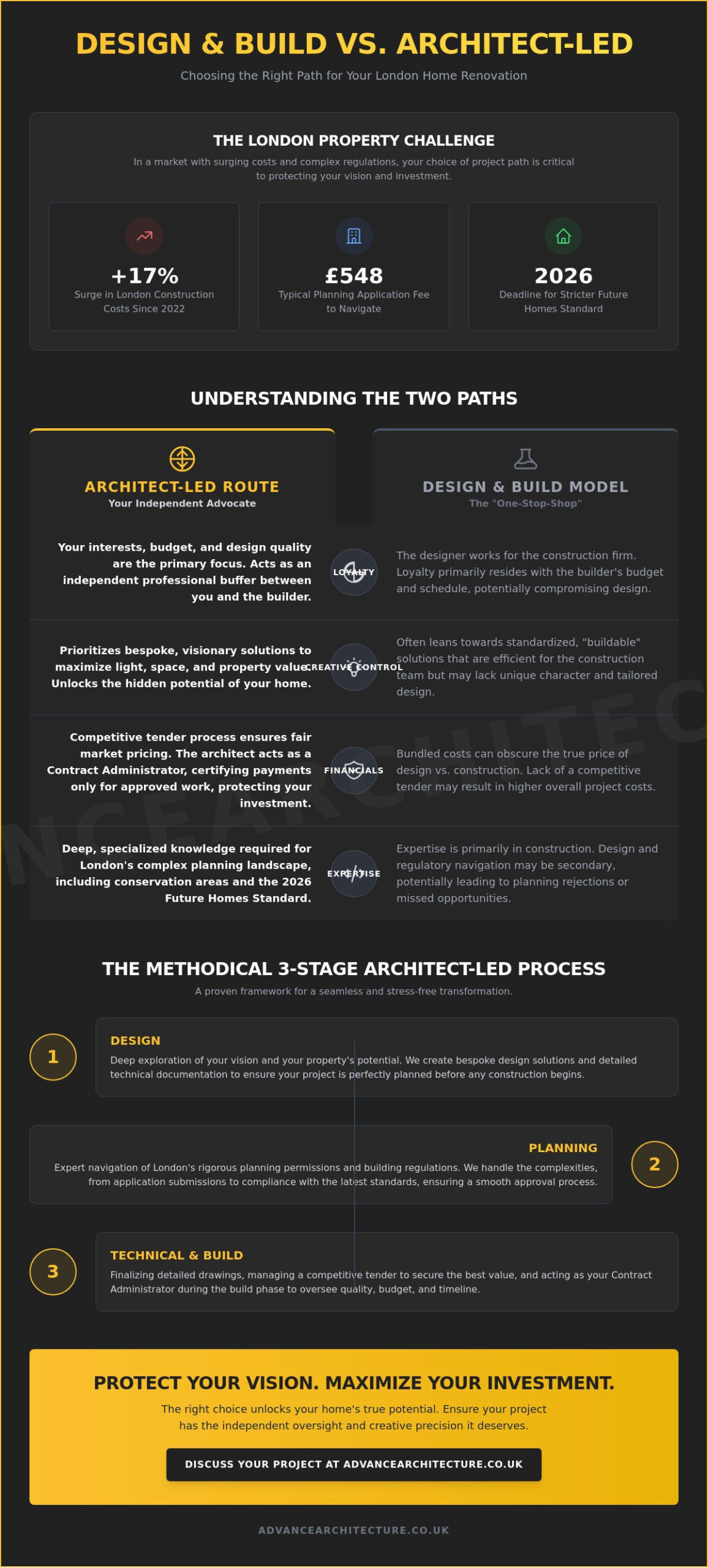
The core difference lies in where the loyalty resides. In an architect-led project, your consultant’s primary duty is to protect your interests, your budget, and the design’s quality. They act as a professional buffer between you and the builder. Conversely, in a design and build model, the designer often works directly for the construction firm. This shift can impact the finished result; when construction challenges arise, a builder-led team might favor cost-cutting over the creative problem-solving required to maintain a bespoke vision. This distinction is critical for London’s unique period properties, where a £548 planning application fee is only the beginning of a rigorous regulatory journey.
The Traditional Architect-Led Approach
This route begins with deep exploration. We focus on technical documentation and bespoke design to ensure your vision is airtight before construction starts. Once planning permission is secured and building regulations drawings are finalized, your project enters a competitive tender process. This allows multiple builders to bid for your work, which often drives better value and transparency. Throughout the build, the architect acts as a “Contract Administrator.” They certify payments only when work is completed to the required standard, ensuring your investment is protected against sub-par craftsmanship.
The Design and Build Model
Design and build firms market themselves as a “one-stop-shop” to reduce the number of contracts a homeowner must manage. This model appeals to busy London professionals seeking a single point of responsibility. By bundling design and construction into one package, they can sometimes bypass the formal tender phase to start on-site faster. However, this speed often comes at the cost of design refinement. Because the design is often handled in-house with a focus on “buildability,” it may lack the visionary edge needed to truly maximize natural light or optimize cramped urban plots.
To help you evaluate these paths, consider these three factors:
- Creative Control: Architects prioritize unlocking a property’s potential through bespoke solutions, while D&B firms often lean toward standardized construction methods.
- Financial Protection: Independent architects provide oversight to prevent costs from spiralling, whereas D&B firms bundle costs, which can sometimes obscure hidden fees.
- Regulatory Expertise: Navigating London’s strict conservation area rules and the 2026 Future Homes Standard requires a high level of technical authority that goes beyond simple drafting.
The Architect-Led Route: Unlocking Bespoke Value and Independent Oversight
London homes often face unique spatial constraints, from narrow Victorian footprints to restrictive light angles. The Architect-Led Route follows a rigorous framework designed to mitigate these challenges through methodical, stage-by-stage planning. Choosing between design and build vs architect London involves deciding who will prioritize your interests during the high-stakes construction phase. An independent architect doesn’t just draw plans; they act as your professional advocate, ensuring that the £520,000 to £640,000 typically spent on a four-bedroom London new build is used with maximum efficiency and creative precision.
Competitive tendering is where the architect-led model often pays for itself. Instead of accepting a single quote from a design and build firm, your architect invites several vetted contractors to bid on a fixed set of technical drawings. This process frequently identifies savings of 10% or more on construction costs, which can offset the standard 10% to 15% architectural fee. In the competitive London market, high-quality, bespoke design consistently yields a higher return on investment. Buyers recognize the value of a home that has been thoughtfully optimized for modern living while respecting its original DNA.
Creative Freedom and Visionary Design
In London’s dense urban fabric, every millimeter counts. Standardized templates often fail to capture the nuances of light and heritage required for a truly successful transformation. By utilizing 3D visualisation, you can experience your proposed loft conversion or extension in a virtual space before any physical work begins. This visionary approach allows for the optimization of natural light and the selection of materials that honor local conservation area requirements. It’s about creating a bespoke home that reflects your lifestyle rather than a builder’s convenience.
Financial Protection and Contract Administration
One of the most significant advantages of this route is the architect’s role as a Contract Administrator. This professional acts as an independent buffer between client and contractor. They verify that the construction matches the professional architectural plans exactly before any funds are released. If a builder requests a variation or an extra payment, the architect evaluates the claim with technical authority. This prevents the emotional stress of disputes and ensures you only pay for work that meets the required 2026 building regulations and the Future Homes Standard. If you’re ready to explore how this level of oversight can protect your investment, you can book a consultation with our team to begin your journey.
The Design and Build Model: Evaluating Convenience Against Creative Control
The Design and Build (D&B) model is frequently marketed as the ultimate solution for the time-poor Londoner. By providing a single point of responsibility, these firms eliminate the need for the homeowner to act as a bridge between separate consultants. This “one-stop-shop” approach can lead to faster project start dates because it bypasses the traditional four-to-six-week tender phase. However, when choosing between design and build vs architect London, it’s vital to recognize that convenience often comes with a hidden trade-off in creative control and long-term quality.
The most significant risk in the D&B model is the inherent conflict of interest. When the designer and the builder are the same entity, the design is often dictated by “buildability” and profit margins rather than your specific lifestyle needs. If a structural complication arises on-site, an in-house designer may be pressured to find the cheapest fix rather than the most elegant one. Without independent oversight, you lose the professional “check and balance” that ensures your vision isn’t compromised for the sake of the builder’s bottom line.
Convenience vs. Compromise
In areas like North London, where Victorian and Edwardian properties require intricate technical knowledge, the “standardized” approach of many D&B firms can be problematic. They often rely on repetitive details to maintain speed, which may not respect the unique character of your home. You might encounter “value engineering,” a practice where high-end specifications are swapped for mid-range alternatives during construction to protect the firm’s fixed-price margin. This subtle erosion of quality can lead to a finished product that feels generic rather than bespoke.
Managing the Budget
The promise of a “fixed price” is one of the most compelling arguments for the D&B route, yet the reality is often more complex. These quotes frequently include “provisional sums” for items like kitchens, tiling, or glazing. If your tastes exceed these modest allowances, the price will rise sharply. Beyond this, without a standardized set of technical drawings, comparing two different D&B quotes is nearly impossible; you aren’t comparing like-for-like services. This is why choosing the best architects in London is often a more secure financial strategy. An independent architect provides the granular detail needed to lock in true construction costs before you sign a contract, ensuring transparency from the outset.
Navigating London’s Complex Planning and Building Regulations
London’s planning landscape is notoriously rigorous, and the decision regarding design and build vs architect London often hinges on who can best navigate the £548 planning application fee for householder alterations. While a builder might understand the fundamentals, an architect provides the technical authority required to handle nuanced requirements like the 2026 Future Homes Standard. This regulation now mandates that new developments produce 75-80% fewer carbon emissions compared to previous standards, a hurdle that requires precise architectural planning rather than guesswork. For heritage projects, an architect-led approach is indispensable for securing Listed Building Consent, as it requires a sensitive balance between contemporary living and historical preservation.
Technical accuracy in your documentation is the only definitive way to avoid the catastrophic risk of enforcement action from a London local authority. Beyond the initial design, your project must comply with the Building Safety Levy, effective October 1, 2026, and other stringent safety updates. An independent architect ensures that your vision is translated into a robust technical framework that satisfies both your aesthetic desires and the council’s legal requirements.
The Local Authority Hurdle
Every borough has its own DNA, and securing approval in Barnet requires a different strategy than in Islington or Haringey. Planning officers in these areas are particularly sensitive to “right to light” issues and overlooking concerns, which are common in dense terrace housing. Professional documentation doesn’t just present a design; it builds a case for approval. By providing a clear rationale backed by policy, we reduce the risk of rejection, which is vital when only 2,158 new homes were started in London in the first half of 2025 due to planning constraints. Understanding permitted development rules is equally essential for rear and side extensions, as it allows certain transformations to proceed without a full planning application, provided the criteria are met exactly.
Beyond the Design: Technical Compliance
Design is the spark, but technical compliance is the engine that drives a project to completion. Once planning is secured, you must meet the latest 2026 Building Regulations standards. This involves creating detailed building regulations drawings that cover everything from fire safety to structural integrity. In a dense urban environment, you’ll also need to coordinate with party wall surveyors and structural engineers to protect neighboring properties and ensure the long-term stability of your home. If you’re concerned about navigating these complexities, start your planning journey with a professional consultation today to ensure your project is compliant from day one.
Making the Right Choice: How Advance Architecture Protects Your Vision
The decision between design and build vs architect London doesn’t have to be a compromise between creative vision and project management. At Advance Architecture, we’ve refined a 3-stage process-Design, Planning, and Technical-to provide the ultimate stress-free experience. This methodical approach provides a structural framework that feels as sturdy and well-planned as the buildings we design. We act as your steady hand, guiding you through the daunting journey of property transformation with ease and expertise. Our role is to ensure that the creative spark of your initial idea is never lost during the rigorous transition to a physical structure.
Independent oversight remains the “Gold Standard” of residential construction. It ensures that your contractor remains strictly accountable to the technical drawings and that your investment is protected from the first day on-site. By maintaining this professional distance, we eliminate the friction often found in builder-led designs where profit margins can sometimes overshadow architectural integrity. Working with specialized residential architects in London means your project is handled by experts who understand local property DNA, from the foundations of a Victorian terrace to the complexities of the 2026 Building Safety Levy.
The Advance Architecture Advantage
Our expertise covers the full spectrum of urban transformation, including high-end house extensions in London and complex loft conversions. We operate with a fixed-fee approach for our design and planning stages, providing you with absolute transparency from day one. This commitment to financial clarity is essential in a market where construction tender prices are expected to rise by 3.5% in 2026. We prioritize bespoke solutions that maximize your property’s market value while respecting the heritage and context of your specific neighborhood. Our focus is always on unlocking the potential of your space through visionary design and technical precision.
Realise Your Vision Today
Moving from an abstract idea to a technical reality requires a partner who values both contemporary innovation and functional elegance. Before your first consultation, it’s helpful to gather your inspirations and consider how you want your daily lifestyle to improve. We’ll handle the granular details of project execution, from the £610 planning application for a new dwelling to the intricate building regulations drawings required for modern safety compliance. You don’t have to navigate these hurdles alone. Realise your vision with a bespoke architectural consultation and take the first step toward a seamless, high-value home transformation.
Realise Your Vision with Professional Confidence
Navigating the complexities of a London renovation requires more than just a builder. It requires a partner who protects your interests at every stage. We’ve explored how independent oversight prevents budget inflation and how bespoke design respects the unique heritage of North London properties. While convenience is tempting, the long term value of your home depends on technical precision and creative vision. You deserve a process that remains transparent and professional from the first sketch to the final certificate.
Advance Architecture was founded in 2009 to offer this exact blend of technical authority and seamless project management. We specialize in stress-free planning applications and building regulations drawings that meet the 2026 Future Homes Standard. Deciding on the design and build vs architect London route is about more than just construction. It’s about ensuring your project is handled with the expertise your property deserves. Our team is ready to help you navigate the local planning landscape and transform your abstract ideas into a high-value reality.
Unlock your property’s potential with a free consultation from Advance Architecture.
We look forward to partnering with you on your journey of property transformation and helping you create a home that truly stands out.
Frequently Asked Questions
Is an architect more expensive than a design and build company?
An architect-led project is often more cost-effective in the long term, despite the visible professional fee. While a full architectural service typically costs 10% to 15% of construction, this investment is frequently offset by the savings found through competitive tendering. Design and build firms bundle their costs into a single figure, which can make it difficult to identify where your money is actually being spent or to spot hidden profit margins.
Can a design and build firm handle planning permission in London?
Yes, most design and build firms can submit planning applications, but they may lack the specialized design nuance required for complex urban sites. London planning authorities are particularly rigorous regarding “right to light” and heritage preservation. An independent architect provides the technical authority and professional documentation needed to navigate these hurdles, reducing the risk of a costly rejection from your local council.
Do I need an independent architect for a small kitchen extension?
While not a legal requirement, an independent architect ensures that even a small extension is optimized for natural light, flow, and structural integrity. In a dense London environment, even minor projects face strict building regulations and party wall issues. Professional oversight ensures your small transformation adds maximum market value and complies with the latest 2026 safety standards from day one.
What happens if a design and build firm goes bust mid-project?
If a design and build firm becomes insolvent, you lose both your designer and your contractor simultaneously, which often halts the project indefinitely. In the architect-led model, your architect acts as a constant professional presence. They hold the technical drawings and contract details, allowing them to guide you through the process of appointing a replacement builder to complete the work without losing your original vision.
How do I compare quotes between an architect and a D&B firm?
Comparing design and build vs architect London quotes requires looking beyond the bottom line. An architect’s quote covers professional design and oversight, while a D&B quote includes physical construction. To compare fairly, use an architect’s detailed technical drawings to obtain fixed-price bids from several contractors. This ensures you are evaluating the same level of quality and specification across all potential partners.
What is the biggest risk of the design and build model?
The primary risk is the inherent conflict of interest between design quality and construction profit. Since the designer works for the builder, they might prioritize “buildability” or lower material costs over the visionary edge you originally envisioned. Without an independent professional to certify work and payments, you lose the essential “check and balance” that protects your budget and the finished quality of your home.
How long does the architectural design process take compared to D&B?
The design and planning phase usually takes between 8 and 12 weeks, which is similar to the timeline of a design and build firm. While a D&B firm might start on-site four weeks sooner by bypassing the formal tender phase, the architect-led route uses that time to lock in competitive pricing. This extra preparation ensures a more refined, cost-controlled outcome that respects your long-term budget.
Can Advance Architecture help me find a reliable builder?
Yes, we manage the entire competitive tender process to ensure you find a reputable contractor for your project. We invite vetted builders to bid on our detailed technical drawings, providing you with transparent, comparable quotes. This allows you to select a builder who delivers high-quality craftsmanship at a fair price, all while we remain as your independent advocate to monitor construction quality.