

Chimney Breast Removal in London: The 2026 Homeowner’s FAQ Guide
What if the most valuable square metre in your London home is currently hidden behind a redundant stack of Victorian brickwork? For many residents in terrace houses across Fulham or Hackney, a protruding stack can waste up to 15% of a room’s usable floor area, turning a potential master suite into a cramped bedroom. You likely feel that your home’s layout is working against you, yet the fear of structural instability or a £5,000 legal dispute often stalls a chimney breast removal project. At Advance Architecture, we believe your property should adapt to your lifestyle, not the other way around.
We’ve designed this 2026 guide to help you master the structural and legal requirements of this transformation, ensuring you unlock that hidden potential with ease. You’ll gain a clear roadmap of the essential steps, from securing building regulations approval to managing the Party Wall Act. This article provides the technical clarity and architectural insight needed to modernise your living space with absolute confidence and precision.
Key Takeaways
- Reclaim valuable square footage in your London terrace by identifying how to safely modify the internal architecture of heritage properties.
- Master the technical requirements of chimney breast removal, focusing on the essential role of Rolled Steel Joists (RSJs) in preserving structural integrity.
- Navigate your legal obligations under the Party Wall Act 1996 to ensure seamless compliance and maintain positive relationships with your neighbours.
- Follow a professional, step-by-step roadmap from initial structural calculations to final building control approval for a truly hassle-free experience.
- Uncover the visionary potential of your floor plan, learning how bespoke reconfigurations can integrate your reclaimed space into a modern house extension.
Understanding Chimney Breast Removal in London Properties
London’s architectural heritage is defined by its iconic Victorian and Edwardian terraces, built between 1837 and 1910. While these properties exude character, their original layouts were dictated by the necessity of coal fires in every room. In a modern context, these masonry structures often represent redundant mass that restricts contemporary living. A chimney breast removal is the strategic process of extracting this internal masonry to reclaim floor space and modernise a property’s footprint. It’s essential to distinguish this from a full stack removal; the latter involves the portion of the chimney that extends above the roofline, whereas internal removal focuses on the projection within the living areas.
To grasp the technical scope, one must first ask: What is a Chimney Breast? It’s the part of the wall that projects into a room to accommodate the flue. Because these structures are integral to the building’s load-bearing system, their removal is a significant structural modification. London homeowners increasingly prioritise these projects to facilitate open-plan configurations, turning cramped, partitioned rooms into fluid, light-filled environments. This transformation requires a meticulous balance of structural engineering, aesthetic vision, and regulatory compliance.
Why Remove a Chimney Breast in 2026?
In 2026, the value of space in prime London postcodes has reached unprecedented levels, with some areas exceeding £15,000 per square metre. Reclaiming even a single square metre through chimney breast removal offers a tangible return on investment. Beyond financial gain, removing old flues eliminates persistent maintenance headaches. Old chimneys often harbour hygroscopic salts and soot that cause stubborn damp issues. By extracting the stack, you create a seamless canvas for high-end finishes while improving the thermal efficiency of the building envelope.
The Architectural Impact on Your Floor Plan
Removing a chimney breast does more than just add floor area; it fundamentally redefines the room’s geometry. By eliminating the protruding masonry, you unlock the awkward alcoves on either side, creating a continuous wall that is perfect for bespoke joinery or large-scale art. This modification significantly improves the distribution of natural light, allowing it to reach deeper into the floor plate without being obstructed by shadows. For those seeking layout inspiration, our guide on residential architects london explores how these structural changes act as a catalyst for visionary property transformations. The result is a home that feels intuitive, expansive, and tailored to a sophisticated lifestyle.
Structural Integrity and Building Regulations Compliance
A chimney breast removal is never a simple cosmetic tweak; it’s a fundamental alteration to your home’s skeletal structure. In London’s Victorian and Edwardian terraces, these masonry stacks often provide essential lateral stability to the entire building. A typical chimney stack can weigh over two tonnes, meaning the removal of the ground floor section leaves a massive weight suspended above your living space. Without a calculated support system, you risk catastrophic ceiling sag or structural failure. This is why professional architectural plans are vital. They transform a high-risk demolition into a controlled engineering exercise, ensuring your home remains as sturdy as the day it was built.
London boroughs, including Camden and Southwark, require formal notification to Building Control before any work commences. This oversight ensures that every chimney breast removal meets the rigorous safety standards expected in the UK. A Rolled Steel Joist (RSJ) is typically installed to catch the load of the remaining masonry. This steel beam must be sized correctly to prevent even a millimetre of movement, protecting the finish of your upper rooms and the safety of your family.
The Role of the Structural Engineer
Precision is the hallmark of a successful transformation. A structural engineer works alongside your architect to calculate the exact loads the new steel must carry. They determine whether “Gallow Brackets” are sufficient for smaller chimneys or if a full-width steel beam is necessary for larger stacks. In a 1930s semi-detached property, the engineer ensures the remaining stack in the loft is braced correctly, preventing it from shifting once the lower support is gone. This technical rigour provides the peace of mind that your visionary home improvement won’t lead to expensive repairs later.
Meeting UK Building Standards
Compliance involves more than just structural strength. UK Building Standards mandate specific safety features that are often overlooked by DIY enthusiasts:
- Fire Safety: Structural steel must be encased in fire-resistant materials, usually two layers of 12.5mm fire-rated plasterboard, to provide a 30-minute or 60-minute fire break.
- Ventilation: Any redundant flues must be capped with ventilated cowls to prevent moisture build-up and the subsequent rot of internal timbers.
- Legal Compliance: If the chimney is on a shared boundary, you must follow the Party Wall Act 1996 guidance to avoid legal disputes with neighbours.
The process culminates in the issuance of a Building Regulations Completion Certificate. This document is essential when selling your home, as it proves the work was carried out to professional standards. Our team helps you unlock your property’s potential by managing these technical hurdles with a bespoke, stress-free approach.
Navigating the Party Wall Act and Neighbourly Concerns
When your project involves a shared structure, the Party Wall Act 1996 becomes your primary legal framework. For homeowners in London’s dense Victorian or Edwardian terraces, a chimney breast removal almost always affects a wall shared with a neighbour. You must formally notify those living on the other side of the boundary before any masonry is disturbed. This isn’t just a courtesy; it’s a statutory requirement that ensures the structural integrity of both properties remains uncompromised. Our role is to ensure this process feels like a partnership rather than a confrontation.
Most neighbours worry about the practicalities of living next to a construction site. Vibrations from heavy masonry work, fine dust ingress, and the rhythmic thud of demolition can cause significant anxiety. By following the Building Regulations for Chimney Removal alongside the Party Wall process, you provide a transparent roadmap that mitigates these fears. We focus on creating a stress-free transition that protects your relationship with your neighbours while unlocking the potential of your interior layout.
The Party Wall Notice Process
You should serve a formal notice at least two months before your intended start date. If your neighbour dissents or fails to respond within 14 days, a dispute is deemed to have arisen. In this scenario, you’ll need to appoint a Party Wall Surveyor to draft an “Award.” This document includes a “Schedule of Condition,” which records the current state of the neighbouring property to prevent fraudulent damage claims later. This structured approach provides a clear, legal paper trail that protects your investment and your neighbour’s peace of mind.
Protecting Shared Assets
A successful chimney breast removal requires more than just removing bricks; it demands the protection of the adjoining property’s flue. We ensure that your neighbour’s fireplace remains safe to use and that no smoke leakage occurs through the shared wall. This level of detail is what separates a standard renovation from a bespoke architectural transformation.
- Implementing acoustic dampening to reduce noise transfer during the heavy demolition phase.
- Securing comprehensive liability insurance to cover any accidental structural shifts during the work.
- Verifying that the remaining chimney stack is supported by steel gallows brackets or beams approved by a structural engineer to prevent sagging.
By addressing these technicalities early, you transform a potentially volatile situation into a managed, professional operation. Our expertise allows you to navigate these regulations with quiet confidence, ensuring your home’s evolution is both seamless and legally sound.
The Step-by-Step Process of Removing a Chimney Stack
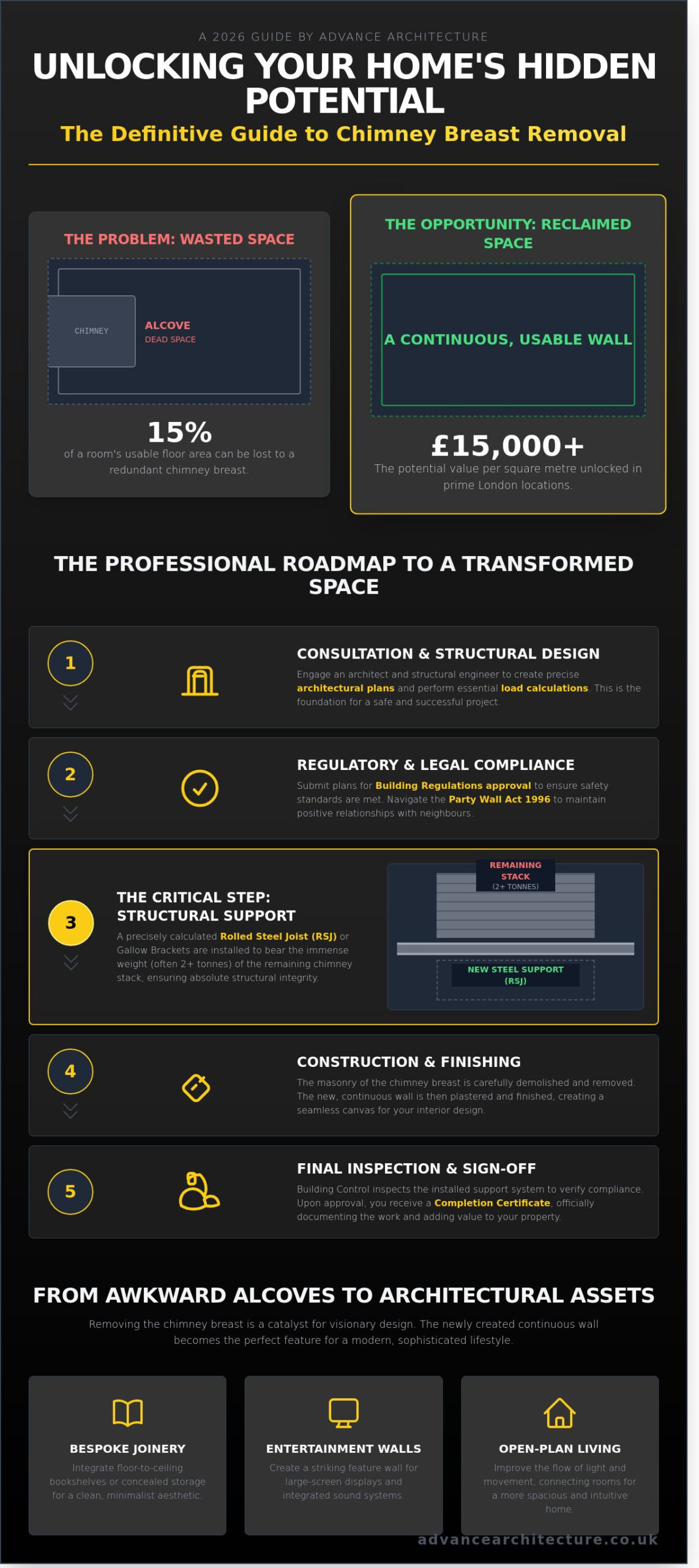
A successful chimney breast removal requires a methodical approach that balances structural precision with meticulous site management. We follow a five-phase roadmap to ensure your home remains safe and the result is seamless. It begins with a professional survey and structural calculations, which typically cost between £500 and £950. These figures dictate the exact size of the steel required to support the remaining stack above. Legal compliance follows, involving a Building Control application and, for 82% of terraced or semi-detached properties in the UK, a Party Wall Agreement under the 1996 Act.
- Phase 1: Professional survey and structural calculation by a qualified engineer.
- Phase 2: Legal compliance, including Party Wall notices and Building Control notification.
- Phase 3: Site preparation, focusing on temporary propping and dust containment.
- Phase 4: Controlled demolition and the precision installation of structural supports.
- Phase 5: Making good, including plastering, skirting matching, and decorative finishing.
Preparation and Site Safety
Before a single brick is moved, we prioritise the stability of your home. Contractors use Acrow props and “Strongboy” attachments to support the floor joists and the masonry above. This phase is also about containment. A single chimney can harbour up to 35 litres of fine soot and debris, which we manage with heavy-duty polythene screening and industrial vacuums. For properties built before 1999, we verify the absence of asbestos in flue linings. This prevents hazardous fibres from entering your living space during the chimney breast removal process.
Installation of Structural Support
Once the masonry is removed, the focus shifts to the installation of the RSJ (Rolled Steel Joist). This steel beam must be secured into load-bearing walls, resting on concrete padstones to distribute the weight effectively. To meet Part B of the Building Regulations, we apply fire-rated plasterboard to the new steelwork to provide 30 minutes of fire resistance. The process concludes with a final inspection by the local Building Control officer. They issue a completion certificate, which is a vital document for any future property sale.
Our team handles every technical detail, ensuring your project moves from a complex structural challenge to a beautifully finished room. Consult Advance Architecture to begin your bespoke home transformation and unlock the hidden potential within your floor plan.
Unlocking Space: Architectural Potential Beyond Removal
While a contractor views a project as a series of structural tasks, an architect approaches the space as a cohesive narrative. A chimney breast removal isn’t merely an exercise in demolition; it’s a strategic opportunity to reconfigure your home’s entire circulation. By removing these bulky masonry protrusions, you gain more than just floor area. You gain the freedom to align furniture, improve sightlines, and create a seamless transition between living zones. This visionary approach ensures that every square centimetre serves a purpose within the functional whole.
This process often serves as the catalyst for a larger house extension. When we integrate the reclaimed alcove space into a wider floor plan, the result is a unified environment that feels intentional rather than fragmented. It’s the difference between a house that’s been patched up and one that’s been expertly curated for modern life. Professional design adds significantly more value than simple trade demolition by ensuring the new layout flows logically and aesthetically.
Bespoke Interior Solutions
Reclaiming the 0.75 square metres typically occupied by a Victorian stack allows for precision joinery. We often design floor-to-ceiling library walls or integrated media units that sit flush with the remaining structure, creating a symmetrical, modern centrepiece. By using recessed LED lighting to highlight these new, cleaner architectural lines, we transform a once-dark corner into a sophisticated focal point. This level of detail ensures the intervention feels like a premium upgrade rather than a structural necessity.
Investment Value and Resale
In the London property market, where prices in boroughs like Islington or Wandsworth often exceed £12,000 per square metre, maximising usable area is a direct investment in your equity. Beyond the physical space, future buyers look for a clean structural history. Having a professional architectural package ensures all Building Regulations are met and documented. This transparency prevents delays during the conveyancing process and justifies a higher asking price because the work is certified and safe. It provides the peace of mind that savvy investors demand in 2025.
Realise your vision with a bespoke consultation. Our team is ready to help you navigate the complexities of chimney breast removal and unlock the hidden potential within your home. Contact Advance Architecture today to begin your transformation.
Realise Your Vision with Expert Structural Guidance
A successful chimney breast removal is a strategic investment in your home’s future functionality and market value. By navigating the 1996 Party Wall Act with precision and adhering to the latest 2026 Building Regulations, you’ll ensure your property remains structurally sound while gaining up to 1.5 square metres of premium floor space per room. This process requires a steady hand to manage the technical complexities and neighbourly nuances that define the London architectural landscape. You aren’t just removing masonry; you’re creating a seamless flow that modernises your entire living environment.
Advance Architecture provides the professional certainty you need through RIBA-standard technical drawings and bespoke fixed-fee architectural packages that eliminate hidden costs. Our expertise in London planning and structural optimisation allows us to handle every regulatory hurdle on your behalf, ensuring a stress-free journey from initial concept to final sign-off. We’re committed to turning your property’s hidden constraints into its most impressive features. Book your free architectural consultation to unlock your home’s potential and take the first step toward a more expansive, light-filled home today.
Frequently Asked Questions
Do I need planning permission for chimney breast removal in London?
Most chimney breast removal projects in London fall under Permitted Development rights and don’t require formal planning permission. You’ll only need to submit a full planning application if your property is one of the 19,000 listed buildings in the capital or sits within a designated conservation area. In these specific cases, securing Listed Building Consent is a legal requirement before you begin any internal alterations to ensure the heritage of the structure is preserved.
How much does it typically cost to remove a chimney breast in 2026?
By 2026, the average investment for a professional chimney breast removal ranges from £3,500 to £6,200 per floor. This figure covers the essential structural steelwork, expert labour, and the administrative fees for building control. Costs can fluctuate based on the age of your property and the complexity of the steel support required; a bespoke gallows bracket installation often costs less than a full-width RSJ (Rolled Steel Joist) spanning a wide room.
Can I remove a chimney breast on the ground floor but leave it upstairs?
You can certainly remove a chimney breast on the ground floor while keeping the stack intact in the bedrooms above. This is a popular way of unlocking potential in cramped living areas without losing the period charm of the upper floors. To do this safely, a structural engineer must design a support system, typically using steel beams, to carry the significant weight of the remaining masonry that still sits above the ceiling line.
Is a structural engineer always necessary for chimney removal?
A structural engineer is always necessary because removing a chimney breast involves altering the load-bearing integrity of your home. They provide the precise technical calculations and steel specifications that your builder needs to ensure the house remains stable. Without these documents, you won’t pass Building Regulations inspections, and you could face significant issues when trying to sell your property, as buyers’ solicitors will demand proof of structural compliance.
How long does the physical demolition and support installation take?
The physical demolition and structural support phase usually takes between 3 and 5 working days to complete. The first 48 hours are the most intensive, involving the careful removal of bricks and the immediate installation of steel beams or brackets. Once the structure is secure, your team will spend another 3 days on making good the walls and ceiling, ensuring the new space integrates with your existing interior design.
Will removing the chimney breast devalue my period home?
Removing a chimney breast rarely devalues a home and often increases its market value by roughly 5% due to the improved floor space optimisation. Modern buyers in the UK prioritise versatile, open-plan layouts that allow for flexible furniture placement. By choosing a bespoke architectural solution that replaces a bulky chimney with a flat wall, you create a more functional environment that appeals to the 74% of contemporary homeowners seeking spacious living areas.
What happens if I remove a chimney breast without a Party Wall Agreement?
Removing a chimney breast without a Party Wall Agreement leaves you vulnerable to legal injunctions and expensive compensation claims from your neighbours. Under the Party Wall etc. Act 1996, you’re legally required to serve notice 60 days before starting work on a shared wall. If you bypass this step, you’ll be liable for any damage your neighbour claims occurred, even if the cracks were there before your project began.
Does Building Control need to inspect the work after completion?
Building Control must inspect the work to ensure it meets strict UK safety standards for structural integrity and fire safety. They typically visit twice: once when the new steel support is installed but still visible, and again when the room is finished. After the final inspection, they’ll issue a completion certificate; this is a vital document that confirms your chimney breast removal was carried out safely and legally.