
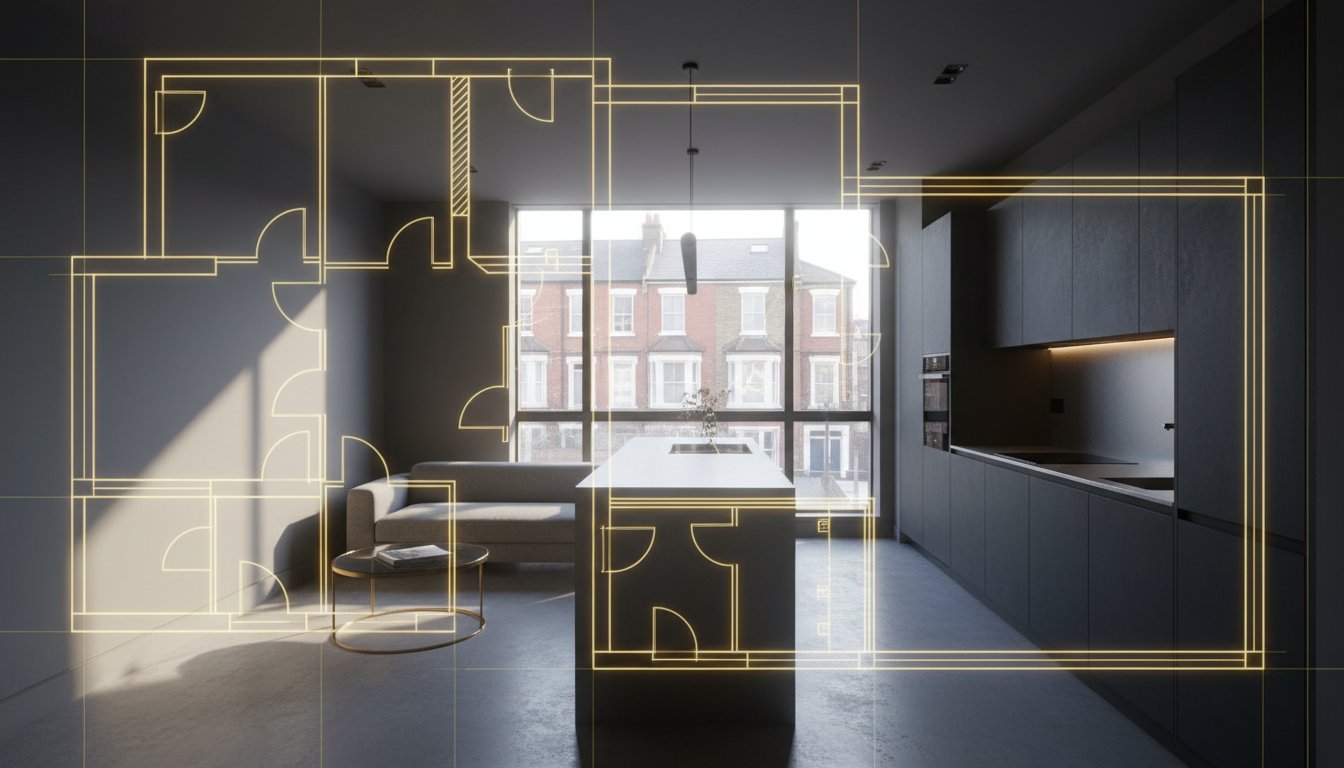
Flat Conversions in London: The 2026 Guide to Unlocking Property Potential
In the 2026 London property market, the difference between a high-yield investment and a costly planning refusal often rests on a single centimetre of floor-to-ceiling height or a miscalculated bin store. You likely recognise that flat conversions represent the most effective way to unlock substantial value from an existing Victorian terrace or underutilised commercial space. It’s a journey that promises significant rewards, yet the path is frequently blocked by the London Plan’s rigid 37-square-metre minimum for one-person dwellings and the increasingly complex sustainability requirements enforced by individual boroughs.
We’ve developed this bespoke architectural roadmap to help you master these complexities, ensuring you secure planning permission while maximising your unit count without compromising on design quality. Our approach transforms the daunting task of regulatory compliance into a visionary design opportunity. You’ll gain a clear understanding of the 2026 planning landscape, learn how to manage technical building regulations with ease, and discover our proven strategy for a stress-free project management experience from initial sketch to final handover.
Key Takeaways
- Discover how to identify high-potential London properties, from Victorian terraces to suburban homes, to maximise your investment yield in 2026.
- Learn why flat conversions almost always require full planning permission for a “Material Change of Use” and how to navigate these regulatory requirements.
- Master the art of spatial optimisation to move beyond basic subdivision and create bespoke, high-end living environments that enhance flow and value.
- Follow a structured, step-by-step roadmap from initial creative concepts to technical drawings and final building control approval.
- Understand how a partnership-driven architectural approach can streamline the complex planning hurdles unique to North London for a stress-free transformation.
Feasibility and Market Potential for Flat Conversions in London
Unlocking the hidden value within a single dwelling requires a blend of creative vision and technical precision. In 2026, flat conversions remain a premier investment strategy across the capital, driven by a persistent 15% shortfall in housing supply relative to the growing demand for urban dwellings. By transforming a substantial property into multiple, self-contained units, you aren’t just creating space; you’re diversifying your portfolio and meeting the urgent need for high-end, modern living. It’s a process of Design, Planning, and Management that turns a static asset into a high-yield opportunity.
The success of these projects hinges on a rigorous feasibility study conducted at the earliest stage. We examine the structural skeleton, the regulatory landscape, and the local market trends to identify potential deal-breakers before they become costly issues. For instance, while Loft conversions in the United Kingdom are a popular way to expand upwards, not every roof pitch or floor joist can support the weight of a new residential unit without significant reinforcement. In North London boroughs like Islington and Camden, the demand for bespoke, self-contained units has risen by 12% over the last 24 months, making the right property selection more critical than ever.
Identifying the Right Property for Subdivision
Victorian terraces are often the ideal candidates for flat conversions due to their vertical orientation and generous ceiling heights. However, large detached suburban homes in areas like Finchley offer expansive footprints that allow for visionary rear extensions. You must check for Article 4 Directions, as these can remove permitted development rights and necessitate full planning permission for even minor changes. We also assess the logistical reality of separate entrances. A successful subdivision requires independent access points that feel private and premium, ensuring each unit retains its sense of identity and prestige.
Calculating ROI and Market Value in 2026
The financial logic of subdivision is compelling. In many London postcodes, the combined value of three leasehold titles can exceed the value of a single freehold dwelling by 25% to 40%. This “London Premium” is most pronounced when the design prioritizes high-quality, light-filled interiors and seamless layouts. Investing in professional architectural plans ensures every square metre is optimized for both comfort and resale appeal. A well-executed conversion doesn’t just add units; it creates a lifestyle that commands a higher price point in a competitive market, providing a steady hand for your investment journey. To further support your financial planning, you can visit BGS Capital for expert insights into capital gains tax for UK investors.
Navigating London Planning Permission and Material Change of Use
Transforming a Victorian terrace into a collection of contemporary apartments is a visionary undertaking that requires a deep understanding of the Town and Country Planning Act 1990. Under this legislation, the transition from a single-family dwelling to multiple units is classified as a “material change of use.” This legal distinction is the reason why flat conversions almost always require full planning permission rather than falling under permitted development rights. While you can often extend a home without a full application, creating a new, independent planning unit triggers a much higher level of scrutiny from the Local Planning Authority (LPA).
The LPA’s primary objective is to balance housing growth with the preservation of the existing community fabric. For example, the City of London planning permission guidelines clarify that works permitted for houses often don’t apply once a property is subdivided. Our role is to act as your steady hand, navigating these technicalities to ensure your project aligns with both local and regional expectations. We focus on Design, Planning, and Management to ensure every hurdle is cleared with confidence.
London-Specific Planning Constraints
The London Plan 2026 dictates a rigorous approach to housing diversity, often placing developers at odds with borough-specific “loss of family home” policies. In North London, councils like Barnet or Camden frequently protect houses with an original floor area of less than 130 square metres to ensure families aren’t priced out. We overcome these hurdles by demonstrating how your proposal adds high-quality, sustainable units to the local stock. We also tackle common objections regarding parking by proposing “car-free” developments, a strategy that aligns with London’s shift toward greener transit and helps secure approval in high-density areas.
Minimum Space Standards and Amenity Requirements
Successful flat conversions must prioritise the well-being of future residents. This means adhering strictly to the Nationally Described Space Standards; a one-bedroom, two-person flat typically requires a minimum of 50 square metres of internal space. We focus on the “outlook” and natural light of every room, ensuring no unit feels subterranean or cramped. Modern planning criteria also demand private or communal outdoor space, such as a bespoke terrace or a shared garden. By integrating these elements early, we ensure a seamless transition from concept to approval. If you’re ready to explore what’s possible, our team can help you unlock the potential of your property through expert architectural guidance.

Architectural Design Strategies for Spatial Optimisation
Successful flat conversions demand a move away from basic subdivision towards the creation of bespoke, high-end living environments. We don’t just split properties; we reimagine them. As a “Visionary Expert” in the London market, our role is to maximise every square metre of a building’s footprint without compromising the natural flow of the home. This involves a meticulous analysis of the existing structure to identify where space is being wasted. By integrating the design principles of luxury residential architects, we ensure that multi-unit developments feel as intentional and refined as a single-family residence.
Our process relies heavily on 3D visualisation. This technology allows stakeholders to see the potential of a converted space long before construction begins. It’s a vital tool for assessing light penetration and sightlines, ensuring that even the most compact units feel airy and expansive. This digital-first approach eliminates guesswork, allowing us to refine the layout until it reaches peak efficiency. It transforms the planning stage into a collaborative journey, providing clarity and confidence to investors and homeowners alike.
Bespoke Layouts: Privacy, Light, and Sound
Designing efficient vertical circulation is the foundation of a successful conversion. We focus on creating common areas that feel welcoming, using durable yet aesthetic materials to set a premium tone from the front door. Acoustic separation is a priority that goes far beyond standard building regulations. We target a performance increase of 5dB to 8dB over the Part E requirements, using resilient bars and high-density insulation to ensure tenant privacy is never compromised. This attention to detail creates a sense of sanctuary that is often missing in standard flat conversions.
- Broken-plan living: We use internal glazing and varying floor levels to create distinct zones for cooking, relaxing, and working without closing off the space.
- Clever storage: Every void, from eaves to under-stair spaces, is converted into integrated storage to keep living areas clutter-free and functional.
- Light wells: We often introduce internal light wells or oversized skylights to bring natural illumination into the deepest parts of the floor plate.
Integrating Modern Building Regulations and Sustainability
Navigating the 2026 regulatory environment requires technical precision. Meeting Part L (Fuel and Power) and Part O (Overheating) standards is a core component of our modern design strategy. We implement high-performance thermal envelopes and solar-control glass to manage internal temperatures effectively. Fire safety, governed by Part B, remains a complex challenge in multi-unit projects. We integrate sophisticated misting systems and fire-rated partitions that protect residents while remaining invisible to the naked eye.
Future-proofing is central to our architectural philosophy. We’ve transitioned away from gas, opting instead for air-source heat pumps and smart energy management systems. These technologies don’t just meet sustainability targets; they provide tangible benefits to residents. Some of our integrated systems reduce annual energy costs by 20% compared to traditional setups. This commitment to innovation ensures the property remains a valuable, high-performing asset for the long term.
The Step-by-Step Flat Conversion Workflow
Dividing a London property into multiple dwellings requires a methodical approach that balances creative vision with rigorous technical standards. It’s a journey that transforms a single residence into a high-yield asset through a series of logical, expert-led steps. This structured roadmap ensures that every detail, from the initial structural assessment to the final legal sign-off, is handled with precision. Successful flat conversions rely on this seamless transition between phases to avoid the common pitfalls of the London property market.
Phase 1: Survey, Design, and Planning
The process begins with a comprehensive site survey. This technical audit maps every structural constraint, drainage point, and ceiling height to provide a factual foundation for the design. We then develop bespoke architectural drawings that maximise the building’s footprint while respecting the local council’s density and parking requirements. For many projects, we secure permitted development certificates for associated extensions, which can provide the vital additional square footage needed to make a conversion viable without the uncertainty of a full planning application.
Phase 2: Technical Design and Construction
Legal compliance runs parallel to the physical construction. You must serve notices under the Party Wall Act 1996 if your works affect shared boundaries with neighbours, a process that typically requires a two-month lead time. Simultaneously, your solicitors will need to draft new leases for the separate units. This dual-track approach ensures that when the final Building Control certificate is issued, the property is both physically sound and legally ready for sale or let.
Managing these moving parts requires a steady hand and deep industry knowledge. By following this disciplined workflow, you eliminate the stress of the unknown and focus on the high-end result. If you’re ready to unlock the hidden value in your property, contact our team of visionary experts to discuss your project requirements.
Realising Your Vision with Advance Architecture
Successful flat conversions require more than just technical drawings; they demand a partner who understands the delicate balance between architectural innovation and strict local authority requirements. We’ve spent over a decade refining a process that removes the friction from property development. Our team specialises in the North London landscape, where Victorian terraces and post-war blocks present unique structural and regulatory challenges. By acting as a steady hand through every phase, we ensure your project moves from a conceptual sketch to a completed dwelling without the typical industry headaches.
Our firm is built on the philosophy of unlocking potential. We don’t just see a building; we see an opportunity to create value through intelligent, bespoke design. Professional project management remains the anchor of our success. We coordinate with structural engineers, Thames Water, and building control officers on your behalf. This comprehensive oversight ensures that your conversion meets the 2024 standards for sustainability and safety while remaining on schedule. We take pride in our ability to deliver high-end results that feel both accessible and sophisticated.
Our Bespoke Design and Planning Partnership
Every property presents a unique set of constraints. We don’t believe in generic solutions; we focus on layouts that respect the original character of the building while introducing modern functionality. Our fixed-fee structure for the design and planning phases provides you with budget certainty from day one. This transparency eliminates the fear of hidden costs during the most critical stages of the project. We’ve successfully secured planning permission for complex flat conversions in challenging boroughs such as Camden and Islington, where our detailed submissions and proactive communication with planning officers have consistently yielded positive results.
- Detailed feasibility studies to assess project viability and density.
- Fixed-fee design packages for total financial transparency.
- Expertise in North London planning policies and conservation area requirements.
Starting Your Conversion Journey
The path to a successful development starts with a free initial architectural consultation. During this 30-minute session, we bridge the gap between your creative vision and the practicalities of UK building regulations. We translate your aspirations into a technical strategy that adheres to Part B Fire Safety and Part M Access requirements. Our team ensures that your vision is both architecturally stunning and commercially viable. We handle the complexities of the planning system so you can focus on the future of your investment. Realise Your Vision with Advance Architecture and take the first step toward a seamless property transformation.
Realise Your Property’s Future Potential
Navigating the London property market in 2026 demands a strategic approach to spatial optimisation and a deep understanding of material change of use. Successful flat conversions aren’t just about dividing space. They’re about creating bespoke living environments that meet rigorous building regulations while maximising your investment’s yield. Since 2009, Advance Architecture has served as a steady hand for property owners across the capital. Our team provides a comprehensive Design, Planning, and Management service, specifically tailored to the nuances of North London planning policy.
We turn complex regulatory hurdles into seamless transitions. This ensures your project moves from a visionary concept to a tangible, high-end asset. Whether you’re looking to repurpose a Victorian terrace or a modern commercial unit, the right architectural partnership makes the journey stress-free. Your property’s hidden potential is ready to be unlocked through expert design and technical precision. We look forward to helping you transform your vision into a functional reality.
Book Your Free Flat Conversion Consultation Today
Frequently Asked Questions
Do I need planning permission for flat conversions in London?
Yes, you’ll almost certainly require full planning permission for flat conversions in London. Local authorities view the division of a single dwelling into multiple self-contained units as a material change of use. This process involves rigorous assessments of local housing density, refuse storage, and parking availability. Our team manages these complexities to ensure your project aligns with the London Plan and specific borough requirements.
What are the minimum floor area standards for a new flat in the UK?
The UK government’s Nationally Described Space Standards mandate a minimum internal floor area of 37 square metres for a one-bedroom, one-person flat with a shower room. For a two-person, one-bedroom home, the requirement rises to 50 square metres. We meticulously design each layout to exceed these benchmarks. This ensures your development provides high-quality living spaces that meet both regulatory demands and modern lifestyle expectations.
How much does it cost to convert a house into flats in 2026?
Budgeting for 2026 requires accounting for inflation, with current industry projections from the BCIS suggesting costs between £1,800 and £3,200 per square metre for high-specification London projects. Total investment for a standard three-bedroom house often ranges from £160,000 to £310,000 depending on structural complexity. We provide detailed feasibility studies to help you navigate these financial commitments while unlocking the maximum capital value of your property.
Can I convert a terraced house into flats under Permitted Development?
No, you can’t convert a terraced house into separate flats using Permitted Development rights. The creation of new dwellings always requires a formal planning application because it’s classified as a change of use. While certain extensions might fall under Permitted Development, the actual subdivision of the internal volume necessitates council approval. We specialise in crafting bespoke design strategies that navigate these rigid planning constraints to achieve successful outcomes.
How long does the flat conversion process typically take from start to finish?
A typical project takes between 10 and 16 months from the initial design phase to final completion. The planning stage usually occupies 8 to 12 weeks, followed by another 6 weeks for detailed technical drawings and building regulations approval. Construction timelines vary, but most London projects require 6 to 9 months on-site. We provide a structured roadmap to keep your transformation on track and stress-free.
What are the building regulation requirements for fire safety in conversions?
Building regulations for fire safety require 60-minute fire resistance between separate dwellings and the installation of FD30S fire doors throughout the property. You must also provide a protected internal escape route and a Grade D1 LD2 mains-linked fire alarm system. These technical measures are essential for protecting residents. We integrate these safety features seamlessly into our visionary designs to ensure compliance without compromising on aesthetic elegance.
Is a Party Wall Agreement necessary for a flat conversion project?
Yes, a Party Wall Agreement is necessary if your flat conversions involve structural work to shared walls or excavations within 3 to 6 metres of a neighbour’s property. This legal requirement under the Party Wall etc. Act 1996 ensures that adjoining owners are protected during construction. We coordinate with specialist surveyors early in the process. This proactive approach prevents delays and maintains positive relationships with your London neighbours.
How many flats can I realistically fit into my London property?
The number of flats depends on your property’s total internal area and the 37 square metre minimum standard for single-occupancy units. Most standard three-storey Victorian terraced houses in London comfortably accommodate two or three high-quality apartments. We conduct a thorough site analysis to determine the optimal configuration for your specific building. Our goal is always unlocking potential by balancing unit density with the creation of spacious, light-filled homes.