
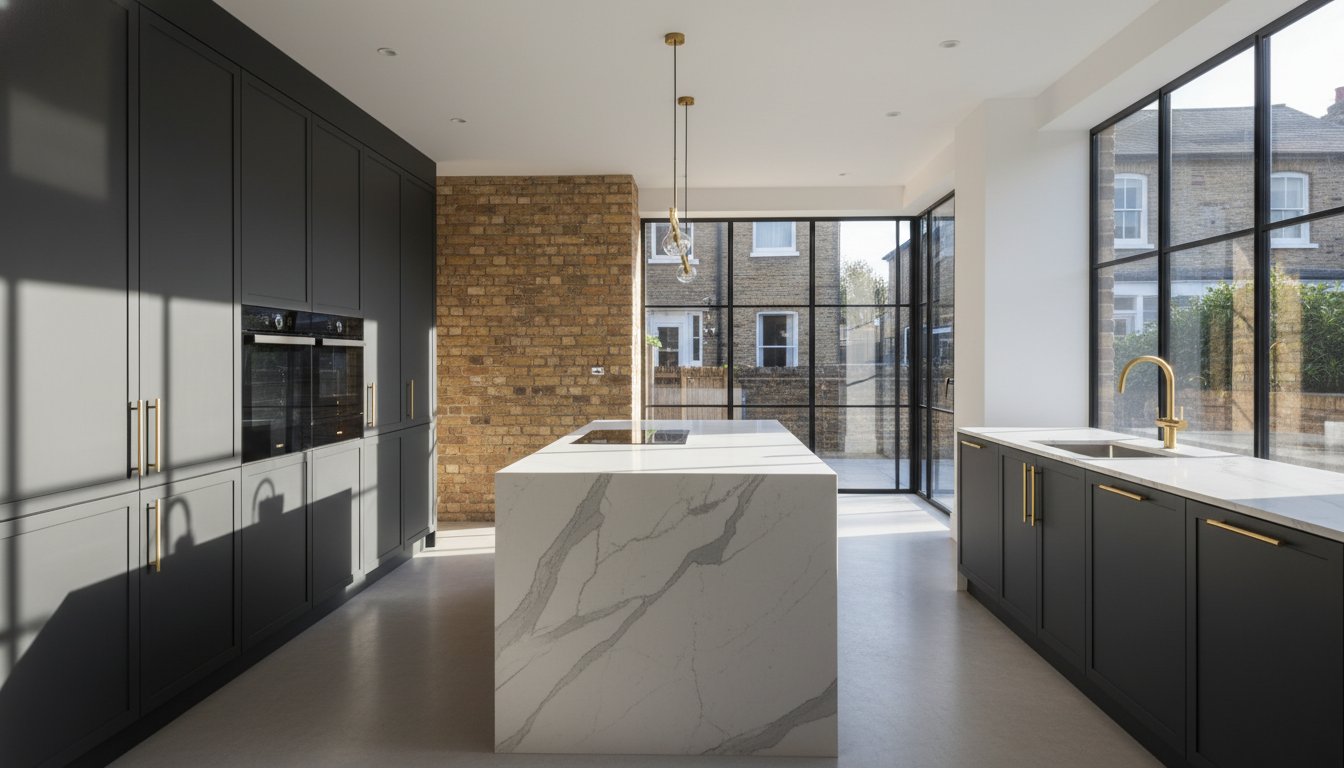
Kitchen Extension London: Unlocking Your Property’s Potential in 2026
What if the only thing standing between your current cramped galley and a light-drenched sanctuary is a single, visionary structural shift? You likely feel the daily friction of a kitchen that lacks flow, especially when 82% of UK buyers now prioritize open-plan living according to recent property market surveys. It’s common to worry that local London councils will block your vision with rigid planning restrictions or that the architectural process will become a source of endless stress.
The transition from a conceptual dream to a physical structure requires a bridge built on technical precision and creative insight. Moving your kitchen extension project from a digital mood board to a construction site is where the expertise of a visionary professional becomes indispensable. In 2026, the architectural process has evolved to be more immersive than ever. We utilise high-fidelity 3D visualisation to let you walk through your new space before the first spade hits the ground. By integrating advanced tools like the ArchKit Mobile Application, we can provide augmented reality previews that bridge the gap between design and reality. This immersive approach eliminates the guesswork, allowing you to experience the play of natural light and the flow of the layout in a virtual environment. It’s a vital step that prevents costly mid-build changes, which industry data suggests can inflate project budgets by more than 15% when handled without proper foresight.
We’re here to show you that your home’s limitations are actually hidden opportunities. In this guide, you’ll discover how to transform your London property with a bespoke kitchen extension that blends sophisticated design with practical optimization. We’ll reveal the architectural secrets to maximizing natural light and provide a clear roadmap through the planning and building regulations process. From contemporary glass box additions to traditional side-returns, you’ll learn exactly how to realize a seamless, high-end transformation that elevates your lifestyle and your home’s value in 2026.
Key Takeaways
- Understand how the 2026 kitchen has evolved into a multi-functional social hub that prioritises wellness and hybrid working requirements.
- Explore the most effective architectural styles for London properties, including how a bespoke kitchen extension can maximise volume in Victorian terraces.
- Learn to navigate the complexities of London planning permission and Conservation Areas with a stress-free strategy for securing approval.
- Discover design strategies that use natural light to enhance well-being while implementing “fabric-first” sustainability to reduce long-term energy costs.
- Realise your vision through advanced 3D visualisations that allow you to experience your transformed space before construction begins.
The Evolution of the London Kitchen Extension in 2026
London homeowners in 2026 view their properties through a lens of strategic optimization. A bespoke kitchen extension is no longer a mere renovation; it’s a fundamental reconfiguration of how families live and work. By integrating advanced architectural design, we transform underutilised footprints into high-value assets. This process begins with understanding the basics of What is a building extension? before applying the sophisticated nuances required for the capital’s unique property landscape. For those considering broader structural changes, our guide to house extensions london provides the essential technical framework for 2026.
We treat every project as an opportunity to unlock hidden value. Viewing architectural fees as a cost is a common misconception; in reality, expert design is the primary driver of return on investment. A well-executed extension does more than add square footage. It improves flow, captures natural light, and future-proofs the home against changing market demands. Our role is to guide you through this transformation with a steady hand and technical precision.
Shifting from Utility to the Heart of the Home
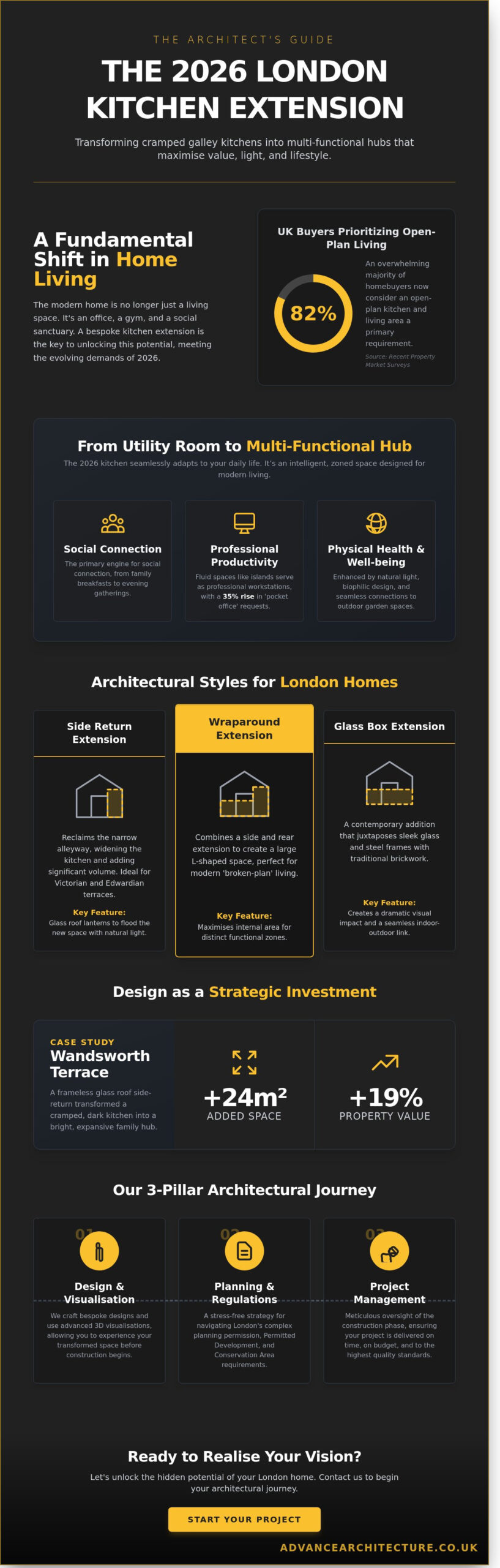
The traditional, isolated galley kitchen has become a relic of the past. In 2026, the demand for open-plan living has matured into a requirement for intelligent “zoning.” Homeowners now prioritise spaces that accommodate hybrid work schedules and wellness routines alongside meal preparation. Data from London planning departments in early 2026 shows a 35% increase in requests for integrated “pocket offices” and biophilic design elements within kitchen layouts. We design these spaces to be fluid. A kitchen island serves as a breakfast bar at 8:00 AM, a professional workstation at 11:00 AM, and a social focal point at 7:00 PM.
The Heart of the Home is an architectural standard where the kitchen functions as the primary engine for social connection, physical health, and professional productivity within the modern residence.
Unlocking Potential in Period Properties
Victorian and Edwardian terrace houses dominate the London landscape, yet their original layouts often stifle modern life. Unlocking the potential of these heritage assets requires a delicate balance. We achieve this by juxtaposing original brickwork with contemporary structural glass and slimline steel frames. This contrast doesn’t just add floor area; it floods deep-plan houses with natural light that was previously blocked by internal walls.
Consider a recent project in Wandsworth completed in February 2026. We replaced a cramped side return with a full-width kitchen extension featuring a frameless glass roof. This design didn’t just add 24 square metres of space; it increased the property’s market valuation by 19% and created a seamless link to the garden. This philosophy treats architectural design as a strategic investment that pays dividends in both lifestyle quality and capital growth. We focus on three core pillars: Design, Planning, and Management.
Architectural Styles: Choosing the Right Extension for Your London Home
London’s architectural heritage provides a unique canvas for homeowners. Choosing the correct style ensures your kitchen extension feels like a natural evolution of the property rather than a detached afterthought. Every Victorian terrace or Edwardian semi-detached house has its own DNA. Our role is to identify the structural opportunities that allow for a seamless transformation, unlocking potential that has remained hidden for decades.
The Side Return: Maximising Narrow Urban Plots
The side return remains the quintessential solution for London’s narrow plots. It reclaims the underutilised alleyway at the side of the property to widen the kitchen. This transformation often hinges on navigating the Party Wall Act 1996, a critical legal step for 92% of terrace projects in the city. To prevent the new space from feeling like a dark corridor, we integrate high-performance roof lanterns. These glass features flood the core of the home with natural light, ensuring the new footprint feels airy and expansive. It’s a surgical approach to design that adds significant volume without sacrificing garden space.
Wraparound and L-Shaped Designs
Wraparound extensions combine side and rear expansions to create a comprehensive L-shaped footprint. This layout is perfectly suited for the “broken-plan” living trends of 2026. Unlike standard open-plan designs, broken-plan uses subtle level changes or internal glazing to zone the space for cooking, dining, and relaxation. This configuration offers a 35% increase in usable floor area compared to simple rear additions. This process requires expert oversight, particularly when removing original load-bearing walls to create a unified space. We align our technical delivery with The RIBA Plan of Work to ensure every structural milestone is met with precision and safety.
Contemporary Glass and Pitched Roof Profiles
In 2026, we see a significant surge in “Crittall-style” steel-framed doors and frameless glazing. These elements provide a sophisticated, industrial aesthetic that balances period charm with modernism. Asymmetry is also becoming a signature for bespoke London homes. We often pair flat roofs with vaulted sections to create a sense of vertical space. Comparing these profiles is essential; while a flat roof offers a discreet exterior, a vaulted ceiling provides an interior volume that feels far larger than its actual dimensions. If your priority is a direct connection to the outdoors, consult our guide on a rear extension for deep dives into garden-facing designs. Our team provides the steady hand needed to realise these ambitious designs, ensuring your bespoke kitchen transformation remains a stress-free experience from the first sketch to the final brick.
Navigating London Planning Permission and Permitted Development
London’s planning environment is a dense tapestry of regulations that requires a sophisticated approach. It isn’t just about what you want to build; it’s about how that build respects the existing streetscape and local heritage. Many boroughs now enforce Article 4 directions, which strip away standard rights to ensure architectural harmony. This makes the capital a unique hurdle compared to the rest of the UK, where rules are often more relaxed.
The fear of a planning rejection is the primary hurdle for many homeowners. We view a potential refusal not as a dead end, but as a technical challenge to be solved. In 2024, data from several London councils showed that roughly 18% of residential applications faced initial refusal. Our expert team uses detailed house extension plans london to mitigate these risks from the outset. These technical drawings provide the clarity planning officers need to see that your kitchen extension adds value to the neighbourhood. We provide a seamless journey through Design, Planning, and Management to ensure your vision remains intact.
Understanding Permitted Development Rights in 2026
Permitted Development (PD) rights act as a reliable safety net for London homeowners, providing a predictable path for many projects. In 2026, these rules allow for rear extensions of up to 4 metres for terraced homes and 8 metres for detached properties under the larger home extension scheme, provided you follow the prior notification process. However, we always advise obtaining a Certificate of Lawfulness. This document proves your build was legal at the time of construction, which is vital for future property sales. You should review the official government guidance on permitted development to understand the specific height and volume limits that apply to your postcode.
Conservation Areas and Listed Building Constraints
Properties in North London zones like Barnet, Islington, or Camden require a more nuanced touch. Councils here prioritize the preservation of character, often requiring bespoke solutions that respect the original masonry. Our strategic design approach involves a deep dive into local history to meet these aesthetic standards. We might specify reclaimed London stock brick to match a Victorian facade or suggest a frameless glass link to create a “light touch” between the old and the new. This deliberate contemporary contrast often wins over planning officers because it clearly distinguishes the original heritage from your modern kitchen extension, unlocking the property’s potential without erasing its history.
Design Strategies for Light, Space, and Sustainability
Designing a kitchen extension in 2026 requires a sophisticated balance between aesthetic ambition and environmental responsibility. We advocate for a “fabric-first” philosophy. This strategy prioritizes the building’s envelope; high-performance insulation and airtightness; to minimize energy demand before any mechanical systems are even considered. It’s a proactive way to insulate your household against the energy price fluctuations predicted for the late 2020s.
Successful layouts also rely on the evolution of “The Golden Triangle,” the ergonomic relationship between the refrigerator, cooktop, and sink. In contemporary London homes, we expand this into “activity zones” that accommodate cooking, socializing, and remote work. Before you commit to a specific layout, review our house extension cost guide to understand how these high-spec sustainable choices align with your financial planning.
Maximising Natural Light in Urban Settings
London’s dense architectural fabric often presents light-starved environments. We utilize sun-path analysis software during the design phase to track how solar gain hits your specific plot across all four seasons. Strategic placement of clerestory windows or recessed skylights can draw light deep into the floor plan while maintaining essential privacy from neighbors. While bi-fold doors offer a seamless connection to the garden, we carefully manage the glazing-to-wall ratio. We specify argon-filled cavities and low-emissivity coatings to ensure your kitchen extension doesn’t suffer from the “greenhouse effect” during summer months.
Sustainable Materials and 2026 Building Regulations
Compliance with the latest Part L Building Regulations is a non-negotiable aspect of modern construction. These 2026 standards require significantly lower U-values and enhanced thermal performance compared to previous decades. We guide you through the selection of carbon-sequestering materials, such as timber frames or hempcrete, alongside induction-ready electrical infrastructure that moves away from gas dependency.
Passive Solar Design is a strategic architectural approach that uses the building’s orientation, materials, and glazing to collect, store, and distribute solar energy as heat in the winter while rejecting it in the summer. By integrating high-thermal-mass materials like stone or polished concrete, your extension can naturally regulate its own temperature, reducing the need for active heating. This level of technical foresight ensures your home remains comfortable, compliant, and cost-effective for years to come.
Realising Your Vision: The Architectural Journey
The transition from a conceptual dream to a physical structure requires a bridge built on technical precision and creative insight. Moving your kitchen extension project from a digital mood board to a construction site is where the expertise of a visionary professional becomes indispensable. In 2026, the architectural process has evolved to be more immersive than ever. We utilise high-fidelity 3D visualisation to let you walk through your new space before the first spade hits the ground. This immersive approach eliminates the guesswork, allowing you to experience the play of natural light and the flow of the layout in a virtual environment. It’s a vital step that prevents costly mid-build changes, which industry data suggests can inflate project budgets by more than 15% when handled without proper foresight.
Selecting the right partner is the most critical decision you’ll make in this journey. You need a house extension architect who possesses a deep-rooted understanding of the London landscape. From the narrow access points of Victorian terraces to the stringent aesthetic requirements of conservation areas in boroughs like Kensington or Richmond, local knowledge is the key to unlocking a property’s true potential. This expertise ensures a seamless transformation that respects the heritage of your home while introducing cutting-edge contemporary functionality.
The Value of Bespoke Architectural Plans
Standardised, “off-the-shelf” designs consistently fail when applied to the complex geometries of London properties. Every millimetre counts in an urban kitchen extension. Bespoke architectural plans are essential because they address the specific structural nuances of your home, such as existing foundation depths and party wall complexities. These detailed technical drawings serve three primary purposes:
- Accurate Tendering: They provide contractors with a definitive roadmap, ensuring that quotes are based on facts rather than estimates.
- Cost Control: Precise specifications mean fewer “unforeseen” expenses during the construction phase.
- Structural Integrity: Professional drawings ensure that modern features, such as expansive glass bifold doors or cantilevered roofs, are engineered to last a lifetime.
From Concept to Construction Management
The architect’s role doesn’t end once the planning department grants approval. We act as a steady hand throughout the construction phase, providing a layer of protection between the client and the complexities of the build. This involves certifying progress, conducting site inspections, and ensuring the contractor adheres strictly to the approved design. We manage the delicate dialogue between you, the local council, and the building team, making the entire experience stress-free. Our goal is to transform the daunting task of renovation into an organized, logical progression toward excellence. If you’re ready to start your transformation, contact us today to realise your vision with a free initial consultation.
Realise Your Vision for a Modern London Home
Unlocking the hidden value of your property requires a sophisticated blend of creative innovation and technical precision. As we look toward 2026, the ideal kitchen extension must balance sustainable materials with the unique heritage of London’s period architecture. Navigating the complexities of planning permission and permitted development doesn’t have to be a burden when you have a steady hand to guide the process. Since 2009, Advance Architecture has provided North London homeowners with a comprehensive service that bridges the gap between visionary design and project completion. We focus on bespoke solutions that maximize natural light and floor area; this ensures your home remains functional for decades to come. Our team manages every detail from the initial sketch to the final structural inspection to deliver a stress-free transformation tailored to your specific lifestyle. It’s time to move beyond the abstract and start the concrete journey toward your dream home. You can trust our 15 years of local expertise to turn your architectural aspirations into a reality that enhances both your daily life and your property’s long-term market value.
Book your free 2026 kitchen extension consultation with Advance Architecture
Frequently Asked Questions
Do I need planning permission for a kitchen extension in London in 2026?
You don’t always need full planning permission because many projects fall under Permitted Development rights. For a single storey rear extension, you can often extend up to 8 metres for a detached house or 6 metres for terraced properties under the Prior Approval scheme. We manage the entire lawful development certificate process to ensure your project meets all 2026 criteria. This approach provides a structured, stress-free path to unlocking your home’s potential.
How much value does a kitchen extension add to a London home?
A well-executed kitchen extension adds between 10% and 15% to the total value of a London property according to data from Nationwide Building Society. In high demand boroughs like Islington or Camden, this uplift often exceeds the initial construction costs. Our bespoke designs focus on maximizing this return by creating seamless, functional spaces that appeal to the premium market. We combine architectural excellence with strategic property optimization to ensure your investment is sound.
What is the average build time for a kitchen extension in North London?
The average build time for a kitchen extension in North London is 12 to 16 weeks once the groundworks are complete. This timeline includes the structural phase, internal fit-out, and final decorative touches. We coordinate every stage from design to management to ensure a methodical progression. By maintaining a clear schedule, we transform your living space without the common delays found in less organized projects.
Can I extend my kitchen under Permitted Development if I live in a Conservation Area?
You cannot use standard Permitted Development rights for a kitchen extension if your home is in one of London’s 600 conservation areas. These locations require full planning permission to ensure the design respects the local heritage and architectural character. Our team specializes in navigating these regulatory hurdles by proposing sensitive, high-end solutions. We secure the necessary approvals while maintaining the creative vision for your property transformation.
Should I choose a flat roof or a pitched roof for my kitchen extension?
Your choice depends on the desired internal ceiling height and the architectural style of your existing home. Flat roofs offer a contemporary, minimalist aesthetic and often allow for large roof lanterns that flood the space with light. Pitched roofs provide a traditional feel and can create dramatic vaulted ceilings internally. We evaluate your site’s specific constraints to recommend a bespoke solution that balances thermal efficiency with visionary design.
How do I find a reliable architect for a kitchen extension near me?
You should look for an architect registered with the Architects Registration Board (ARB) who has a proven portfolio in your specific London borough. Check for local expertise in navigating the 2026 planning landscape and look for firms offering a comprehensive design, planning, and management service. We pride ourselves on being a steady hand for homeowners, providing a professional and reassuring partnership throughout the entire journey of property transformation.
What are the 2026 building regulations for thermal efficiency in extensions?
The 2026 building regulations require extensions to meet strict U-values for insulation, specifically targeting a 30% reduction in carbon emissions compared to previous standards. This involves high-performance glazing, advanced floor insulation, and airtight construction methods. Our technical experts integrate these requirements into the initial design phase. We ensure your new space is not only beautiful but also achieves peak energy performance and structural integrity through precise engineering.
Is a side return or a rear extension better for a Victorian terrace?
A side return extension is often the best way to utilize the narrow alleyway space typical of Victorian terraces without sacrificing the garden. Combining this with a rear extension creates a wide, open-plan kitchen extension that completely transforms the ground floor layout. This L-shaped configuration maximizes every square inch of your property. It provides the perfect framework for a bespoke, high-end kitchen that feels both spacious and integrated with your outdoor space.