
London House Extension Cost Guide: 2026 Pricing and Planning
What if the true value of your London home isn’t found in its current market price, but in the square footage you haven’t built yet? In a city where property prices rose by 3.5% in the last twelve months, many homeowners feel trapped between a desire for more space and the fear of a spiralling house extension cost. You’re likely aware that London’s construction landscape is uniquely challenging; it’s marked by 2026’s projected 6% increase in material prices and the dense constraints of Victorian and Georgian terrace plots.
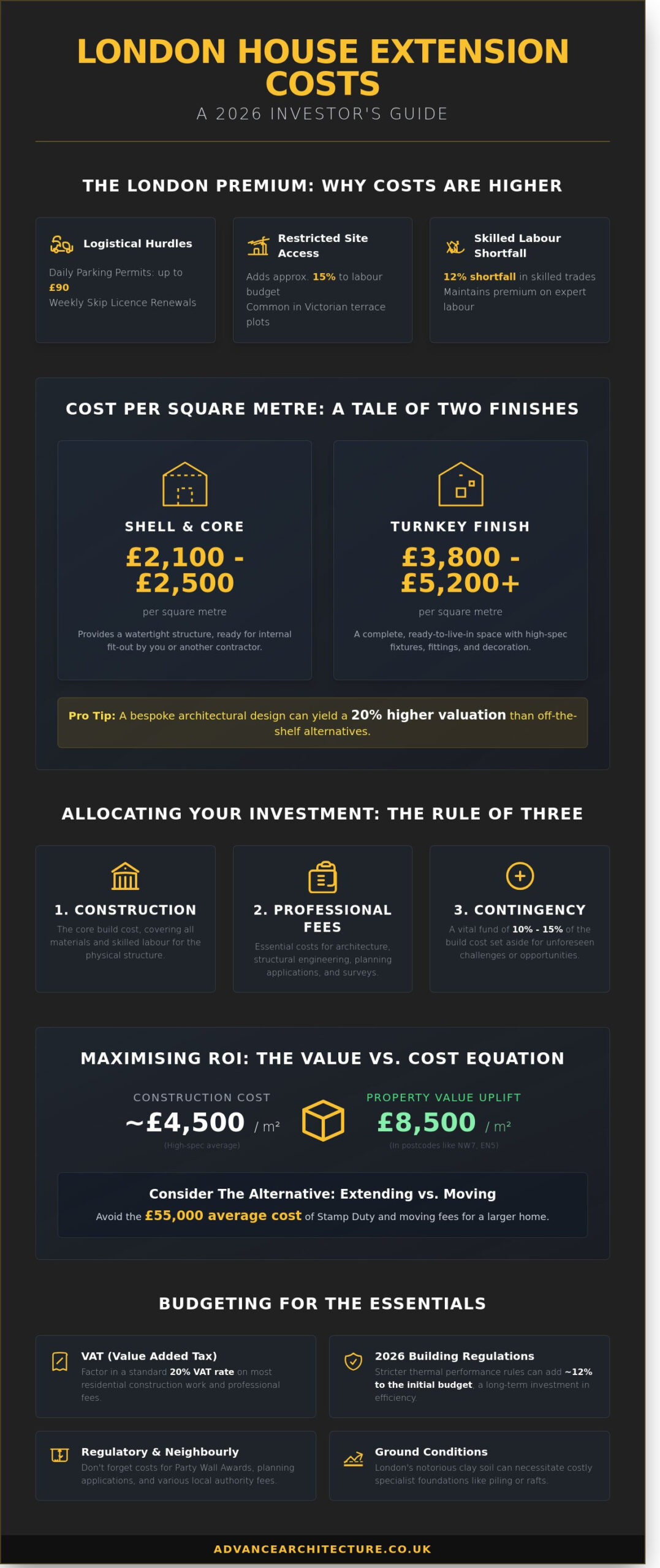
London’s built environment presents unique logistical hurdles that don’t exist in regional projects. Contractors must account for daily parking permits costing up to £90 in central boroughs and skip licences that require weekly renewal. Restricted site access in Victorian terraces often necessitates specialist equipment or manual handling, adding 15% to the standard labour budget. Professional firms in London also carry higher insurance premiums to cover the complexities of working in high-density areas. This localised demand in North London hubs like Barnet and parts of Hertfordshire continues to drive premium rates for Tier-1 contractors like Donema Construction Vision Ltd, who specialise in high-end Extensions and guarantee structural integrity and refined finishes.
London’s built environment presents unique logistical hurdles that don’t exist in regional projects. Contractors must account for daily parking permits costing up to £90 in central boroughs and skip licences that require weekly renewal. Restricted site access in Victorian terraces often necessitates specialist equipment or manual handling, adding 15% to the standard labour budget. Professional firms in London also carry higher insurance premiums to cover the complexities of working in high-density areas. This localised demand in North London hubs like Barnet and parts of Hertfordshire continues to drive premium rates for Tier-1 contractors, such as Donema Construction Vision Ltd, who guarantee structural integrity and refined finishes.
We understand that managing unpredictable builder quotes and complex planning restrictions feels like a full-time job. Our goal is to replace that uncertainty with a clear, line-item budget framework that empowers you to invest with confidence. You’ll learn exactly how to allocate funds across professional fees, structural works, and high-end finishes while unlocking the maximum potential of your site. This guide examines the specific ROI of side-returns and loft conversions, showing you how a bespoke architectural strategy turns a daunting renovation into a seamless, value-driven transformation.
Key Takeaways
- Navigate the 2026 London market with confidence by understanding the delicate balance between material price stabilisation and current skilled labour shortages.
- Master the ‘Rule of Three’ to strategically allocate your investment across design, planning, and management for a structured and stress-free project delivery.
- Analyse how structural complexity and property type dictate the house extension cost, allowing you to choose the most efficient design for your specific home.
- Identify and budget for essential regulatory requirements, from Party Wall Act awards to local authority fees, to ensure a seamless and compliant transformation.
- Uncover how bespoke architectural design can unlock the hidden potential of your property, eliminating ‘dead space’ while significantly enhancing your long-term ROI.
Understanding the House Extension Cost Landscape in London for 2026
Extending a home in London requires a strategic mindset. By January 2026, the average house extension cost in the capital has settled into a new rhythm. While material prices have stabilised, with steel and timber costs fluctuating by less than 3% over the past twelve months, a 12% shortfall in skilled bricklayers and carpenters maintains a premium on expert labour. Embarking on a home improvement project of this scale isn’t just about adding square footage; it’s about unlocking the latent potential of your property through meticulous planning and visionary design.
Projecting the final investment requires a clear distinction between ‘shell only’ and ‘turnkey’ delivery. A shell-only build, which provides a watertight structure ready for internal fit-out, typically starts at £2,100 per square metre. In contrast, a turnkey solution offers a seamless transition from concept to completion, including bespoke joinery, high-spec lighting, and professional decoration. This comprehensive approach usually demands an investment of £3,800 to £5,200 per square metre. Choosing a bespoke architectural design over a generic modular unit ensures the new structure integrates perfectly with your existing home, often yielding a 20% higher valuation than off-the-shelf alternatives.
Why London prices differ from the UK average
London’s built environment presents unique logistical hurdles that don’t exist in regional projects. Contractors must account for daily parking permits costing up to £90 in central boroughs and skip licences that require weekly renewal. Restricted site access in Victorian terraces often necessitates specialist equipment or manual handling, adding 15% to the standard labour budget. Professional firms in London also carry higher insurance premiums to cover the complexities of working in high-density areas. This localised demand in North London hubs like Barnet and parts of Hertfordshire continues to drive premium rates for Tier-1 contractors who guarantee structural integrity and refined finishes.
The Value per Square Metre vs Cost per Square Metre equation
Calculating the house extension cost is only half of the financial picture. Smart homeowners focus on the “sweet spot” where the cost of construction is significantly lower than the resulting property value increase. In postcodes such as NW7 or EN5, the capital uplift can reach £8,500 per square metre. When you compare this to the £55,000 average cost of Stamp Duty and moving fees for a larger home, extending becomes the most viable path for growth. We help you identify the exact floor area that maximises your Return on Investment while transforming your daily lifestyle into something truly extraordinary.
A Detailed Breakdown of Your Extension Investment
Navigating a property transformation in the capital requires a clear-eyed understanding of how capital is allocated. A successful project relies on the “Rule of Three,” which balances Design, Planning, and Management to ensure the final result matches your initial vision. When calculating your house extension cost, you must categorise your investment into three distinct pillars: construction, professional fees, and a robust contingency fund of at least 10% to 15%.
By 2026, the landscape of residential construction has shifted significantly due to stricter building regulations. These updates mandate a substantial uplift in thermal performance, requiring advanced insulation materials and high-spec glazing to meet carbon reduction targets. While these requirements might increase your initial 2026 budget by approximately 12% compared to previous years, they represent a long-term investment in your home’s efficiency and resale value. It’s also vital to remember that most residential work attracts a 20% VAT rate, a figure that must be factored into your earliest feasibility studies to avoid mid-project surprises.
Construction costs: Shell and core vs full fit-out
Your construction budget is largely dictated by the level of finish you desire. For a standard 2026 London extension, shell and core costs typically start at £2,500 per square metre. If you’re aiming for a high-end fit-out featuring bespoke joinery, underfloor heating, and structural glass, these figures often rise to £4,500 per square metre or more. London’s unique geography adds another layer of complexity. Dealing with the city’s notorious clay soil often necessitates deeper foundations or piling, while existing Victorian drainage systems frequently require sophisticated rerouting. These hidden groundworks can add £5,000 to £15,000 to a project before the first brick is even laid above ground.
Professional fees: Architects, engineers, and surveyors
Securing the right expertise is the most effective way to protect your investment. Expertly drafted house extension plans London homeowners can rely on provide the technical blueprint for everything that follows. Beyond the architect, you’ll need to budget for a structural engineer and, in many terrace properties, a Party Wall surveyor to manage legal requirements with neighbours. If your project falls under permitted development rights, professional guidance ensures you remain strictly within the technical limitations to avoid costly enforcement issues later. Working with a skilled house extension architect is essential for navigating London’s planning maze and securing the best possible outcome for your project. Professional project management acts as a final safeguard, preventing expensive contractor errors and ensuring the house extension cost doesn’t spiral due to poor on-site coordination. To see how we can streamline this process for you, explore our bespoke architectural services today.
Comparing Costs by Extension Type: Rear, Side, and Wrap-around
Structural complexity dictates the financial trajectory of your project more than any other factor. In 2026, London homeowners see a clear price distinction between simple additions and complex structural reconfigurations. While a standard rear extension follows a predictable path, wrap-around designs introduce intricate corner loadings that require significant steel reinforcement. This engineering necessity drives up the initial investment but yields a superior cost-to-space ratio by unlocking the full potential of neglected garden corridors. Victorian properties often require more sensitive structural interventions compared to modern homes, which impacts the overall house extension cost through increased labour hours and specialist masonry work.
Combining your extension with internal remodelling is a strategic financial move. By refreshing the existing ground floor layout while the builders are already on-site, you reduce the “per square metre” cost of the total renovation. This holistic approach ensures the new and old spaces feel seamless, preventing the “bolt-on” aesthetic that can devalue a property. It’s about creating a unified vision that justifies the premium of London construction.
Rear extension costs: The London favourite
The rear extension remains the most popular choice for Londoners looking to expand their living zone. For a 3-metre deep extension, 2026 budget allocations typically range from £80,000 to £115,000. Extending to 6 metres often pushes costs beyond £160,000, as these projects frequently fall outside Permitted Development and require more rigorous Planning Permission for extensions. Glazing choices represent a significant portion of this spend; ultra-slim bi-fold doors and oversized roof lanterns can easily account for 20% of the total budget. If you’re integrating a kitchen, remember that a kitchen extension in London with a high-specification fit-out in 2026 often matches the shell-and-core build cost, effectively doubling the investment for that specific area.
Side return and wrap-around extensions: Unlocking narrow plots
Side return extensions are the definitive solution for North London’s Victorian terraces, where narrow “alleyway” spaces offer untapped potential. These projects are technically demanding because they involve “knocking through” original load-bearing external walls, necessitating complex steel “goalpost” frames to maintain structural integrity. A wrap-around extension, which combines a side return and a rear addition, carries a higher price premium due to the removal of the entire rear corner of the building. Despite the higher house extension cost, often exceeding £200,000 for premium finishes, wrap-arounds offer the most dramatic lifestyle transformation. They turn cramped, dark floorplans into expansive, light-filled hubs that significantly increase a property’s market appeal in competitive London boroughs.
- Rear Extension (3m): £80,000 – £115,000
- Side Return: £95,000 – £140,000
- Wrap-around: £180,000 – £250,000+
Navigating Hidden Costs and Regulatory Requirements in London
The total house extension cost is rarely limited to the physical build. In the dense architectural fabric of London, the “invisible” budget often dictates the project’s pace and success. We view these regulatory requirements not as hurdles, but as essential steps in securing your property’s future value and structural integrity. Managing these details with precision ensures a seamless transition from concept to completion.
Party Wall Agreements and local authority fees
The Party Wall Act 1996 is a central pillar of London renovations. If your extension involves work on a shared wall or digging foundations within three to six metres of a neighbour, you must serve formal notice. While a simple consent costs nothing, a formal dissent requires the appointment of surveyors. Budget between £1,200 and £2,500 per neighbour for surveyor awards if they require independent representation. It’s a necessary investment to prevent legal disputes that could stall your vision.
Local authority fees also require careful planning. In boroughs like Barnet or Islington, a standard Householder Planning Application currently costs £258, though Lawful Development Certificates for permitted development are roughly half that price. You should also investigate the Community Infrastructure Levy (CIL). Many London extensions exceeding 100 square metres trigger this tax, which can range from £50 to £350 per square metre depending on your specific borough’s charging schedule. These figures are vital for maintaining an accurate house extension cost forecast.
Site constraints: Access, skips, and parking permits
London’s logistical complexity often introduces what we call the “Basement Effect.” Even for ground-floor extensions, restricted access might require hand-digging foundations or using specialised micro-machinery. This can increase groundwork labour costs by 15% to 20% compared to open-access sites. Your budget must also reflect the daily reality of working on busy streets. Consider these typical London overheads:
- Skip Permits: Expect to pay £65 to £115 per week depending on borough regulations.
- Suspended Parking Bays: Essential for delivery lorries, these cost between £45 and £95 per day in zones like Camden or Westminster.
- Temporary Works: Comprehensive scaffolding with weather protection for a standard Victorian terrace typically starts at £4,800.
Choosing between Council building control and private approved inspectors is another strategic decision. Private inspectors often provide a more bespoke, responsive service, ensuring that your project adheres to the latest 2025 Building Regulations without the scheduling delays often associated with local authority departments. This professional oversight acts as a safeguard, protecting your investment from costly remedial works later.
Professional guidance is the most effective way to mitigate these hidden expenses. Book a feasibility study with Advance Architecture to receive a comprehensive breakdown of the regulatory costs specific to your London borough.
Maximising ROI: How Strategic Design Optimises Your Budget
Strategic design isn’t a luxury; it’s the primary tool for protecting your investment. When calculating your total house extension cost, the most expensive mistake is building square footage that adds no functional value. We focus on unlocking potential by eliminating “dead space”, those awkward corridors or dark corners that often plague poorly planned additions. A well-conceived house extension in London should feel like a natural evolution of the property. Every centimetre must serve a purpose, whether it’s integrated storage, a hidden utility zone, or a seamless transition to the garden.
Finalising your budget requires a blend of ambition and realism. We recommend a non-negotiable contingency of 10% to 15% to handle the “unforeseens” that often arise in urban builds. This isn’t for design changes; it’s a safety net for structural anomalies or Victorian-era drainage issues discovered during excavation. This buffer ensures your journey remains stress-free and your project reaches completion without financial strain.
The Advance Architecture approach to cost-effective excellence
We utilise advanced 3D visualisation to let you walk through your project before a single brick is laid. This process identifies potential layout issues early, preventing the costly mid-construction changes that typically inflate a house extension cost. Our bespoke solutions often favour clever light use and high ceilings over expensive extra square footage. By expertly navigating permitted development rights, we also reduce planning risk and the associated costs of lengthy appeals.
Planning for the future: Energy efficiency and longevity
In 2026, energy efficiency is a core component of property value rather than an optional extra. Integrating air-source heat pumps or solar arrays might increase initial outlays by 8% to 12%, but the long-term operational savings are substantial. We prioritise high-performance glazing and superior insulation to future-proof your home against rising energy prices. Consider these benefits for your 2026 build:
- Reduced Maintenance: High-quality materials like zinc or treated timber prevent the “buy cheap, buy twice” cycle.
- Increased Resale Value: Modern buyers prioritise high EPC ratings and sustainable technology.
- Enhanced Comfort: Consistent thermal performance makes your new space usable 365 days a year.
Realising your vision requires a steady, expert hand at every stage. By combining visionary design with technical precision, we ensure your extension is not just a building project, but a transformative investment that enhances your lifestyle and your wealth. Let us help you unlock the hidden potential of your home with a solution that is as sturdy as it is beautiful.
Unlock the Potential of Your London Home
Navigating the 2026 property market requires a strategic approach to design and a clear-eyed understanding of your house extension cost. By balancing high-quality materials with smart architectural choices, you can achieve a return on investment that often exceeds the 20% average typically seen in North London. Since 2009, our team has mastered the nuances of local regulations, particularly within the specific framework of Barnet council policies. We transform the complexities of planning permission and building regulations into a seamless journey toward a bespoke living space.
Success in property transformation isn’t just about the build; it’s about meticulous design, planning, and management. Whether you’re considering a rear extension starting from £2,500 per square metre or a complex wrap-around, the right expertise ensures your budget works harder for you. Our proven track record across London provides the steady hand you need to avoid hidden pitfalls and maximise every square metre of your property.
Book your free initial consultation with our North London experts and let’s start shaping your future home today. Your ideal space is closer than you think.
Frequently Asked Questions
How much does a 30m2 house extension cost in London in 2026?
A 30m2 house extension in London typically costs between £75,000 and £105,000 in 2026. This reflects a base rate of £2,500 to £3,500 per square metre for a standard build. High-end finishes or complex groundworks often push the total towards £120,000. These figures account for the 4% annual inflation seen in the construction sector over the last three years.
Is it cheaper to build a side return or a rear extension?
A rear extension is generally more cost-effective per square metre than a side return. While a rear extension might cost £2,500 per square metre, a side return often reaches £3,200 due to structural complexities. Approximately 85% of side returns require extensive steelwork to support the original flank wall, which increases the technical demands of the project.
What professional fees should I expect to pay for an architect in London?
You should budget between 8% and 12% of your total construction budget for comprehensive architectural services. For a project with a £100,000 house extension cost, this equates to a fee of £8,000 to £12,000. This investment covers the entire journey, including bespoke design, planning applications, and the technical building regulations drawings required for a seamless build. To understand exactly what to look for when selecting the right professional, our guide to hiring a house extension architect in London provides a comprehensive overview of the process.
Do I need to pay VAT on my house extension?
You must pay the standard 20% VAT rate on most residential extension projects in the UK. This applies to both the labour and the materials provided by VAT-registered contractors. If your property has been empty for over two years, you may qualify for a reduced rate of 5% under HMRC Notice 708. We always recommend verifying your eligibility with a tax professional before starting.
How much does a Party Wall Agreement cost for a terrace house?
A Party Wall Agreement for a terrace house in London typically costs between £1,200 and £2,500 per neighbour. If your neighbours dissent and appoint their own independent surveyors, these costs can easily double. In 2025, 60% of terrace projects required at least two separate awards to satisfy legal requirements for structural work near property boundaries.
How much value does a kitchen extension add to a London home?
A well-designed kitchen extension in London adds between 10% and 15% to the total value of a London property. In boroughs like Islington or Hackney, this can represent a capital gain of £80,000 to £120,000. This uplift frequently exceeds the initial house extension cost, making it a strategic way to unlock the hidden potential of your home while improving your lifestyle.
What are the hidden costs of extending a house in North London?
Hidden costs in North London often include parking permits for skips, which can cost £60 per day in boroughs like Camden. You should also set aside a 10% contingency fund for Victorian sub-floor issues. Around 40% of North London renovations encounter historic drainage complications that require an additional £3,000 to £5,000 to rectify during the groundworks phase.
Can I get a fixed-fee quote for architectural drawings?
You can certainly obtain a fixed-fee quote for the design and planning stages of your project. We provide transparent, fixed pricing for planning sets and building regulations packages to ensure your budget remains secure from the outset. This approach eliminates financial ambiguity. It allows you to focus on the creative transformation of your space without worrying about unexpected professional costs.