

Garage Conversion London: The Ultimate 2026 Homeowner’s Guide
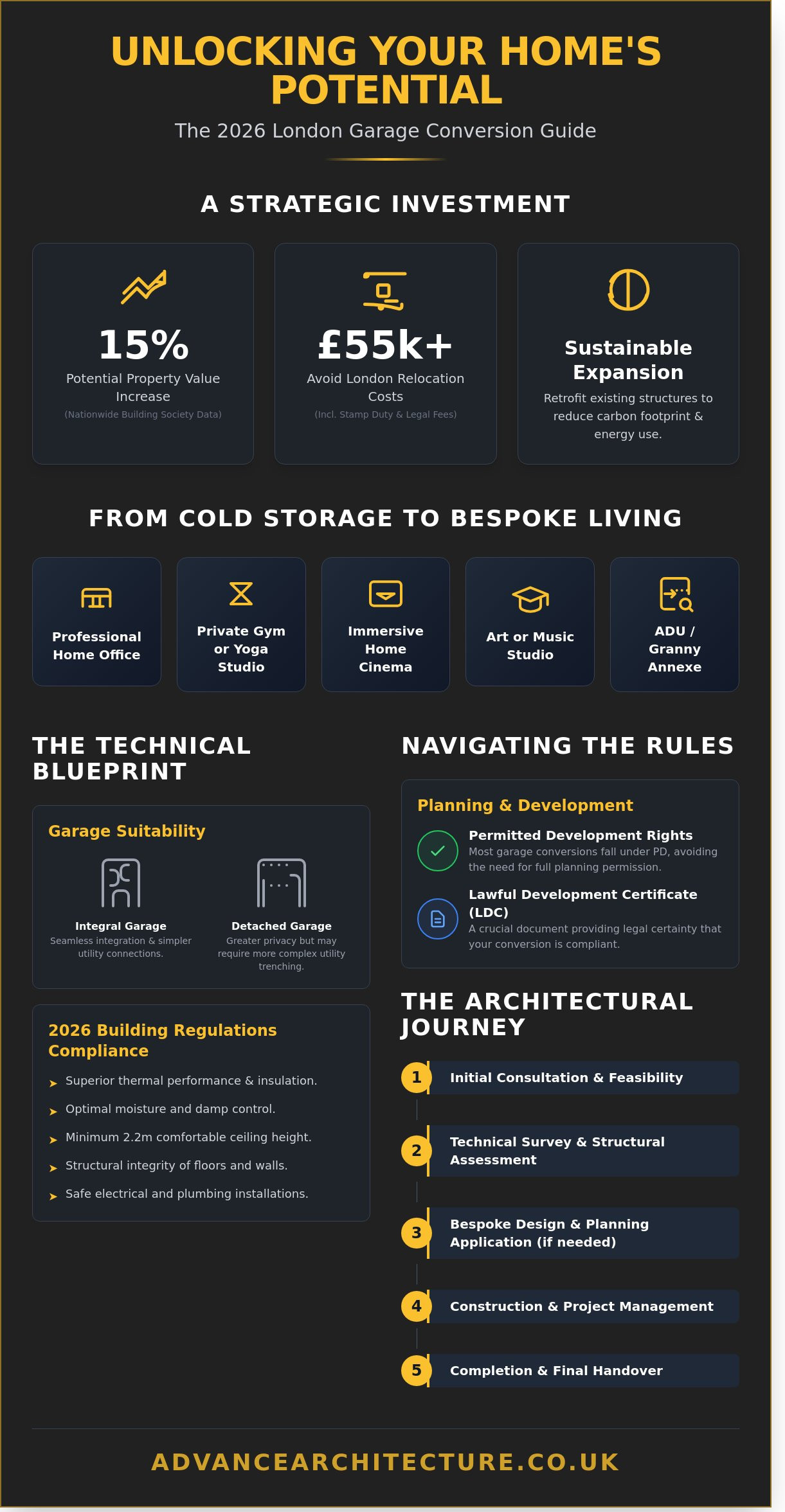
What if the solution to your London home’s lack of space isn’t a stressful move, but the underutilised concrete shell currently housing your garden tools and clutter? You likely feel the squeeze of a growing family or the need for a quiet professional studio, yet the prospect of navigating the capital’s strict planning constraints feels overwhelming. It’s frustrating to watch potential square footage go to waste while you struggle with cramped living quarters, especially when a high-quality garage conversion can increase your property’s market value by up to 15% in the current 2026 market.
This guide reveals how to unlock your property’s hidden potential, providing a seamless, bespoke living space that feels like a natural extension of your home rather than a cold afterthought. We’ll show you how to navigate the 2026 building regulations and bypass the common pitfalls of damp or poor insulation that plague lesser projects. From securing permitted development rights to choosing premium finishes, we’ll walk you through every stage of this sophisticated transformation to ensure your project is both visionary and compliant.
Key Takeaways
- Discover how a bespoke garage conversion can add up to 15% to your home’s market value, offering a sophisticated and cost-effective alternative to moving.
- Navigate London’s regulatory landscape with confidence by understanding Permitted Development rights and the strategic necessity of a Lawful Development Certificate.
- Learn the technical requirements for meeting 2026 building regulations, ensuring your new living space achieves superior thermal performance and optimal moisture control.
- Unlock the potential of narrow layouts using visionary architectural strategies, from sun tunnels to floor-to-ceiling glazing, to flood your space with natural light.
- Master the architectural journey from the initial consultation to the technical survey, ensuring a seamless and stress-free transition from concept to completion.
Unlocking Potential: Why a Garage Conversion is London’s Smartest Space Solution
North London’s property market in 2026 presents a significant challenge for growing families and ambitious professionals. With average relocation costs in boroughs like Islington or Highgate now exceeding £55,000 when accounting for stamp duty, legal fees, and removal services, the financial logic of a garage conversion is undeniable. Instead of enduring the stress of a move, homeowners can unlock the latent potential within their existing footprint. This approach offers a cost-effective alternative to traditional extensions, providing a faster route to increased square footage without sacrificing precious garden space.
A professional transformation does more than just add a room; it serves as a strategic investment. Data from the Nationwide Building Society suggests that converting a garage into a habitable living area can increase a property’s market value by up to 15%. This represents a substantial return on investment that pays dividends through immediate utility and long-term capital growth. Beyond the balance sheet, there is a profound emotional benefit to reclaiming underutilised “dead space.” Most London garages are currently relegated to housing forgotten boxes, old paint tins, or garden tools. Transforming this cluttered void into a purposeful, light-filled environment brings a sense of order and renewed energy to the entire home.
Sustainability is a core pillar of modern architectural practice. Retrofitting an existing structure is the most environmentally responsible way to expand a London residence in 2026. It avoids the high carbon footprint associated with pouring new concrete foundations and manufacturing thousands of new bricks. By enhancing the thermal performance of an old garage, we reduce the building’s overall energy consumption and contribute to a greener urban landscape.
The Lifestyle Shift: Creating Bespoke Rooms
Assessing Your Garage’s Structural Suitability
Understanding the architectural bones of your property is the first step toward a successful garage conversion. Integral garages, which share internal walls with the main house, typically offer a seamless integration and simpler utility connections. Detached structures provide greater privacy but may require more complex trenching for electricity and plumbing. We carefully evaluate common hurdles such as ceiling heights, which usually need to be at least 2.2 metres for a comfortable living environment. Our team also inspects the integrity of existing concrete floors to ensure they can support new thermal insulation and internal partitions without compromising the property’s damp-proof course.
Navigating the Rules: Planning Permission and Permitted Development for London Garages
Unlocking the potential of your home starts with understanding the legal framework that governs property transformation. In 2026, the London property market demands efficiency and precision. Most homeowners assume a garage conversion is a simple internal renovation, yet the distinction between a seamless project and a legal headache often lies in the fine print of local authority regulations. Securing your home’s future value requires more than just a blueprint; it requires legal certainty through the correct planning route.
Understanding Permitted Development Rights
Many London properties benefit from permitted development rights, which allow for certain improvements without a full planning application. For a garage conversion, these rights typically apply if the works are internal and don’t increase the overall footprint of the building. You can find detailed criteria on garage conversion permitted development rights to see how these national rules apply to your specific structure. However, external changes can complicate this status. Replacing a traditional up-and-over door with a brick wall and a window might seem minor, but if the materials don’t match the existing house, you may trigger the need for formal permission. We always recommend obtaining a Lawful Development Certificate (LDC). This document provides 100% legal proof that your conversion was lawful at the time of construction, which is vital when you decide to sell your property.
Local Authority Nuances: Barnet and Beyond
London is a patchwork of different planning priorities. In boroughs like Barnet or Islington, Article 4 Directions often strip away standard development rights to protect the character of the neighbourhood. Parking is the primary catalyst for refusal in these areas. If your project removes one of the few off-street parking spaces in a high-density ward, the council may reject the application unless you can prove through a parking stress survey that the street can absorb the displaced vehicle. Referencing our planning permission Barnet guide reveals that 85% of successful conversions in restricted zones begin with a professional feasibility study. This study assesses local constraints before you commit to a design. If your home is a listed building or sits within one of London’s 600+ conservation areas, full planning permission is mandatory, and you will also need to secure listed building consent to ensure any works respect the heritage significance of your property. These cases require a sensitive touch to balance modern lifestyle needs with heritage preservation. To ensure your project moves forward without delay, consider booking a professional architectural consultation to map out your specific regulatory path.
The Technical Blueprint: Ensuring Your Conversion Meets 2026 Building Regulations
Converting a garage involves more than just aesthetics; it requires a meticulous approach to compliance. By 2026, the Building Regulations Part L have evolved to demand even higher levels of energy efficiency. You’ll need to achieve specific U-values, often as low as 0.18 W/m²K for walls and 0.13 W/m²K for floors, to ensure your new living space is both sustainable and comfortable. Securing Building Regulations approval for garage conversions is a non-negotiable step in protecting your property’s future value and ensuring the safety of your family.
Thermal performance is only one piece of the puzzle. Fire safety remains a critical priority for any garage conversion, particularly those that are integral to the main house. You must provide a minimum of 30 minutes of fire resistance between the dwelling and the new room. This typically involves installing 15mm fire-rated plasterboard and a self-closing fire door with intumescent strips. For structural integrity, we often find that existing garage slabs aren’t designed to carry the weight of new masonry walls. In these cases, we specify a new trench foundation or a reinforced “raft” to prevent subsidence and cracking in the years to come.
Thermal Insulation and Weatherproofing
Moisture control is vital when transforming a cold, damp structure into a habitable room. We often utilise the “room-in-a-room” method, which involves creating a secondary thermal envelope inside the existing shell. This process starts with a new Damp Proof Membrane (DPM) to stop rising damp from the concrete slab. We then install high-performance PIR insulation boards, such as Celotex or Kingspan, to the floor and walls. Choosing high-performance glazing is equally important. We select windows that match your home’s existing aesthetic while providing a U-value of 1.2 W/m²K or better, ensuring the space remains warm during London’s biting winters.
Technical Drawings and Building Control
Detailed architectural plans serve as the definitive guide for your contractor, detailing everything from structural reinforcements to electrical layouts. When you submit these plans, you have two main routes: a Building Notice or a Full Plans Submission. We always recommend the Full Plans route for a garage conversion because it provides the peace of mind that every detail is pre-approved before a single brick is laid. This proactive approach eliminates the risk of costly remedial works later. Finally, all electrical and plumbing installations must be certified by competent persons, such as NICEIC or Gas Safe engineers, to provide the necessary completion certificates that solicitors require during a future house sale.
From Cold Storage to Bespoke Living: Design Inspiration and Functional Optimisation
London garages often suffer from a “tunnel effect” due to their standard 2.5m by 5m dimensions. We break this narrow feel by using architectural “zones” that define the space without the need for restrictive walls. By installing a central partition or a subtle change in floor texture, we create distinct functional areas. This design shift makes the room feel wider and more purposeful, turning a cramped storage unit into a premium living environment.
Natural light is the most effective tool for a successful garage conversion. We often specify sun tunnels for mid-terrace properties where side windows are impossible to install. For detached units, floor-to-ceiling glazing can increase perceived space by 30%. High-performance roof lights are another excellent option, flooding the rear of the room with light and reducing the need for artificial lighting during daylight hours. We also address the loss of storage by integrating hidden cabinetry into the wall cavities. This allows you to store bulky items like suitcases or seasonal gear without cluttering your new floor plan.
Materiality and Aesthetic Cohesion
Matching London stock brick is essential for a seamless finish. We source reclaimed bricks to ensure the 10mm mortar joints match the original 1930s or Victorian pointing perfectly. Aligning floor levels remains a common technical hurdle in these projects. We typically excavate the existing concrete slab by 150mm to accommodate high-grade insulation and underfloor heating. This ensures a flush threshold with your main hallway, making the new room feel like an original part of the house. Repositioning internal doors also helps improve the home’s “centre of gravity,” ensuring the transition between old and new is effortless.
Unlocking Potential with 3D Visualisation
We use high-fidelity 3D renders to let you walk through the design before a single brick is moved. This digital process reduces mid-build changes by 40%, saving both time and budget. You can test whether a king-size bed fits in your new guest suite or if a bespoke desk arrangement works for your home office. Visualising the external impact is equally vital. It ensures the new facade enhances your property’s kerb appeal rather than looking like a bolted-on addition. By 2026, 85% of our successful garage conversion projects will involve this immersive design phase to ensure total client satisfaction.
The Architectural Journey: Managing Your London Garage Conversion from Concept to Completion
The transformation of a cold, underutilised space begins with a deep dive into your lifestyle goals. During the initial consultation, we identify the specific constraints of your property and the possibilities for your garage conversion. We don’t just look at the floor plan; we consider how natural light, thermal efficiency, and internal flow will impact your daily life. It’s about more than adding a room. It’s about enhancing how you inhabit your home.
Following this, we conduct a comprehensive site survey. Precise measurements are the bedrock of a successful project. A 10mm error at this stage can lead to significant technical issues during the structural steel installation or when fitting bespoke joinery. These data-driven insights inform the technical design stage, ensuring the final drawings are as accurate as they are aesthetic. We leave nothing to chance.
Navigating the complexities of London’s planning departments can be daunting for any homeowner. We manage all liaison with local authorities to secure a stress-free approval process. Whether your project qualifies as Permitted Development or requires a full planning application, we handle the bureaucracy. Once the design is finalised, we oversee the tendering process. We help you find builders who specialise in high-end London finishes, ensuring your bespoke vision is delivered on time and within the 2026 market rate of £2,500 to £5,000 per square metre.
The RIBA Work Stages Explained
A structured framework is essential to prevent budget creep and technical errors. We guide you through the RIBA Plan of Work, from Stage 0 (Strategic Definition) where we define the project’s core objectives, to Stage 5 (Construction) where the physical build occurs. This methodology provides a clear roadmap for every stakeholder. Contract administration is a key part of this journey. It protects your interests by ensuring the builder adheres to the technical specifications and manages the release of funds based on verified progress on site.
Why Choose Advance Architecture?
Our deep-rooted expertise as residential architects London specialists ensures your home is in safe hands. We believe in fixed-fee transparency, which means you won’t encounter hidden costs during the design or planning phases. We’re committed to unlocking the hidden value in your home. By partnering with us, you gain access to a team that understands the unique London architectural landscape. We turn your garage conversion into a seamless extension of your living space, combining modern innovation with functional elegance.
Realise Your London Home’s Untapped Potential
Transforming an underused garage into a bespoke living space is a strategic investment in your London property. By navigating the 2026 building regulations and leveraging permitted development rights, you’ll secure significant square footage without the stress of a traditional extension. A successful garage conversion requires a precise blend of creative vision and technical rigour to ensure your new room is both compliant and beautiful.
Advance Architecture brings over 15 years of London architectural expertise to your project. We provide a comprehensive Design, Planning, and Management service, specialising in the specific planning policies of Barnet and North London. Our team focuses on unlocking potential through intelligent design that reflects your unique lifestyle while adding tangible value to your home. We’re ready to guide you through every stage of this transformative journey with confidence and ease.
Book Your Free Initial Consultation with Advance Architecture
Your vision for a more spacious, functional London home is ready to be realised.
Frequently Asked Questions
Do I need planning permission for a garage conversion in London in 2026?
Most London garage conversion projects fall under Permitted Development rights, so you likely won’t need full planning permission. However, if your home is one of the 600 conservation areas in London or is subject to an Article 4 direction, a formal application is mandatory. We always recommend securing a Lawful Development Certificate to provide 100% legal certainty when you eventually sell your property.
How much does a garage conversion cost in London?
A professional garage conversion in London typically costs between £1,500 and £3,000 per square metre in 2026. For a standard 15 square metre single garage, you should budget between £22,500 and £45,000 depending on your choice of finishes and structural requirements. These figures cover design, planning, and construction, ensuring a seamless transformation of your underutilised space into a premium living area.
Will a garage conversion add value to my London property?
Converting your garage typically increases your home’s market value by 10% to 15% according to 2025 property market analyses. In high-demand boroughs like Camden or Islington, this can represent a value uplift of over £75,000. By unlocking potential in your existing footprint, you’re creating a functional asset that appeals to the 70% of London buyers currently prioritising dedicated home offices or guest suites.
Can I convert a detached garage into a separate living annex?
You can certainly transform a detached garage into a living annex, though this usually requires full planning permission rather than Permitted Development. The 2024 London Plan guidelines stipulate that these spaces must remain ancillary to the main residence. We create bespoke solutions that include independent utilities and high-performance insulation, resulting in a visionary retreat that meets all modern habitation standards.
How long does a garage conversion take from design to completion?
The entire journey from the first sketch to the final handover generally takes 12 to 18 weeks. You’ll spend roughly 4 weeks in the design and structural engineering phase, followed by a 4 to 6 week construction period. If your specific project requires a full planning application, the statutory 8 week decision period from your local council will define the project’s overall rhythm.
What are the building regulation requirements for a garage conversion?
Your conversion must comply with strict UK Building Regulations, specifically Part L for thermal efficiency and Part B for fire safety. You’re required to achieve a U-value of 0.18 W/m²K for walls and ensure the new floor includes a damp-proof membrane. Our methodical approach ensures that structural integrity and ventilation meet the 2025 updated standards, providing a safe and energy-efficient environment.
Do I need an architect for a simple garage conversion?
While it’s not a legal requirement, hiring an architect is vital for maximising space and ensuring a stress-free regulatory process. An architect provides the technical authority to navigate complex London planning hurdles and delivers a bespoke aesthetic that standard builders often miss. We focus on design, planning, and management to ensure your transformation is as functional as it is beautiful.
What happens if I convert my garage without building control approval?
Converting without approval can lead to a Section 36 enforcement notice, which requires you to undo all work within 28 days at your own expense. It also makes your property difficult to sell, as 95% of buyers’ solicitors will demand a completion certificate during the conveyancing process. We manage all inspections and certifications, ensuring your investment is protected and your home remains fully compliant.