
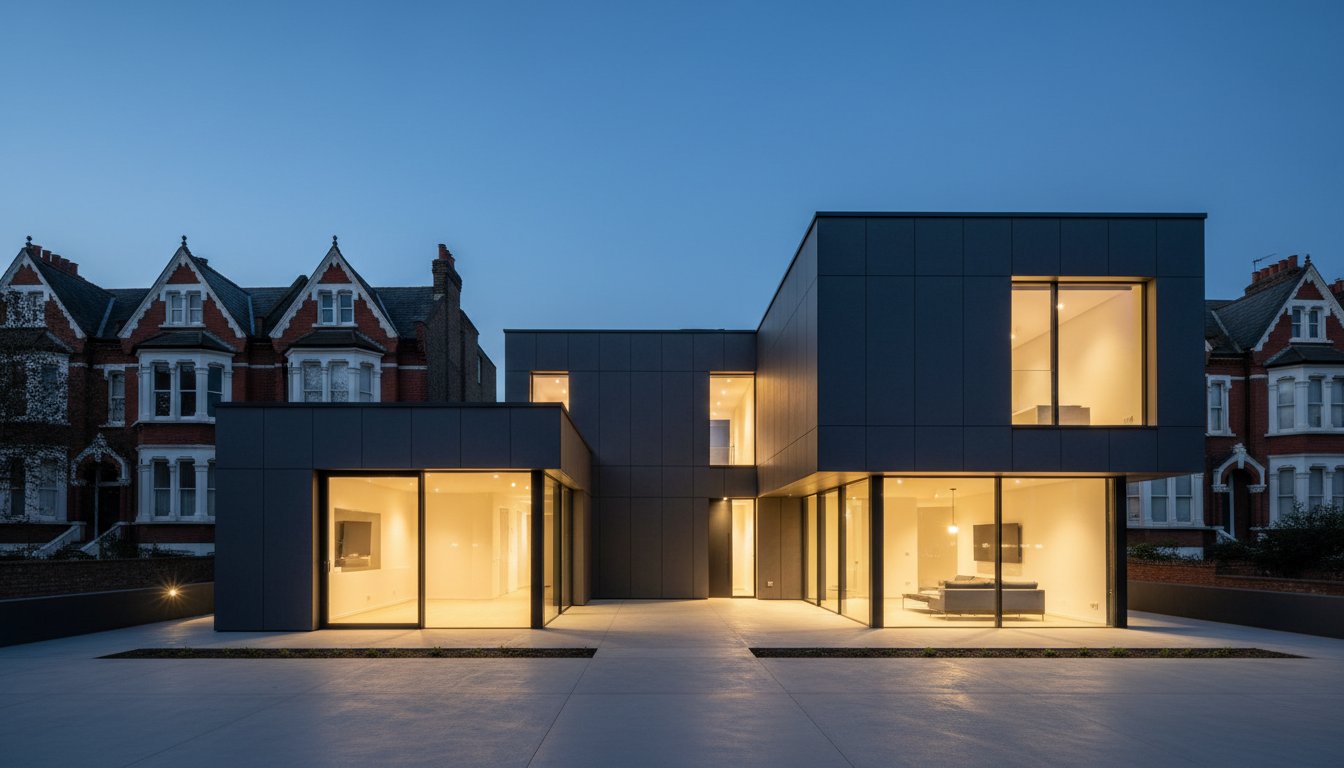
New Build Houses in London: The 2026 Architect’s Guide to Bespoke Development
In the competitive London property market, the most significant financial and lifestyle rewards aren’t found in existing terraces, but in the creation of new build houses designed specifically for the 2026 landscape. You’re likely aware that the capital’s planning environment is more restrictive than ever. With construction material prices having risen by 4.1% in the last year according to recent industry data, the dream of a bespoke home can often feel like a high-stakes gamble against bureaucracy and budget overruns.
We believe that your vision shouldn’t be stifled by technical hurdles or regulatory red tape. This guide provides a clear, architect-led roadmap to navigating the complexities of London’s 33 planning authorities while ensuring your project remains a sound investment. We’ll examine how to secure planning permission for ambitious designs, the methods for achieving a substantial uplift in property value through intelligent space optimisation, and the essential steps to delivering a high-performance, energy-efficient home tailored to your unique requirements.
Key Takeaways
- Understand the essential trade-offs between volume developments and bespoke architecture to ensure your project prioritises creative freedom and lifestyle optimisation.
- Discover how to navigate the RIBA Plan of Work to provide a structured, stress-free roadmap for designing and constructing high-end new build houses in the capital.
- Master London’s complex planning landscape by learning how the London Plan influences borough decisions and how to overcome the challenges of building in sensitive Conservation Areas.
- Protect your investment by breaking down bespoke construction costs per square metre and identifying hidden expenses such as the Community Infrastructure Levy (CIL) and party wall agreements.
- Learn why partnering with a visionary expert architect is crucial for unlocking the full potential of your plot and ensuring professional project management from concept to completion.
New Build Houses in London: Buying vs Commissioning a Bespoke Home
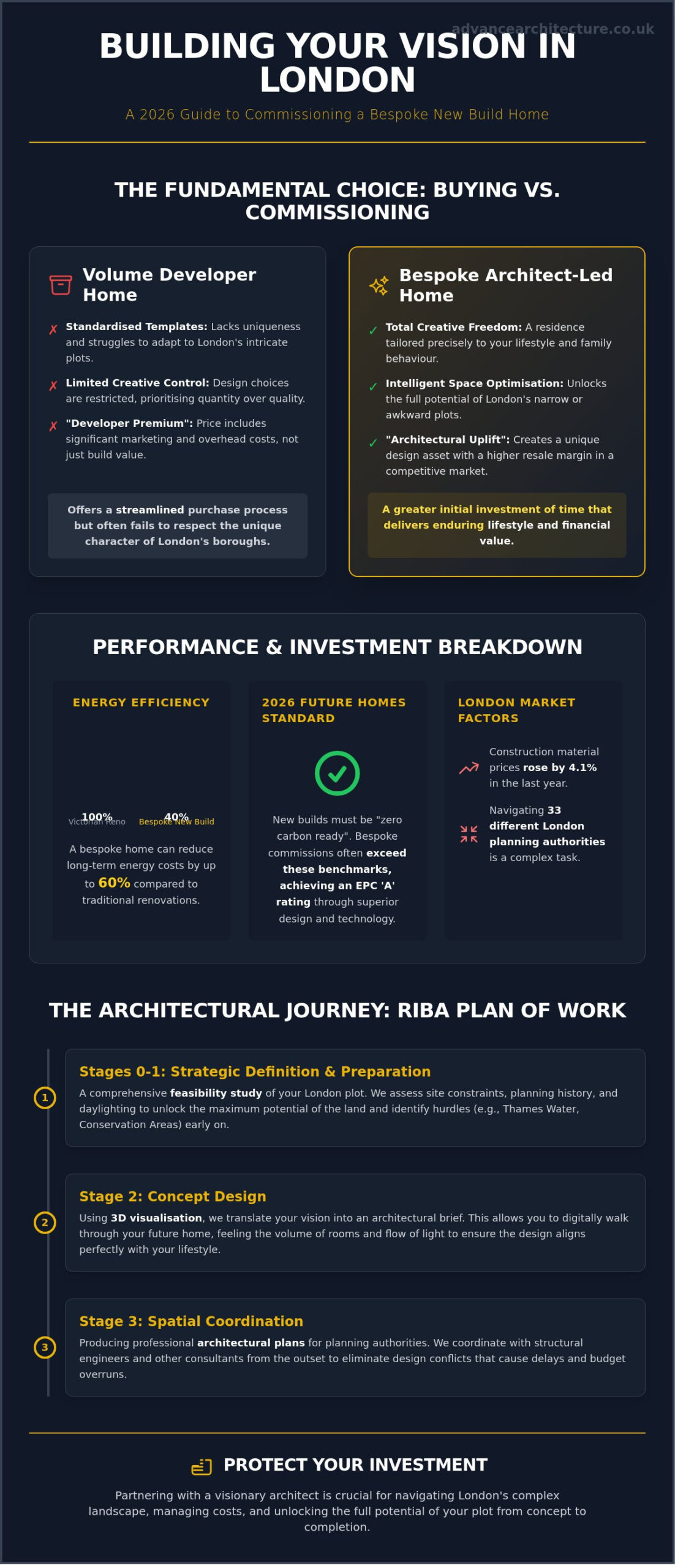
In 2026, the landscape for new build houses in the capital has shifted from sprawling suburban estates toward sophisticated urban infill. This evolution reflects a growing demand for density and quality over mere quantity. Homeowners now face a fundamental choice between the immediate convenience of a volume-built property and the enduring value of commissioning a bespoke home. While volume developers offer a streamlined purchase process, they often rely on standardised templates that struggle to adapt to London’s intricate streetscapes. Choosing a custom path allows for the precise optimisation of space, particularly on the narrow or awkward plots that define much of the city’s available land.
The trade-off involves balancing time against creative control. A bespoke project requires a greater initial investment of energy but delivers a residence tailored to your specific lifestyle. By 2026, the Future Homes Standard dictates that all new dwellings must be “zero carbon ready.” A bespoke commission often exceeds these benchmarks, achieving an EPC ‘A’ rating through integrated solar arrays and high-performance thermal envelopes. This technical rigour reduces long-term energy costs by as much as 60% compared to traditional Victorian renovations, providing both environmental and financial peace of mind.
The Rise of the Bespoke London Residence
Off-the-shelf designs frequently fail to respect the unique character of London’s 32 boroughs. A bespoke approach unlocks potential by ensuring the architecture responds to its specific context, whether it’s a heritage-sensitive mews or a contemporary corner plot. This process prioritises your family’s behaviour, creating a seamless flow between living zones. It also allows for the integration of premium materials and “smart home” technology that is hardwired into the structure rather than added as an afterthought.
Volume Developers vs Private Commissions
Volume builds typically come with a 10-year NHBC warranty, providing a safety net for industrial-scale construction. However, a private commission offers the security of an architect’s professional indemnity insurance and a dedicated contract administrator. This ensures a level of craftsmanship that mass-market developers cannot replicate. While volume houses include a “developer premium” to cover their marketing and overheads, a bespoke home creates “architectural uplift.” This unique design value often results in a higher resale margin, as the property stands out as a singular asset in a competitive market.
The Architectural Journey: Designing Your New Home from Concept to Completion
Embarking on a project for new build houses in London requires more than just a creative spark; it demands a rigorous, structured approach to ensure your investment is protected. We follow the RIBA Plan of Work, a definitive roadmap that organises the process into manageable stages. This journey begins with a comprehensive feasibility study of your London plot. We assess site constraints, local planning history, and daylighting requirements to unlock the maximum potential of the land before a single brick is laid. This initial groundwork is vital for identifying any potential hurdles with Thames Water or local conservation area restrictions early on.
Effective communication during this phase relies heavily on 3D visualisation. It’s one thing to see a flat drawing, but quite another to walk through your future home digitally. This technology allows you to feel the volume of the rooms and the flow of natural light, ensuring the spatial arrangement aligns perfectly with your lifestyle. We also engage with structural engineers and specialist consultants during these early stages. By coordinating with technical experts from the outset, we eliminate design conflicts that often lead to delays and budget overruns later in the process.
RIBA Stages 0-3: Concept and Design Development
Translating your initial vision into a functional architectural brief is the core of RIBA Stages 0 through 3. During this period, we produce professional architectural plans that serve as the primary tool for communicating with local planning authorities. Whether you prefer the sleek lines of modern minimalism or the timeless character of traditional London brickwork, your new build houses must adhere to the latest government design guidance for new builds. This ensures your project meets the high standards for beauty, safety, and sustainability expected in 2026.
The Role of Technical Drawing in Build Quality
Once planning is secured, the focus shifts to the granular details. Detailed building regulations drawings are the bible for your contractor. These documents provide the technical accuracy needed to ensure thermal performance and structural integrity, specifically meeting the updated Part L and Part O standards for energy efficiency and overheating. Precise documentation is the most effective way to prevent costly on-site surprises. When every junction, insulation layer, and structural beam is specified in advance, the construction phase becomes a seamless execution of a well-vetted plan. If you’re ready to begin your journey, you can consult with our design team to see how we can realise your vision.
Navigating London’s Planning Maze for New Developments
Success in the capital depends on balancing the overarching London Plan with the granular requirements of individual boroughs. While the Mayor’s spatial development strategy provides the ten-year framework for growth, local councils in Barnet, Islington, and Camden maintain strict control over their unique streetscapes. Building new build houses in these areas requires a sophisticated understanding of both regional policy and local character. It’s a process of negotiation, design, and technical precision.
- The London Plan: This document sets the strategic vision for housing density and sustainability across all 32 boroughs.
- Conservation Constraints: Working near Grade II listed buildings or within sensitive Conservation Areas demands a sympathetic architectural response that respects heritage.
- Pre-application Engagement: This formal dialogue with planning officers acts as a stress-free litmus test, identifying potential hurdles before a full submission.
Local expertise serves as your most valuable asset. Each borough has its own personality. Barnet often prioritises suburban character and garden preservation; Islington focuses on high-density urban integration and heritage protection. By engaging early through pre-application advice, we secure a clear roadmap, reducing risk and accelerating your project’s timeline. This proactive approach allows us to refine the design, address officer concerns, and build a case for approval before the clock starts on the official eight-week determination period.
Securing Planning Permission in North London
North London’s dense urban fabric presents specific challenges, particularly regarding the “right to light” and privacy. Planning officers scrutinise every proposal for overlooking or overshadowing neighbouring properties. As experienced residential architects london, we utilise advanced 3D massing studies to mitigate these concerns. We design, refine, and justify every elevation to ensure your vision aligns with council expectations. Clever use of obscured glazing, recessed balconies, and strategic setbacks allows us to maximise floor area while respecting the privacy of adjacent residents. This technical mastery ensures we are unlocking potential in even the most constrained urban plots.
Permitted Development and New Build Restrictions
It’s a common misconception that Permitted Development (PD) rights apply to the creation of entire homes from scratch. In reality, nearly all new build houses require full planning permission. Recent updates to the National Planning Policy Framework (NPPF) in December 2023 have placed even greater emphasis on design quality and “beauty.” A robust Design and Access Statement is no longer a formality; it’s a vital tool for securing consent. This document tells the story of your site, explaining how the development enhances the local area through functional elegance and visionary design. We bridge the gap between technical requirements and creative ambition, ensuring your project is both compliant and exceptional.
Calculating the Investment: Costs, Timelines, and ROI
Building new build houses in London requires a meticulous financial strategy. For 2026, high-end residential construction costs typically range from £4,500 to over £7,000 per square metre. This figure fluctuates based on your chosen borough and the complexity of the architectural specification. Beyond the visible structure, you must account for the Community Infrastructure Levy (CIL). In prime locations like Westminster or Camden, CIL charges can exceed £500 per square metre, significantly impacting your initial capital requirements.
Hidden costs often arise during the pre-construction phase. You should prepare for the following essential expenditures:
- Surveys and Investigations: Topographical, geotechnical, and GPR surveys usually cost between £3,000 and £5,500.
- Party Wall Agreements: If your plot borders existing structures, expect to pay approximately £1,800 to £2,500 per neighbour for professional surveyor awards.
- Planning and Legal Fees: Specialist consultants for heritage statements or biodiversity net gain assessments are increasingly mandatory for London approvals.
A standard programme for a bespoke residence spans 18 to 24 months. The journey begins with a three to six-month design and planning phase, followed by a 12 to 18-month construction period. Maintaining this timeline requires a disciplined management approach to avoid the holding costs associated with London land values.
Budgeting for a Bespoke Build in 2026
Successful projects rely on a balanced allocation of funds. We recommend reserving 15% of the total budget for professional fees and maintaining a 10-15% contingency fund. This buffer is essential for managing the price volatility of specialist materials and the inherent risks of urban groundworks. Experienced luxury residential architects provide value by specifying high-performance materials that reduce long-term maintenance while ensuring the interior finishes align with a premium market position.
Maximising Property Value through Design
Architectural distinction creates a tangible price premium. Industry data suggests that design-led new build houses command a 20% higher resale value than standard developer-led projects. Future-proofing through Net Zero standards is a primary value driver in the current market. Homes equipped with air-source heat pumps, triple glazing, and integrated solar arrays attract higher valuations and lower operational costs. Turning a derelict plot or an underutilised brownfield site into a high-value residential asset unlocks equity that far exceeds the initial land cost, provided the design maximises every millimetre of the building envelope. For property investors seeking to maximise returns through strategic development, flat conversions in London offer an alternative pathway to creating multiple high-yield units from existing Victorian terraces or commercial buildings.
To ensure your project remains financially viable from the first sketch, book a professional feasibility consultation with our expert team.
Realising Your Vision: Why a Specialist Architect is Essential
Building a home in London requires more than just a set of technical drawings. While a draughtsman might provide basic layouts, a specialist architect acts as a Visionary Expert. This role involves synthesising your lifestyle needs with the rigorous demands of the 2026 London planning system. For new build houses, this expertise is the difference between a standard property and a bespoke landmark that maximises every square metre of your investment. We view every plot as a puzzle where the solution must balance aesthetics, functionality, and strict local regulations.
Our approach at Advance Architecture focuses on a seamless, stress-free delivery. We don’t just hand over a design; we lead the entire process. This ensures that the creative spark of the initial concept survives the practical realities of the construction site. By acting as the bridge between your vision and the contractor’s execution, we eliminate the friction often associated with major builds.
The Architect as Your Partner and Protector
Construction sites are complex environments where small errors lead to significant delays. As your contract administrator, we manage the builder relationship to ensure the project stays on track. We certify payments only when work meets our exacting standards, protecting your capital from unfair claims. This rigorous oversight ensures the physical structure perfectly reflects the approved architectural plans. Regular site inspections allow us to catch discrepancies early, providing the final sign-offs required for building regulations and warranty providers. This layer of protection is essential for maintaining the structural integrity and long-term value of your new home.
Start Your New Build Journey Today
The first step toward your new home is a structured initial consultation. To make the most of this session, it’s helpful to prepare a basic brief, your target budget, and any known constraints of your London plot. We specialise in “unlocking the potential” of challenging sites, whether they are constrained urban infills or expansive suburban gardens. Our team evaluates the site’s orientation, local heritage context, and structural possibilities to provide a clear roadmap for development. We’ve helped hundreds of clients navigate these early stages, transforming uncertainty into a concrete plan of action.
We believe that your home should be as unique as your signature. By combining technical authority with a passion for elegant design, we turn your property vision into a bespoke reality. Book your free initial consultation today and let us guide you through the rewarding journey of creating new build houses that define your future.
Step Into Your Future with a Bespoke London Development
Navigating the path to a custom-designed home requires a strategic roadmap through the capital’s intricate planning landscape. While the market for new build houses remains highly competitive, commissioning a bespoke development allows you to bypass the compromises of speculative builds. You gain absolute control over architectural aesthetics, sustainable performance, and long-term asset value. Success in this high-stakes environment hinges on precision and local insight. With over 15 years of London planning expertise, Advance Architecture specialises in navigating the unique challenges of North London and Hertfordshire residential projects. We replace uncertainty with total budget clarity through our fixed-fee architectural packages; this ensures your investment remains protected from concept to completion.
By bridging the gap between visionary design and technical building regulations, we ensure your project moves seamlessly from an initial sketch to a structural reality. Our team is dedicated to unlocking the hidden potential of your site while maintaining a stress-free experience for you. It’s time to move beyond the ordinary and create a space that reflects your lifestyle and ambitions.
Realise your vision for a bespoke London home with a free consultation. We’re ready to help you build something truly exceptional.
Frequently Asked Questions
Is it cheaper to build a new house or buy an existing one in London?
Building a new home in London typically involves a higher initial cost per square metre than purchasing an existing property, but it offers far greater long-term value. According to 2024 BCIS data, high-end construction costs in the capital range from £3,000 to £4,500 per square metre. While the upfront investment is significant, you’re unlocking potential through superior energy performance and a layout tailored exactly to your lifestyle.
How long does it typically take to design and build a new house?
A bespoke project generally requires between 18 and 24 months to move from the initial concept to completion. This timeline accounts for approximately 6 months of design and planning, followed by a 12 to 18 month construction phase for new build houses. We maintain a methodical rhythm throughout this journey, ensuring every technical detail is managed with precision to keep the process stress-free and predictable.
Do I need planning permission for a new build house on my own land?
You’ll always need full planning permission to construct a new dwelling, as Permitted Development rights don’t apply to the creation of new homes. Every London borough has specific density and design requirements that your application must satisfy. We navigate these complexities by creating a visionary design that respects local policies while maximising the site’s footprint, ensuring your project gains the necessary approvals from the local authority.
What are the main building regulations I need to be aware of for new builds?
The most vital requirements are Part L and Part O, which dictate the energy efficiency and overheating standards for all modern developments. Since the 2021 updates to the Building Regulations, new homes must produce 31% less carbon emissions than previous iterations. We integrate these technical demands into your home’s fabric, using high-performance insulation and sustainable technologies to ensure your project is both compliant and future-proof.
Can I build a new house in a Conservation Area in London?
It’s possible to build in a Conservation Area if your design preserves or enhances the character of the neighbourhood. Historic England notes that London contains over 600 of these protected zones, each with unique architectural heritage. Success depends on a sensitive approach that balances contemporary innovation with traditional materials. We focus on creating bespoke solutions that satisfy strict planning officers while delivering a modern, functional living space.
What is the Community Infrastructure Levy (CIL) and does it apply to me?
The Community Infrastructure Levy is a mandatory charge used by local councils to fund regional improvements like transport and schools. However, most individuals building their own primary residence can claim a full exemption under the CIL Regulations 2010. It’s essential to submit your self-build claim before work starts on-site, as failing to follow this sequence can result in a bill worth tens of thousands of pounds.
How much does an architect charge for a new build house project?
Architectural fees for a bespoke residential development usually fall between 8% and 15% of the total construction cost. These rates, based on standard industry benchmarks, cover the entire process from feasibility studies to site management. This investment ensures you have a steady hand guiding the project, providing the technical authority needed to deliver a high-end result that exceeds the quality of standard market offerings.
What kind of warranty comes with a bespoke new build home?
A bespoke home is typically protected by a 10-year structural warranty from a recognised provider such as NHBC or LABC. This policy is a standard requirement for most UK mortgage lenders and covers any major defects in the building’s structure or weatherproofing. It provides a reassuring layer of security, confirming that your property has been built to the highest professional standards and protecting your long-term financial investment.