
Architect vs Design and Build Company in London: Which is Best for Your 2026 Project?
The perceived convenience of a “one-stop shop” may actually be the biggest risk to your property’s long-term value. When weighing up an architect vs design and build company London for your 2026 renovation, it’s easy to be swayed by the promise of simplicity. However, sacrificing independent oversight often leads to compromised design and unexpected hurdles with the Building Safety Regulator. You likely feel the weight of rising costs, with London labor rates now 25% higher than the national average; you’re right to be cautious about who manages your investment.
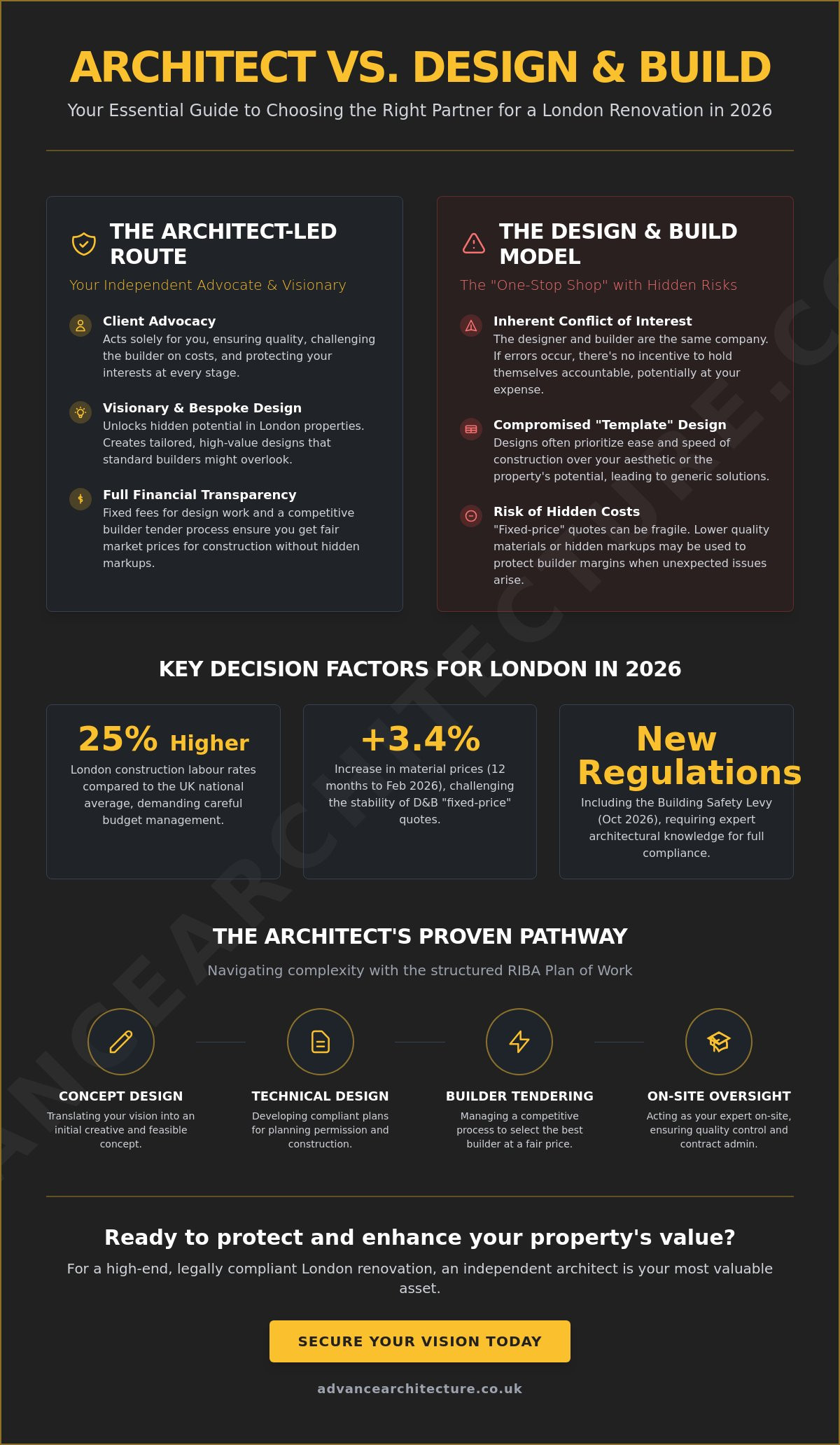
D&B companies generate profit through volume and construction speed. Bespoke architectural features, such as complex structural glass or intricate masonry details, are time-consuming and labor-intensive. In a city where London construction labor rates are already 25% higher than the national average, builders naturally favor “standard” solutions that can be executed quickly. This often results in a home that looks like every other extension on the street, failing to unlock the true market potential of your property. When design becomes secondary to build speed, the long-term value of your investment is inevitably compromised. To avoid these pitfalls, you can learn more about Home Extensions from specialists who prioritise quality and detailed execution.
This guide clarifies the essential distinctions to help you secure a seamless, high-end transformation that remains fully compliant with the new Building Safety Levy regulations starting October 1, 2026. We’ll explore how to unlock the full potential of your space while maintaining fixed-fee transparency and expert navigation of council requirements in areas like Barnet and Islington. You’ll learn how bespoke solutions and technical authority protect your vision from the pitfalls of conflicting advice and hidden project costs.
Key Takeaways
- Compare the independent advocacy of an architect against the single-point-of-contact model to choose the most secure path for your 2026 project.
- Uncover how a visionary architect identifies bespoke design opportunities in London’s unique terraces that a standard design-and-build firm might overlook.
- Assess the true value of an architect vs design and build company London by examining budget transparency and the risks of hidden construction markups.
- Navigate the complexities of London planning permission using the RIBA Plan of Work to ensure technical excellence and regulatory compliance.
- Realise your vision through tailored solutions that prioritise your long-term property value over the perceived convenience of a consolidated construction package.
Understanding the Models: Architect vs Design and Build in London
The London property landscape in 2026 is defined by record-high labor costs and stringent safety standards. Choosing between an architect vs design and build company London isn’t just a matter of preference; it’s a strategic decision that dictates your project’s legal safety and financial health. The architect-led route involves appointing a visionary expert to design and manage your vision independently. Conversely, the Design and Build (D&B) model merges design and construction into a single contract. While D&B offers a streamlined structure, it often lacks the “independent advocate” required to challenge construction quality or cost variations on your behalf.
In a market where London construction labor rates sit 25% above the national average, a nuanced approach is essential. A one-size-fits-all solution rarely works for complex London terraces or heritage properties. You need a partner who prioritizes your interests over the builder’s profit margins. This is where the independent advocate becomes the missing piece in the D&B puzzle. Without this separation of powers, you lose the checks and balances that ensure your home is built to the highest possible standard.
What Does an Architect Actually Do in 2026?
Beyond the creative spark, the contemporary role of an architect has evolved into that of a high-level technical consultant. They don’t just sketch; they navigate the intricate web of London’s council requirements and the Building Safety Regulator’s oversight. Professional architectural plans act as your legal blueprint, ensuring that every centimeter of your extension or conversion complies with the September 30, 2026, amendments to Approved Document B. Your architect serves as your protector, verifying that the work on-site matches the technical specifications without compromise.
The Design and Build Company Proposition
D&B firms appeal to busy homeowners by offering a single point of contact. This model promises to handle everything from the initial concept to the final brick. It’s a convenient proposition, but it comes with caveats. The reality of “fixed price” quotes can be fragile in a market where material prices for new housing rose 3.4% in the 12 months leading to February 2026. Most D&B companies either outsource their design work or use in-house teams who may prioritize ease of construction over visionary design. This internal link between the designer and the builder can create a conflict of interest. If a design error occurs, the builder is unlikely to hold themselves financially accountable, often leading to hidden markups or reduced material quality to protect their margins.
The Architect-Led Route: Prioritising Design Excellence and Advocacy
Design excellence isn’t a luxury; it’s the bedrock of long-term property appreciation. When choosing between an architect vs design and build company London, you’re deciding between a tailored masterpiece and a templated solution. An architect acts as your dedicated advocate, ensuring that every design choice prioritizes your lifestyle and the property’s structural integrity. While a builder might look at a narrow London terrace and see limitations, a visionary architect sees a hidden opportunity to maximize light and volume. They utilize the RIBA Plan of Work to provide a structured roadmap, guiding you from the initial creative spark to the final handover with meticulous precision.
By opting for an architect-led approach, you avoid the risk of “template” architecture. Builders often prefer certain materials or layouts because they’re easier to install, not because they’re better for your home. Your architect ensures that the finishes are bespoke, reflecting your aesthetic while adhering to the latest building regulations. This level of detail is what separates a standard extension from a transformative investment. In the complex landscape of an architect vs design and build company London, the architect-led route offers the creative freedom that a construction-focused firm simply cannot match.
Maximising Space and Value in London
London’s unique urban fabric requires a specialist touch to truly thrive. Expert residential architects in London specialize in optimizing small footprints, often turning cramped layouts into expansive, light-filled spaces that command a higher ROI. In 2026, with construction material prices for new housing rising by 3.4%, every square meter must work harder. We use 3D visualisation to provide a “stress-free” preview of your project, allowing you to make informed decisions before a single brick is laid. Consider a recent North London extension where clever structural optimization added more market value than the total construction cost, proving that visionary design pays for itself.
The Architect as Your Project Manager
The most critical advantage of the architect-led route is contract administration. Your architect doesn’t just design; they manage the tender process to secure the most competitive market price from vetted builders. They also handle the professional exposures in design-build by acting as an independent inspector. This means they certify payments, ensuring you only pay the builder for work that meets the exact technical specifications. If you’re ready to explore how this level of oversight can protect your investment, you can learn more about our bespoke management services. By coordinating with structural engineers and specialist consultants, your architect remains the steady hand that guides your project through the complexities of the 2026 regulatory landscape.
The Design and Build Route: Convenience vs. Conflict of Interest
The promise of a single point of contact is the primary selling point for any architect vs design and build company London comparison. It sounds like the ultimate stress-free solution; one firm handles the concept, the planning, and the physical construction. However, this convenience often masks a fundamental conflict of interest. When the person designing your home is also the person building it, the incentive to prioritize construction efficiency over architectural integrity becomes overwhelming. If a design error occurs on-site, a design-and-build (D&B) firm is unlikely to alert you to their own mistake. Instead, they may quietly adjust the technical specifications to suit their timeline, leaving you with a result that is “functional” rather than visionary.
Many homeowners are lured by the prospect of “free” or heavily discounted design services within a D&B package. In reality, these costs are rarely absent; they’re simply redistributed into construction markups or hidden within the procurement of materials. With construction material prices for new housing rising by 3.4% in the 12 months leading to February 2026, D&B firms face immense pressure to protect their margins. Without an independent architect to verify that you’re getting exactly what you paid for, you risk paying premium prices for standard-grade materials. This lack of independent oversight is the greatest hazard of the D&B model, as there’s no one to “watch the watcher” on your behalf.
The Profit vs. Quality Dynamic
D&B companies generate profit through volume and construction speed. Bespoke architectural features, such as complex structural glass or intricate masonry details, are time-consuming and labor-intensive. In a city where London construction labor rates are already 25% higher than the national average, builders naturally favor “standard” solutions that can be executed quickly. This often results in a home that looks like every other extension on the street, failing to unlock the true market potential of your property. When design becomes secondary to build speed, the long-term value of your investment is inevitably compromised.
Is Design and Build Ever the Right Choice?
The D&B model can be effective for simple, repetitive projects where the design requirements are minimal and the technical hurdles are low. If you’re looking for a basic, “cookie-cutter” loft conversion or a standard garage extension, the consolidated approach might save you time. However, for complex London renovations involving listed building consent or intricate council requirements in boroughs like Islington, the risks multiply. If you do choose the D&B route, it’s vital to vet their design credentials meticulously. Ask to see their portfolio of completed works and check if their “designers” are actually ARB-registered architects. Even within a D&B framework, many sophisticated homeowners now hire an independent consultant to review the technical drawings and ensure the builder isn’t cutting corners on structural integrity or energy efficiency standards.
Key Decision Factors for London Homeowners in 2026
Deciding between an architect vs design and build company London requires a pragmatic assessment of your project’s unique demands. If your home sits within one of London’s many Conservation Areas, the planning complexity increases exponentially. Navigating these heritage constraints demands a specialist architect in London who understands local nuances. Beyond planning, you must weigh budget transparency. While architects charge clear professional fees, typically ranging from 8% to 15% for high-end residential work, D&B firms often embed their costs within construction markups. This makes it difficult to discern the true price of the design versus the physical build.
Your risk appetite also plays a significant role. Do you want an independent expert to catch technical mistakes before they’re built? In high-density areas, a multi-storey rear extension carries more structural risk than a simple loft conversion. Having an architect-led team ensures that technical building regulations are met without compromise. It’s about more than just aesthetics; it’s about ensuring the structural integrity of your investment in a market where construction inflation is estimated at 3.5% for 2026. If you’re ready to secure your project’s success with expert oversight, contact our team for a bespoke consultation.
Navigating London Planning and Permitted Development
Many homeowners assume that permitted development is an automatic right. In London boroughs like Barnet, Camden, or Haringey, local Article 4 directions can restrict these rights significantly. An architect’s expertise is vital here to ensure your vision aligns with council expectations. We focus on securing Lawful Development Certificates, which provide a legal guarantee that your build is compliant. This document is essential for securing your property’s future sale, as buyers in 2026 are increasingly cautious about unauthorized developments. With householder planning application fees rising to £548 as of April 1, 2026, getting the application right the first time is a financial necessity.
The ‘Hassle-Free’ Reality Check
The time commitment for an architect-led project versus a D&B route is often misunderstood. While D&B promises speed, the lack of detailed technical drawings can lead to mid-build delays and unexpected “extra” charges. Clear, professional drawings prevent these disputes by defining every socket, finish, and structural detail before the builder arrives on site. This methodical preparation creates a steady pace that prevents you from feeling overwhelmed during construction. Detailed architectural plans act as a fixed-price insurance policy for homeowners. By investing in the “how” before the “now,” you eliminate the uncertainty that often plagues London renovations.
Realising Your Vision with Advance Architecture
Since 2009, Advance Architecture has refined a methodology that bridges the gap between creative aspiration and technical reality. We understand that the choice between an architect vs design and build company London often boils down to trust. By remaining an independent practice, we ensure our loyalty lies solely with you, the homeowner. We don’t have a construction crew’s profit margins to protect; this allows us to provide unbiased advice on every detail of your property transformation. This independence is our greatest strength. It empowers us to act as your steady hand throughout the daunting journey of modernising a London home.
Our approach focuses on unlocking potential through bespoke solutions that reflect your specific lifestyle. Whether we’re designing new build houses or managing complex flat conversions, our goal is to maximise every inch of your space. We provide a seamless transition from the abstract “what if” to the concrete “how,” ensuring your chosen builder has the precise documentation needed to execute the vision without costly errors. This collaborative spirit transforms the construction phase into a well-orchestrated realisation of your goals. We believe your home should be a visionary masterpiece, not a compromise of convenience.
The Advance Architecture Experience
Your journey begins with a clear, methodical progression. We offer a comprehensive suite of services designed to handle the regulatory and creative hurdles of the UK planning system. Our process includes:
- Detailed feasibility studies to assess project viability and costs.
- Bespoke 3D visualisations that bring your concepts to life before construction.
- Precise building regulations drawings and technical specifications for tender.
- Expert negotiation for listed building consent and council approvals.
Our role as a visionary expert isn’t just about aesthetics; it’s about providing the technical authority needed to navigate the 2026 Building Safety Regulator requirements. We invite you to book a free initial consultation to discuss how we can optimise your property’s footprint while ensuring full compliance with the latest standards. This early partnership ensures your project starts on a firm, professional footing.
Next Steps for Your London Home
Preparing for a major renovation requires organisation and expert guidance. Before you commit to the architect vs design and build company London route, it’s helpful to gather your ideas and understand the local context of your borough. You can explore our extensive portfolio of house extensions in London to see how we’ve transformed North London terraces into contemporary masterpieces. Seeing our past work provides a tangible sense of the creative possibility we bring to every project. When you’re ready to move from inspiration to execution, contact Advance Architecture today for a bespoke consultation. Let’s work together to create a home that is as functional as it is beautiful.
Secure the Future of Your London Home
Transforming your property is a significant investment that requires both a creative spark and a steady hand. Choosing between an architect vs design and build company London isn’t just about the build phase; it’s about who will champion your vision and protect your budget through the complexities of the 2026 planning landscape. You’ve seen how independent oversight prevents the “blame game” and how bespoke design unlocks market value that standard construction packages often miss. By prioritizing technical authority and transparent management, you ensure your home remains a sanctuary rather than a source of stress.
Advance Architecture has been a cornerstone of the North London architectural landscape since 2009. We specialize in navigating the intricate requirements of local councils and provide fixed-fee transparency for all architectural and technical design stages. Our team acts as your dedicated advocate, ensuring every detail meets the highest standards of safety and elegance. It’s time to move beyond the ordinary and realize a home that truly reflects your lifestyle.
Book Your Free 2026 Design Consultation with London’s Visionary Experts and begin the journey toward a seamless, high-end transformation. Your property’s true potential is waiting to be unlocked.
Frequently Asked Questions
Is it cheaper to use a design and build company or an architect?
While design and build companies often seem cheaper initially due to bundled or “free” design fees, the architect led route frequently offers better long term value. By producing detailed technical drawings, an architect allows you to put your project out to tender. This competitive process ensures you receive multiple quotes from different builders, often resulting in lower construction costs than a single company’s fixed internal markup.
Can an architect help me find a reliable builder in London?
Yes, architects maintain professional networks of vetted contractors who have a proven track record in the London market. During the tender stage, your architect will invite several trusted builders to bid on your specific plans. This methodical approach ensures you partner with a professional who understands the complexities of London property, rather than risking your investment on an unverified contractor.
What happens if a design and build company goes bust mid-project?
If a design and build firm enters insolvency, you face a significant risk because your design and construction contracts are tied to a single entity. You lose both your designer and your builder at once, often with no independent party to verify what work was actually completed. In an architect led model, your architect remains a constant presence to help you appoint a new contractor and safeguard your project’s continuity.
Do I need an architect for a simple loft conversion in London?
While not a legal requirement, hiring an architect for a loft conversion is the most effective way to unlock the full potential of a cramped roof space. An architect ensures your design complies with the September 30, 2026, fire safety amendments to Approved Document B. This professional oversight prevents technical errors and ensures the new floor integrates seamlessly with your existing home’s structural integrity.
Who is responsible for building regulations approval in a design and build contract?
In a design and build contract, the company is responsible for the submissions, but the legal liability for compliance ultimately rests with the homeowner. Without an independent architect to inspect the site, you’re essentially allowing the builder to verify their own work. This lack of oversight can lead to complications with the Building Safety Regulator if the physical build deviates from the approved technical standards.
Can I hire an architect just for the planning stage and use a builder for the rest?
You can hire an architect solely for the planning and design phases, but this often leaves a gap in project quality control. The real strength in the architect vs design and build company London debate is the architect’s role as a contract administrator. Without them, you lose the independent advocate who inspects the builder’s work and certifies that payments are only made for correctly completed stages.
How do I know if my London home is in a Conservation Area?
You can check your property’s status by visiting the planning portal of your local council, such as Barnet, Islington, or Camden. These websites provide interactive maps showing Conservation Areas and Article 4 directions that may restrict your permitted development rights. An architect can perform a detailed feasibility study to confirm these constraints and ensure your project is designed to meet specific local council requirements.
What is the main advantage of an independent architect over a design-and-build firm?
The primary advantage is independent advocacy. An architect’s professional loyalty is exclusively to the homeowner, whereas a design and build firm must balance your needs against their own construction profit margins. This independence ensures that your architect will challenge the builder on quality, verify that materials meet the bespoke specifications, and act as a steady hand throughout the entire property transformation process.