
Loft Conversion Price London 2026: The Ultimate Homeowner’s Cost Checklist
What if the most expensive mistake in your home transformation isn’t the materials you choose, but the £12,500 in hidden regulatory costs you didn’t see coming? In a city where a well-executed attic extension can increase property value by up to 22%, getting your initial loft conversion price right is the difference between a visionary investment and a stressful financial headache. It’s easy to feel overwhelmed by the gap between a builder’s rough estimate and the final invoice, especially when technical requirements and material costs shift so rapidly.
We agree that the path to unlocking your home’s potential shouldn’t feel like a gamble. You deserve a stress-free experience that balances architectural elegance with strict budgetary control. This guide provides a professional breakdown of architectural fees, construction estimates, and those often-overlooked statutory charges that catch many homeowners off guard. We’ll provide a clear roadmap for your 2026 project, helping you distinguish between essential structural investments and areas where you can safely optimise your spend to realise your vision with total confidence.
Key Takeaways
- Navigate the three distinct pricing tiers for London properties in 2026 and understand why capital projects command a specific premium.
- Discover how bespoke architectural design and feasibility studies act as vital risk-mitigation tools to protect your long-term investment.
- Access a comprehensive breakdown of the current loft conversion price, ranging from “shell and core” structural work to superior interior finishes.
- Uncover the “hidden” regulatory landscape, including Party Wall Act obligations and potential Community Infrastructure Levy (CIL) charges across London boroughs.
- Learn how an architect-led strategy eliminates the “builder’s estimate” trap by using precise technical drawings to secure your structural budget.
Understanding the Loft Conversion Price Landscape in London
Investing in your home requires a clear-eyed view of the financial commitment required for high-end architectural changes. In 2026, the average loft conversion price in London remains approximately 25% higher than the UK national average. This premium reflects the capital’s unique architectural heritage and the logistical complexities of urban construction. Our role is to help you navigate these costs while unlocking the hidden potential within your roofline.
Your property’s DNA dictates the initial budget. A Victorian terrace with a shallow roof pitch often requires more structural intervention than a 1930s semi-detached home. Beyond the shell, the intended use of the space significantly shifts the final figure. Incorporating a master suite with a bespoke ensuite bathroom adds roughly £12,000 to £18,000 in plumbing and high-end finishes compared to a “dry” room like a home office or creative studio. We focus on creating a seamless transition that feels like a natural extension of your home rather than an afterthought.
The Three Main Conversion Types and Their Price Points
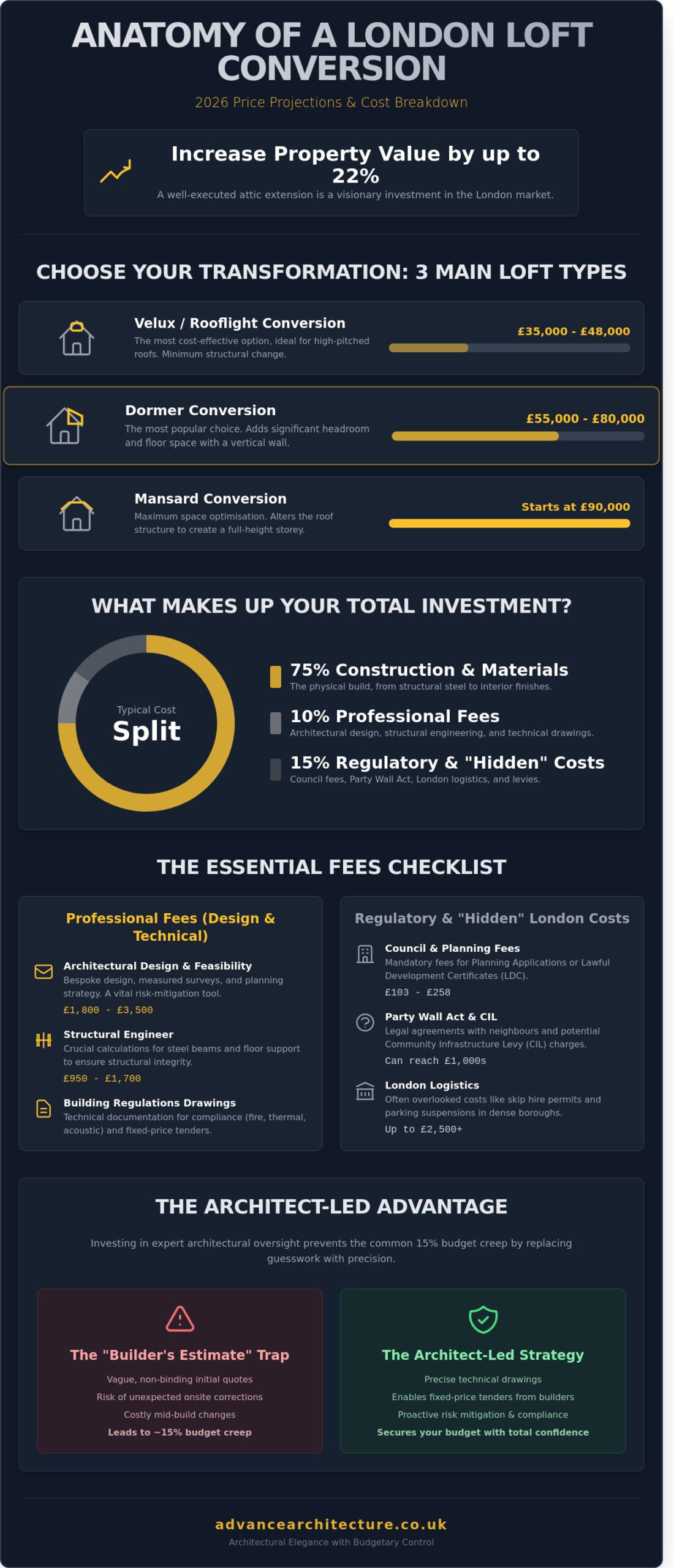
- Velux/Rooflight Conversions: These are the entry-level option for London budgets, typically ranging from £35,000 to £48,000. They work best when existing head height is at least 2.2 metres.
- Dormer Loft Conversions: As the most popular choice for North London terraces, these add significant internal volume. Expect to invest between £55,000 and £80,000 for a professionally designed dormer.
- Mansard Conversions: These offer the ultimate space optimisation in high-value postcodes and conservation areas. Because they involve altering the entire roof structure, prices generally start at £90,000.
Why London Location Impacts Your Quote
The specific borough where you live introduces variables that can fluctuate your loft conversion price by several thousand pounds. Logistical challenges are a primary driver. In densely populated areas like Islington or Barnet, skip hire permits and parking suspensions for delivery lorries can add £2,500 to your total spend. These are the granular details we manage to ensure your project remains stress-free.
Structural requirements also vary by street. Narrow London plots often share foundations, necessitating complex party wall agreements and specialised structural steelwork to protect neighbouring properties. Furthermore, local authority variations mean planning fees and heritage requirements differ. A project in a Kensington conservation area will face more stringent design demands than a similar build in a more modern suburb, requiring a more sophisticated architectural approach to secure approval.
The Professional Fees Checklist: Design and Planning Costs
Professional fees represent far more than administrative overhead; they’re a strategic investment in project risk mitigation. Investing in expert architectural oversight at the outset prevents the 15% budget creep often seen when homeowners bypass detailed planning. These fees ensure your vision is both structurally sound and legally compliant, protecting the overall loft conversion price from unexpected onsite corrections. A well-executed design phase acts as a blueprint for efficiency, transforming a dusty attic into a sophisticated living space with precision.
Architectural Design and Planning Stages
The journey begins with a comprehensive measured survey and a bespoke design concept tailored to your lifestyle. For a typical London property, conceptual design and feasibility study fees usually range between £1,800 and £3,500. This stage is where we focus on unlocking potential within the existing roofline. Our team manages the entire planning application process, acting as a dedicated liaison with local council officers in boroughs like Richmond or Barnet. Whether you require a full planning application, which carries a standard council fee of £258, or a Lawful Development Certificate for £103, we ensure every drawing meets the stringent requirements of local character and height restrictions.
Technical Documentation and Building Control
Once planning is secured, the focus shifts to technical precision. Detailed building regulations drawings are essential to ensure compliance with thermal efficiency, fire safety, and acoustic standards. You’ll also need to appoint a structural engineer. Their calculations are vital for determining the size of the steel beams required to support your new floor; expect third-party fees for this service to fall between £950 and £1,700 depending on project complexity. These technical documents provide the granular detail your contractor needs to provide a fixed-price tender, eliminating the guesswork that often inflates costs mid-build.
- Measured Surveys: Accurate 3D mapping of your existing structure to prevent design errors.
- Planning Liaison: Expert navigation of Permitted Development rights to accelerate your start date.
- Structural Calculations: Precise engineering to ensure the long-term integrity of your home.
Technical drawings also address Part L of the Building Regulations, focusing on insulation levels that reduce long-term energy costs. To ensure your project is built on a foundation of expert knowledge, speak with our design team about a bespoke feasibility study. Finalising these specifications before construction begins is the most effective way to keep your loft conversion price within your target range while ensuring a seamless transition from drawing board to reality.
Construction Cost Drivers: From Shell to Superior Finish
Moving from a conceptual design to a physical structure requires a clear understanding of the “shell and core” phase. For 2026, London homeowners should budget between £45,000 and £70,000 for this primary stage of a standard dormer. This foundational cost secures the structural integrity of your home while preparing the canvas for your bespoke interior. It’s the skeleton of your project, encompassing everything from the initial demolition to the external weatherproofing.
Structural Essentials and Steelwork
Steelwork is the backbone of your transformation. In congested London postcodes like N1 or SW6, logistics drive the budget. Crane hire for a single day in 2026 averages £1,800, a cost often overlooked in initial estimates. We must also account for upgrading floor joists to meet the latest building regulations, which typically adds £3,500 to the structural tally. Your choice of roofing material also creates a price variance:
- Natural Slate: Increases the roofing budget by 22% compared to concrete tiles but preserves heritage aesthetics.
- High-Performance PIR Insulation: Essential for 2026 thermal efficiency standards, costing approximately £2,800 for a 30-square-metre space.
- Structural Reinforcement: Lateral restraint straps and timber flitch beams add roughly £1,200 to ensure the existing terrace walls remain stable.
Internal Finishes and Lifestyle Optimisation
The internal fit-out is where your lifestyle vision takes shape. A bespoke staircase isn’t just a transition; it’s a design statement that can cost between £3,500 and £9,000. It dictates the entire floorplan flow and determines how seamless the journey feels from the lower floors. These choices directly impact the final loft conversion price.
Glazing options offer the most significant visual impact. While a standard Velux window remains a cost-effective £950, a bespoke floor-to-ceiling “picture window” or a Juliet balcony can reach £5,500. Connecting to Victorian plumbing systems often requires a £2,500 allowance for Stuart Turner pump systems or manifold upgrades to ensure consistent water pressure in your new master ensuite. Unlocking the potential of awkward eaves space with bespoke joinery typically adds £3,000 to £5,000, but it provides the essential storage that makes a loft room truly functional for modern London living.
The “Hidden” London Costs: Regulatory and Legal Fees
While the physical build takes centre stage, the regulatory framework defines your project’s success. London’s dense urban fabric means your loft conversion price is often influenced by legal obligations that ensure safety and neighbourly harmony. These administrative layers provide the structural integrity and legal protection required to secure your investment for the long term.
Party Wall Agreements and Neighbourly Relations
Most London loft conversions involve semi-detached or terraced properties, making the Party Wall Act 1996 a critical factor. You’ll need a surveyor if your work involves cutting into a shared wall or excavating near a neighbour’s foundations. Budget between £900 and £1,600 per affected neighbour for professional awards. Our architectural team provides detailed technical drawings that clarify structural intentions; this clarity often prevents the friction that leads to expensive, protracted disputes. Professional design acts as a bridge between your vision and your neighbour’s peace of mind.
Council Fees and Mandatory Levies
Local authorities like Barnet and Camden have specific fee structures for 2026. A standard planning application for a residential extension currently sits around £258, but you must also account for the Community Infrastructure Levy (CIL). While many loft conversions are exempt if they are under 100 square metres or for self-occupancy, some London boroughs apply specific charges to fund local infrastructure. Logistics in the capital also carry a premium:
- Scaffolding licences: £100–£350 depending on the borough and duration.
- Skip permits: £65–£130 per fortnight for public highway placement.
- Ecological surveys: £500+ if your property is near a green belt or requires bat surveys.
Building control fees typically range from £750 to £1,300. This investment covers the initial plan check and the series of site inspections required to issue your final completion certificate. This document is vital for future property sales. We recommend a 12% contingency fund to manage the unique challenges of London’s Victorian and Edwardian housing stock. Unforeseen structural repairs or drainage diversions can arise once the roof is opened up. A robust contingency ensures a stress-free transformation without compromising on material quality.
Planning these details early is the only way to avoid budget creep. If you’re ready to start unlocking potential in your home, book a bespoke architectural consultation to map out your project’s regulatory path. Expert guidance ensures your loft conversion price remains predictable and transparent from the first sketch to the final inspection.
Maximising ROI: Why an Architect-Led Approach Saves Money
Investing in professional architectural services isn’t an additional expense; it’s a strategic safeguard against the escalating loft conversion price in 2026. Many homeowners fall into the builder’s estimate trap, where a low initial quote masks a lack of technical detail. Without precise drawings, you’re vulnerable to on-site variations that typically inflate final invoices by 15% to 20%. A fixed-fee architectural package provides the granular detail required for accurate tendering. It ensures every structural beam and electrical point is accounted for before a single tile is lifted, giving you price certainty in a fluctuating market. For more on what a detailed construction estimate should contain, see the guide at pagebuildingconsultants.co.uk.
The financial benefits extend beyond the construction phase. In the London market, a professionally designed loft conversion can increase property value by up to 22% according to recent Nationwide data. This return on investment relies on architectural integrity rather than just adding floor space. Professional project management further protects your budget by enforcing strict timelines. We’ve found that unmanaged projects often overrun by 4 to 6 weeks, leading to increased labour costs and mounting rental or storage fees. An architect-led approach mitigates these risks through:
- Technical Precision: Detailed specifications that prevent expensive mid-build corrections.
- Tendering Accuracy: Enabling you to compare “apples with apples” when selecting a contractor.
- Regulatory Compliance: Avoiding the devastating costs of remedial works required by building control.
- Resource Management: Ensuring materials are ordered and delivered exactly when needed.
Designing for Value and Functionality
Great design prioritises light and flow over simple square meterage. We select materials that offer high-end aesthetics without the premium price tag, such as high-performance glazing that reduces long-term energy bills. By matching the character of your original staircase and woodwork, we create a transition that feels intentional. This seamless integration is what commands a higher resale price, as buyers are willing to pay a premium for spaces that don’t feel like an afterthought.
Taking the Next Step with Advance Architecture
We specialise in navigating the specific planning hurdles and structural complexities of London’s boroughs. Our bespoke approach manages the technical requirements of building regulations and permitted development, leaving you to focus on the creative vision for your home. We provide the steady hand and expertise needed for a stress-free transformation. Book your free initial consultation for your London loft project and discover how we can unlock your property’s hidden potential while protecting your loft conversion price.
Unlocking Your Home’s Potential in 2026
Navigating the London property market in 2026 requires a clear-eyed understanding of the investment required. While the average loft conversion price continues to reflect the complexity of urban builds, the value added to a North London home remains substantial. Success depends on balancing three critical pillars: precise design, rigid adherence to building regulations, and proactive project management.
Since 2009, Advance Architecture has specialised in transforming attic spaces into high-end living areas across Barnet and the surrounding boroughs. Our team navigates the intricate planning permissions of North London with technical authority, ensuring your project moves from blueprint to reality without the typical stresses of construction. We provide a comprehensive service that covers everything from initial bespoke concepts to full project management. This structural approach ensures that hidden regulatory fees don’t derail your budget or compromise the integrity of your home. By choosing an architect-led model, you’re investing in a seamless transition that unlocks the hidden potential of your property.
Realise your vision with a bespoke loft conversion plan
Your ideal home is closer than you think. We’re ready to guide you through every stage of this exciting transformation.
Frequently Asked Questions
How much does a basic dormer loft conversion cost in London in 2026?
In 2026, a basic dormer loft conversion price in London typically starts at £55,000 and can reach £75,000 for a standard 25 square metre space. This investment covers structural steel, floor reinforcement, and basic internal finishes. We have observed a 12% increase in labour costs over the last three years, making early budget planning essential for a stress free transformation.
Do I need an architect for a loft conversion if I have a builder?
You should always engage an architect to ensure your vision is structurally sound and compliant with Building Regulations. While a builder executes the construction, an architect provides the technical drawings required for Lawful Development Certificates and structural calculations. This professional oversight protects your investment and ensures the final space is both functional and aesthetically refined.
Is a loft conversion cheaper than a rear house extension in London?
A loft conversion is generally 20% to 30% more cost effective than a ground floor rear extension. While a 30 square metre extension might cost £90,000, a similar sized loft conversion often stays within the £65,000 range. This price difference exists because you’re utilising the existing building envelope rather than excavating new foundations and constructing external walls from scratch.
How much should I budget for Party Wall surveyor fees in North London?
You should budget between £1,200 and £1,800 per adjoining neighbour for Party Wall surveyor fees in North London. If your neighbours dissent to the initial notice, costs can escalate as a second surveyor may be required. Appointing an agreed surveyor for both parties can reduce these expenses by approximately 40%, keeping your project budget on track and your relationships intact.
Does a loft conversion always require full planning permission?
No, most London loft conversions fall under Permitted Development rights, provided they don’t exceed volume limits of 40 to 50 cubic metres. You’ll still need a Lawful Development Certificate to prove the work was legal when you sell the property. If you live in a Conservation Area or a flat, you’ll likely need full planning permission before any work begins on site.
How much value does a loft conversion typically add to a London home?
A well executed loft conversion typically adds between 20% and 25% to the total market value of a London property. According to 2024 Nationwide building society data, adding a double bedroom and ensuite is the single most effective way to increase equity. This transformation turns unused attic space into a high value asset, often yielding a 150% return on the initial loft conversion price.
What are the architectural fees for a loft conversion project?
Architectural fees for a bespoke loft project generally range from £3,500 to £7,000 depending on the complexity of the design. This fee covers the initial feasibility study, detailed planning drawings, and technical specifications for Building Control. Investing in professional design ensures every millimetre of your new space is optimised for light and flow, preventing costly mistakes during the construction phase.
Can I stay in my house during the loft conversion construction?
You can certainly remain in your home throughout the construction process as most of the work is accessed via external scaffolding. Builders typically only enter the main house during the final two weeks to install the new staircase and connect the utilities. This approach ensures your daily life remains largely undisturbed while we focus on unlocking the potential of your roof space.