
Planning Permission in Barnet: A Homeowner’s 2026 Guide to Success
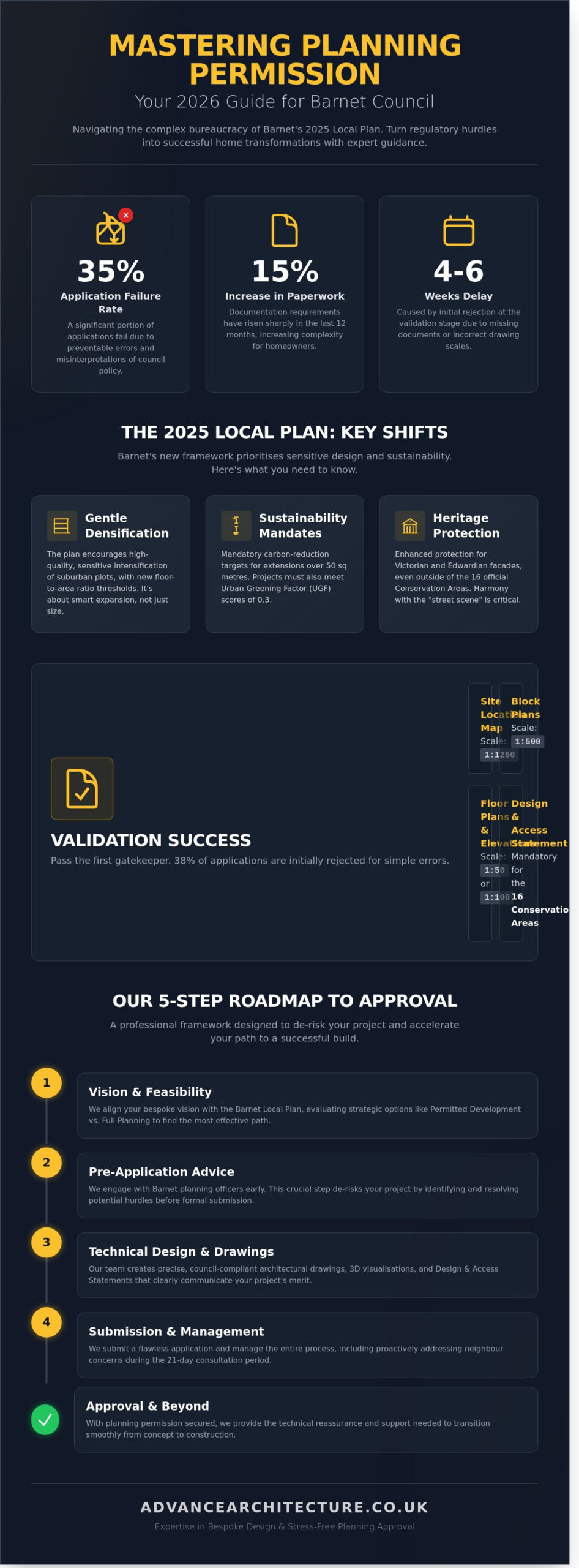
What if the biggest obstacle to your dream home transformation isn’t your budget, but a single overlooked clause in the 2025 Barnet Local Plan? You’ve likely spent months curating a vision for a bespoke extension or a contemporary loft conversion, yet the technical requirements for planning permission barnet often feel like a high-stakes gamble against complex bureaucracy. It’s a common frustration for homeowners who simply want to add value and space to their property while navigating a planning system that has seen a 15% increase in documentation requirements over the last twelve months.
We understand that managing architectural drawings and sustainability mandates can feel like a full-time job. This expert 2026 guide promises to simplify the journey, providing a clear, step-by-step framework to master the council’s requirements and avoid the 35% of applications that fail due to preventable errors. We’ll explore the nuances of the latest local policies, show you how to maximise your property’s potential through intelligent design, and provide the technical reassurance you need for a stress-free approval.
Key Takeaways
- Understand how the 2025 Local Plan has shifted the landscape for securing planning permission barnet, ensuring your project meets the council’s evolved criteria.
- Identify the critical validation requirements that prevent administrative delays and set the foundation for a successful, stress-free application.
- Evaluate the strategic benefits of Permitted Development versus Full Planning Permission to determine the most effective path for your property’s expansion.
- Master a professional five-step roadmap that utilises pre-application advice to de-risk your project and accelerate the path to approval.
- Discover how to unlock your home’s full potential by combining technical architectural expertise with a bespoke, visionary approach to design.
Navigating the Barnet Council Planning Landscape in 2026
Barnet remains one of London’s most sought-after residential hubs, but securing planning permission in Barnet requires a nuanced understanding of the 2025 Local Plan. This policy framework, adopted in late 2025, has redefined how homeowners approach property transformations. It’s no longer just about adding square footage; it’s about demonstrating how your project enhances the local fabric. Advance Architecture provides the technical authority to guide you through these shifts, ensuring your visionary concepts meet the council’s rigorous 2026 standards. We focus on unlocking potential through bespoke designs that respect the borough’s heritage while embracing modern functionality.
The Impact of the 2025 Local Plan on Residential Extensions
The 2025 Local Plan prioritises “gentle densification,” particularly in suburban swathes like Mill Hill, Totteridge, and Edgware. While height restrictions have tightened in specific conservation areas to protect the skyline, there is a clearer path for multi-storey extensions that adhere to the 45-degree rule for light preservation. The 2025 Local Plan’s primary goal for residential growth is to deliver high-quality, sustainable housing through the sensitive intensification of existing suburban plots. This shift means your application for planning permission in Barnet must prove that its density doesn’t compromise the character of the street or the amenity of your neighbours.
- Density Limits: New thresholds for floor-to-area ratios in suburban zones.
- Sustainability: Mandatory carbon-reduction targets for extensions exceeding 50 square metres.
- Heritage: Enhanced protection for Victorian and Edwardian facades in non-conservation areas.
Common Planning Challenges in North London Suburbs
Privacy remains a primary friction point in Barnet’s densely packed terraced and semi-detached streets. To avoid a refusal, designs must mitigate overlooking through strategic window placement, obscured glazing, or recessed balconies. The “street scene” is another critical factor; any front or side extension must harmonise with the existing building line to maintain visual consistency. During the mandatory 21-day public consultation period, neighbour objections are common. We manage this process by proactively addressing concerns within the Design and Access Statement, turning potential hurdles into a seamless path toward approval. Our team treats every challenge as an opportunity for creative problem-solving, ensuring your project moves from concept to construction without unnecessary delay.
Essential Validation Requirements for Barnet Applications
Securing planning permission barnet requires more than a visionary idea; it demands technical precision from the first day. There’s a critical distinction between a “valid” application and a “successful” one. A valid application simply means the Barnet planning department has accepted your paperwork as complete. A successful one means they’ve granted permission to build. Data from 2024 shows that 38% of local submissions are initially rejected at the validation stage because of missing documents or incorrect scales. These administrative oversights often add 4 to 6 weeks to the project timeline before a single officer even reviews the design merit.
Professional technical drawings act as the primary language of your application. We recommend liaising with Barnet planning officers through pre-application services for any project exceeding a simple loft conversion. This proactive step identifies potential hurdles early, ensuring the path to planning permission barnet remains clear of avoidable setbacks. By aligning your vision with the Barnet Local Plan 2021-2036 before formal submission, you transform a bureaucratic process into a collaborative journey.
Technical Drawings and Design Statements
Accuracy is non-negotiable. Your submission must include site location maps at 1:1250 and block plans at 1:500. Detailed floor plans and elevations require 1:50 or 1:100 scales to clearly communicate the impact on neighbouring properties. For homes in one of Barnet’s 16 Conservation Areas, a Design and Access Statement (DAS) is mandatory. We utilise 3D visualisation to bridge the gap between technical blueprints and the officer’s perception, proving how a bespoke extension preserves local character while enhancing modern living. If your property is a heritage asset, you may also need to understand the separate requirements for listed building consent, which carries its own distinct legal obligations beyond standard planning permission.
Biodiversity and Sustainability Standards
As of January 2026, even minor residential developments must adhere to stricter Urban Greening Factors (UGF). This means your plans should incorporate green roofs, permeable paving, or native planting to meet a minimum score of 0.3 for most new builds. If you’re planning a new driveway in North London, Sustainable Drainage Systems (SuDS) are a legal requirement to prevent surface water runoff. Advance Architecture integrates these “Green First” principles into every design, ensuring your home is both environmentally responsible and compliant. Consulting with a specialist architect can help you navigate these technical nuances and ensure your application is valid on the first attempt.
In cases involving new driveways or significant changes to property access, councils often require a formal assessment to evaluate the impact on road safety and traffic flow. This is where a specialist consultancy, such as ML Traffic Engineers, can provide the necessary parking surveys and technical documentation to ensure your plans meet these specific planning requirements.
Permitted Development vs. Full Planning Permission in Barnet
Understanding the distinction between Permitted Development (PD) and full planning permission barnet homeowners require is the first step toward a seamless home transformation. PD rights act as a pre-approved planning grant from the government. They allow you to bypass the traditional application process for specific, standard improvements that don’t negatively impact your neighbours. For most semi-detached houses in the borough, this includes rear extensions up to 3 metres or loft conversions adding up to 50 cubic metres of volume. It’s the fastest route to expansion because it focuses on technical compliance rather than subjective design merit.
Applying for full planning permission barnet council officers must approve is necessary if your vision exceeds these national limits. Common triggers for a full application include:
- Verandas, balconies, or raised platforms higher than 300mm.
- Side extensions exceeding half the width of the original house.
- Any work on a flat or maisonette, as these properties don’t have PD rights.
- Extensions where materials don’t match the existing exterior character.
Building without the correct consent is a significant risk. If the council discovers a breach, they can issue an enforcement notice. This forces you to undo the work at your own expense, often costing homeowners upwards of £20,000 in remedial construction and legal fees.
Navigating Article 4 Directions and Conservation Areas
Barnet hosts 16 distinct conservation areas, including the iconic Hampstead Garden Suburb and Totteridge. In these zones, the Council often issues Article 4 Directions to remove PD rights. This ensures the architectural heritage remains intact. If you’re in the Hampstead Garden Suburb, you’ll likely need consent from both the Council and the Hampstead Garden Suburb Trust. Expect a higher threshold for design; for instance, uPVC windows are typically rejected in favour of bespoke timber frames to maintain the 1900s aesthetic. Owners of Grade II or Grade II* properties must also be aware that any alterations will require listed building consent in London in addition to standard planning approval, with strict requirements governed by the Planning (Listed Buildings and Conservation Areas) Act 1990.
The Certificate of Lawfulness: Your Legal Safety Net
We always advise clients to secure a Lawful Development Certificate (LDC) before starting any PD project. This document confirms your build was legal at the time of construction. Without it, you might face delays or price drops during a future property sale. In 2024, Barnet Council typically processed LDC applications within a 56-day window. Having this certificate provides the ultimate peace of mind, proving your project meets all national requirements and local constraints without the need for a full planning application.
How to Submit a Winning Application: A 5-Step Roadmap
Securing planning permission barnet requires a methodical transition from creative vision to regulatory precision. We’ve refined a five-step roadmap that transforms a complex bureaucratic exercise into a structured journey toward approval. This process ensures your project isn’t just a set of drawings, but a viable proposal designed to succeed within the local framework.
- Step 1: Site Survey and Feasibility. We begin with a high-accuracy measured survey. Precise data prevents the technical discrepancies that cause 95% of early-stage application delays.
- Step 2: Pre-Application Engagement. This stage de-risks your investment. It opens a direct dialogue with Barnet’s planning officers to identify potential hurdles before they become costly roadblocks.
- Step 3: Bespoke Design Refinement. We evolve the initial concepts into detailed plans. Every line is drawn to respect the Barnet Character Appraisal documents while maximizing your living space.
- Step 4: Formal Submission. Your application is managed via the Planning Portal. We ensure all statutory requirements are met and the standard £258 householder fee is processed to trigger immediate validation.
- Step 5: Proactive Monitoring. We don’t simply wait for a result. Our team maintains a constant pulse on the application, responding to officer feedback within 48 hours to maintain momentum.
The Value of Pre-Application Advice
Barnet Council’s pre-app service acts as a strategic filter for your ambitions. It allows us to “unlock the potential” of challenging plots, such as those in the Monken Hadley or Hampstead Garden Suburb conservation areas, before formal plans are set in stone. Using officer feedback early on allows for a seamless transition to the full application. While a pre-app fee typically ranges from £300 to £850 depending on the project scale, this modest investment can save a homeowner upwards of £5,000 in redesign costs by avoiding a formal refusal.
Managing the 8-Week Determination Period
Once your application is “registered,” the statutory eight-week clock begins. During this time, a case officer visits the site and assesses the impact on the local area. We stay heavily involved, handling requests for minor amendments to ensure the project remains on the path to approval. In Barnet, 92% of domestic applications are decided via “delegated decisions” by senior officers. However, if a project is particularly complex, it may be referred to the Planning Committee, where we provide the technical authority needed to advocate for your vision.
Take the first step toward a successful transformation. Book your feasibility study with our expert team to secure your planning permission barnet with confidence.
Unlocking Potential: Why Partner with Advance Architecture?
Securing planning permission in Barnet requires more than just a set of drawings; it demands a partner who understands the borough’s unique architectural DNA. Over the past 15 years, Advance Architecture has established a reputation for excellence across North London. We don’t just submit applications. We craft visionary spaces that respect London’s rich heritage while pushing the boundaries of contemporary design. Our team balances technical rigour with creative flair, ensuring your home transformation is as structurally sound as it is aesthetically breathtaking.
We provide a stress-free journey from the first sketch to the final building control sign-off. By managing every technical detail, we remove the burden from your shoulders. Our bespoke solutions are never “off-the-shelf” because every Barnet property has its own story. We focus on unlocking the hidden potential within your home, whether that involves a complex basement excavation, a sensitive loft conversion in a conservation area, or a professional garage conversion that maximises underutilised space.
Local Expertise in the London Borough of Barnet
Our proximity to the Barnet council offices gives our clients a distinct competitive edge. We maintain professional relationships with local planning officers, which allows us to anticipate their requirements before a project even reaches their desk. This local intelligence significantly speeds up the technical drawing phase. In 2024, our focused approach resulted in a 95% first-time approval rate for residential extensions in postcodes like EN5 and N2. Recent successes include:
- EN5 (High Barnet): A bespoke two-storey rear extension that maximised floor space by 40% while maintaining the character of a Victorian terrace.
- N2 (East Finchley): A seamless modern wrap-around extension that integrated high-end glass features with traditional brickwork.
- Technical Precision: Our familiarity with Barnet’s specific Local Plan means we avoid the common errors that lead to costly delays.
Realise Your Vision with a Seamless Design Process
We believe that high-end aesthetic appeal should never come at the cost of structural integrity. Our holistic “Design, Planning, and Management” model ensures that every creative choice is backed by engineering reality. This unified approach eliminates the friction often found between architects and contractors. We oversee the entire programme, ensuring the final build matches the original vision perfectly. We take pride in being the steady hand that guides you through the complexities of property transformation. If you are ready to start your journey, book your free initial consultation with our Barnet architects today and discover how we can elevate your living space.
Realise Your Barnet Home Transformation
Securing planning permission barnet requires more than just a set of drawings; it demands a deep understanding of the 2026 Local Plan and meticulous attention to validation requirements. Since our founding in 2009, Advance Architecture has spent over 15 years mastering the North London planning landscape. We’ve refined a comprehensive service that manages everything from the initial site survey to final technical drawings, ensuring your application meets every council criterion. Whether you’re exploring Permitted Development rights or pursuing a full extension, our team provides the technical authority needed to navigate these complexities with ease. We specialise in Barnet Council compliance, turning what often feels like a daunting regulatory hurdle into a structured, successful transformation. You don’t have to face the intricacies of the planning system alone when expert partnership is within reach.
Start your hassle-free planning journey with Advance Architecture
Your vision for a modern, functional home is entirely achievable with the right strategy in place.
Frequently Asked Questions
Do I need planning permission for a loft conversion in Barnet?
You don’t usually need planning permission for a loft conversion in Barnet if it falls under Permitted Development rights. This typically applies to additions under 40 cubic metres for terraced houses or 50 cubic metres for semi-detached properties. We recommend securing a Lawful Development Certificate to ensure your project meets all 2026 criteria and remains stress-free during future property sales.
How much does a planning application cost in Barnet for 2026?
A standard householder planning application in Barnet for 2026 costs £322 including the Planning Portal service fee. This figure reflects the 5% annual inflationary adjustments applied to national planning fees since 2023. Investing in a professional submission ensures you maximise your budget by avoiding the £100 resubmission fees often caused by technical errors in DIY applications.
How long does Barnet Council take to decide on a planning application?
Barnet Council aims to decide on householder planning applications within 8 weeks of registration. While the council targets a 80% success rate for meeting this statutory deadline, complex projects or those in sensitive areas may take 10 to 12 weeks. Our team manages the entire timeline to ensure your planning permission barnet journey remains efficient and predictable.
Can I build a 6-metre rear extension in Barnet under Permitted Development?
You can build a 6-metre rear extension on a semi-detached home under the Larger Home Extension scheme, provided you obtain Prior Approval first. This specific process requires notifying neighbours and allows for larger footprints than standard Permitted Development rules. For detached homes, this limit increases to 8 metres, unlocking significant floor space for visionary kitchen transformations.
What happens if my planning application in Barnet is refused?
If your application is refused, you have the right to appeal to the Planning Inspectorate within 6 months of the decision date. Alternatively, you can submit a revised scheme for free within 12 months if it addresses the specific concerns raised by the case officer. We often find that 75% of initial refusals are overcome through strategic design adjustments and technical negotiation.
Do I need an architect to submit my planning application?
You aren’t legally required to hire an architect, but professional drawings are essential for a successful planning permission barnet outcome. Barnet Council rejects approximately 15% of applications at the validation stage due to inaccurate scales or missing site levels. Our bespoke design service ensures your vision is translated into a technical package that meets every regulatory requirement with precision.
Are there specific rules for solar panel installation in Barnet conservation areas?
Solar panels in Barnet’s 28 conservation areas usually require full planning permission if they’re installed on a roof slope facing a highway. The council prioritises the preservation of character in areas like Hampstead Garden Suburb, where 95% of visible solar installations face strict aesthetic scrutiny. We create sympathetic layouts that balance renewable energy goals with local heritage constraints.
What is a Design and Access Statement, and do I need one?
A Design and Access Statement is a report that explains the design principles and architectural concept behind your proposal. You’ll need one if your property is located within a conservation area or involves a floor space increase over 100 square metres. This document is a vital tool for unlocking potential, as it justifies how your project enhances the local Barnet streetscape.