

Building Regulations Drawings in London: The Homeowner’s 2026 Technical Guide
By 2026, a London home extension that passed inspection just five years ago could be deemed legally unfit for construction under the rigorous new Part L energy efficiency mandates. You’ve likely spent months refining your vision and securing planning permission, only to find that the most daunting hurdle isn’t your home’s exterior aesthetic, but the complex technicalities hidden behind the plasterboard. It’s a common source of anxiety to realise that “approved” designs often lack the granular detail required for a safe, lawful build. Our expert guide clarifies this transition by explaining how precise building regulations drawings act as the definitive blueprint for your project’s structural integrity and thermal performance.
We believe the journey to a bespoke home transformation should be inspiring, not bogged down by regulatory jargon or the fear of expensive onsite corrections. This guide provides the steady hand you need to manage London building control officers while unlocking the full potential of your property. You’ll gain a clear perspective on the 2026 technical standards, the essential differences between planning and building control, and the exact documentation required for a stress-free construction phase. We’ll help you ensure your vision is built on a foundation of technical excellence and total compliance.
Key Takeaways
- Learn how to distinguish between visual planning and technical execution to ensure your London project moves seamlessly from visionary concept to concrete reality.
- Discover what a comprehensive set of building regulations drawings must include, from detailed structural build-ups to complex drainage layouts tailored for the city’s historic infrastructure.
- Navigate the rigorous 2026 Part L and Part O standards to enhance energy efficiency and mitigate overheating, securing a future-proofed home that is both sustainable and comfortable.
- Understand why the ‘Full Plans’ application route is the most reliable way to provide technical certainty and a stress-free construction experience for your property transformation.
- Gain the expertise required to liaise with London local authorities and private inspectors, ensuring your bespoke architectural vision meets every regulatory requirement with ease.
Understanding Building Regulations Drawings: The Essential Bridge to Construction in London
Transforming a London property requires more than just a bold vision. It demands a blueprint that bridges the gap between a creative concept and a finished structure. Building regulations drawings aren’t just a formality; they’re the definitive technical manual for your construction team. While a standard floor plan shows where a wall goes, these plans explain how that wall supports the roof, how it retains heat, and how it resists fire. In the high-stakes London property market, these documents are the primary tool for unlocking potential. They take the abstract and make it achievable.
The shift from aesthetic vision to structural integrity is where many projects succeed or fail. Professional technical plans prevent the stress-free promise from becoming a construction nightmare of structural errors and budget overruns. By specifying every joist, lintel, and insulation layer, we ensure the build remains as sturdy as the design is elegant. This methodical approach provides the steady hand needed to guide homeowners through the complexities of property transformation with absolute expertise.
Why Planning Permission is Only the First Step
Many homeowners mistakenly believe that securing planning permission means they’re ready to start digging. It’s a common misconception. Planning permission only covers the look and the impact of a building on its surroundings. It doesn’t tell a builder how to actually construct the walls or lay the foundations. Planning drawings lack the granular detail required for a safe, legal build. Technical drawings protect your investment by removing guesswork. They ensure the bespoke solutions designed for your home are practical, providing a clear roadmap that future-proofs the property against changing environmental standards.
The Legal Requirement for Building Control Approval
Every major renovation or extension in England carries a statutory obligation to comply with the Building Act 1984. This isn’t a suggestion; it’s a legal mandate. Building regulations in the United Kingdom ensure that every structure prioritises the health and safety of its occupants through rigorous standards for fire safety, ventilation, and structural stability. If you build without approved building regulations drawings, you risk local authority enforcement action. This can result in heavy fines or even the forced demolition of the work.
Think of these documents as your primary insurance policy. They provide a documented trail of compliance that protects you against structural failure and expensive legal disputes. When it’s time to sell your property, having a full set of approved plans and a final completion certificate is vital. It proves to buyers and lenders that the transformation was handled with the professional care it deserved, ensuring a seamless transition from your vision to a valuable, legal asset.
Planning Drawings vs Building Regulations Drawings: Navigating the London Regulatory Landscape
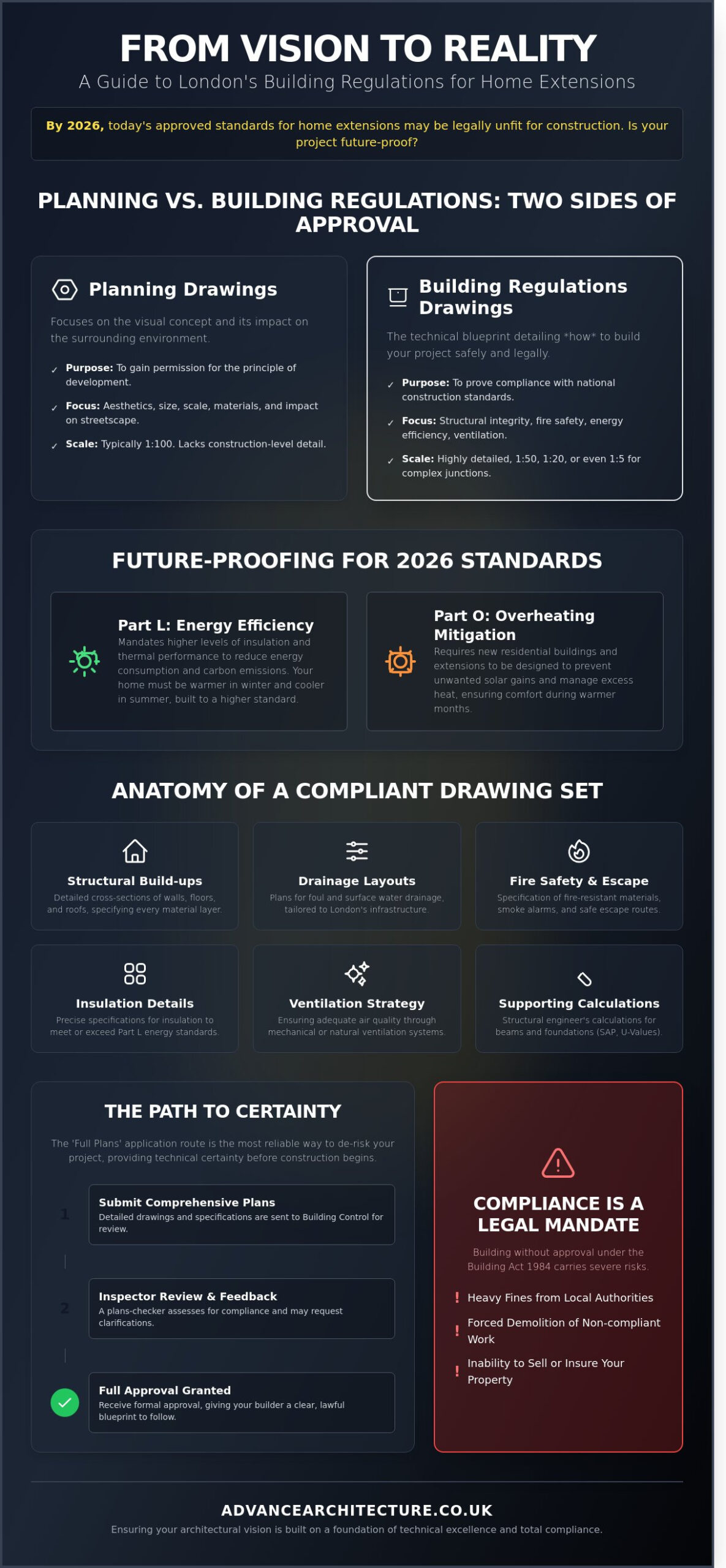
London planning departments in boroughs like Barnet or Islington view your project through two distinct lenses. Planning drawings focus on the aesthetic impact, volume, and how your home interacts with the streetscape. In contrast, building regulations drawings serve as a technical blueprint for the actual construction. While planning sets the vision, these technical plans ensure the vision is safe, warm, and legally compliant. Most London councils require separate submissions for each stage because they address entirely different sets of legislation.
The difference in scale is often the first thing homeowners notice. A planning application typically relies on 1:100 scale drawings. These provide enough detail for a planning officer to judge the external appearance and impact on neighbours. Once you move to the technical stage, the scale increases to 1:50 or even 1:20 for specific junctions. This shift in magnification allows us to specify every layer of the building envelope, from the cavity wall ties to the specific fire-rated plasterboard used in a hallway. Advance Architecture manages this transition meticulously, ensuring that the creative design approved at the planning stage is translated accurately into a buildable reality.
The Granular Detail of Technical Plans
Technical plans reveal the hidden layers of your home. We detail the specific thickness of PIR insulation, the exact route of foul water drainage, and the ventilation rates required for new habitable rooms. This stage is where architect planning evolves into a comprehensive construction manual. For period London terraces or complex loft conversions, bespoke detailing is vital. It protects the heritage of the building while meeting modern thermal standards. We focus on these minute details to prevent issues like cold bridging or damp, which can occur if technical specifications are overlooked.
Structural Integrity and the Engineer’s Role
A building doesn’t stand on aesthetics alone. We integrate structural engineering calculations directly into the building regulations drawings to ensure every beam and column is correctly sized. This collaboration ensures your house extensions london are as sturdy as they are beautiful. Obtaining Building regulations approval requires a tripartite dialogue between the architect, the structural engineer, and the building control officer. This process provides a safety net for the homeowner. It ensures the contractor has a precise set of instructions to follow, reducing the risk of site errors. Advance Architecture acts as the steady hand through this process, unlocking the potential of your property while maintaining a seamless project flow. If you’re ready to move from concept to construction, our team can guide you through the technical design phase with expert precision.
The 2026 Technical Standards: Energy Efficiency and Thermal Performance for London Extensions
The UK construction landscape is shifting toward a zero-carbon future. As we approach the implementation of the 2026 Future Homes Standard, building regulations drawings must evolve beyond simple structural layouts to become sophisticated energy models. These documents now serve as the primary evidence that your project aligns with the updated Approved Documents, specifically focusing on carbon reduction and climate resilience.
Part L requirements for 2026 demand a rigorous approach to the thermal envelope. Your technical drawings specify the exact thickness of PIR insulation, the thermal conductivity of floor slabs, and the precise U-values required for every external element. It isn’t just about ticking boxes. It’s about ensuring your home remains comfortable and cost-effective to run as energy prices fluctuate.
In the dense urban fabric of the capital, the London Heat Island effect presents a unique challenge. Part O regulations now require architects to mitigate overheating through strategic design. Your technical package will detail specific glazing G-values, external shading devices, and window opening limiters. This technical foresight prevents your new glass-roofed extension from becoming an unusable greenhouse during London’s increasingly hot summers.
To maintain a healthy living environment, Part F (Ventilation) works in tandem with these airtightness measures. We specify mechanical extract ventilation or heat recovery systems (MVHR) to ensure a constant supply of fresh, filtered air. This creates a breathable urban home that protects your family from both external pollutants and internal dampness. It’s a seamless integration of health and efficiency.
Maximising Energy Performance in Period Homes
Upgrading Victorian and Edwardian properties in London requires a bespoke touch to balance heritage with modern efficiency. We specify high-performance slimline glazing and internal wall insulation that preserves original cornicing and external brickwork. Part L compliance is a mandatory 30% reduction in carbon emissions for 2026. This standard ensures that even a 120-year-old terrace can achieve contemporary levels of thermal comfort without losing its architectural soul.
Future-Proofing Your Property with Technical Design
Modern building regulations drawings now incorporate complex renewable technologies as standard. We’ve seen a decisive move toward electric heating and air-source heat pumps in new London developments to phase out gas boilers. These systems require careful spatial planning. Using 3D visualisation helps you understand the technical plant room layouts and pipework routing before a single brick is laid. This proactive approach ensures your home is ready for the energy transition, unlocking the long-term value of your property.
Your Building Regulations Checklist: What a Comprehensive Set of Plans Includes
A comprehensive set of building regulations drawings converts a creative vision into a technical reality. These documents serve as the definitive instruction manual for your contractor; they ensure every component of the build meets the rigorous safety and performance standards required by UK law. At Advance Architecture, we produce detailed floor plans and sections at 1:50 or 1:20 scales, illustrating precise construction build-ups from the foundation to the ridge tile. This level of detail eliminates guesswork and provides a clear roadmap for a successful build.
- Thermal Performance: Detailed insulation specifications for walls, roofs, and floors to meet Part L requirements, targeting specific U-values such as 0.18 W/m²K for new roof structures.
- Drainage and Plumbing: Comprehensive layouts that navigate London’s complex, often Victorian, sewer systems to ensure efficient waste management and compliance with local water authorities.
- Material Specifications: A curated list of materials that comply with British Standards, ensuring your bespoke finish is backed by industrial-grade durability and safety.
Fire Safety in Dense London Neighbourhoods
Building control officers in London prioritise fire safety above all else due to the proximity of neighbouring structures. When we design loft conversions for terraced houses, the building regulations drawings must detail a protected escape route. This includes the installation of FD30 fire doors and a mains-linked smoke detection system across all floors. We specify fire-rated glass and finishes that maintain a high-end aesthetic while providing essential protection. It’s about creating a home that is as safe as it is beautiful.
Structural Details and Party Wall Considerations
Your project exists in a wider architectural context. Our technical drawings provide the clarity needed for foundations, steel beams, and joist layouts, showing exactly how new structures interact with existing London party walls. This level of detail is essential for fulfilling your obligations under the Party Wall Act 1996. By providing clear structural sections, we facilitate a smoother process with party wall surveyors and reduce the potential for delays. We handle the technical complexity so you can focus on the transformation of your space.
Securing Building Control Approval: How Advance Architecture Simplifies the Process
The transition from a conceptual design to a physical structure requires more than just creativity; it demands technical precision and a deep understanding of UK legislation. At Advance Architecture, we act as your dedicated partner, managing the complex interactions with London local authorities and private Approved Inspectors. While some contractors suggest a Building Notice for speed, we exclusively recommend the Full Plans application route for our clients. This proactive approach involves submitting comprehensive building regulations drawings for formal review before a single brick is laid, typically securing a decision within the statutory five to eight-week period.
Full Plans Approval: The Gold Standard for Homeowners
Choosing a Full Plans submission is the most effective way to eliminate uncertainty. By obtaining approval upfront, you ensure that every technical detail, from thermal insulation layers to structural steel specifications, meets the rigorous standards of the Building Safety Act 2022. This method provides three distinct advantages for your project: financial transparency, regulatory compliance, and construction efficiency. When you present a builder with a Full Plans approval, you remove the “grey areas” that often lead to expensive on-site variations and mid-build disputes.
During the construction phase, the Building Control Officer or private inspector will visit the site at key milestones. These inspections usually occur within 48 hours of a request and cover critical elements such as:
- Excavation of foundations and damp-proof courses.
- Installation of structural beams and floor joists.
- Drainage layouts and final completion tests.
The Advance Architecture Advantage
Our firm is built on a foundation of technical excellence and visionary design. Based in North London, we understand the unique challenges of the local architectural landscape, from Victorian terrace refurbishments to contemporary new builds. Our bespoke technical packages do more than just satisfy inspectors; they protect your home’s long-term value and structural health. We believe that a well-executed technical design is the bridge between a dream and a reality that lasts for generations.
Securing your completion certificate is the final milestone in your journey. By meticulously following the RIBA Work Stages, we guide you from the initial spark of an idea through to the successful handover of your transformed property. Our process is designed to be seamless, professional, and entirely focused on your peace of mind.
Ready to unlock your property’s potential? Our team is here to provide the steady hand and expert insight you need to navigate the construction process with ease. Contact Advance Architecture today for a free consultation to discuss your vision, planning requirements, and technical needs.
Securing Your Property’s Future with Technical Excellence
Navigating the transition to the 2026 technical standards requires more than just a basic floor plan. It demands a precise set of building regulations drawings that address the latest Part L requirements for thermal performance and energy efficiency. By distinguishing between initial planning concepts and these detailed technical specifications, you ensure your London home isn’t just approved on paper but is also structurally sound and thermally optimised for the future. Advance Architecture brings proven expertise in London local authority requirements, providing bespoke technical drawings specifically tailored for complex period properties. Our comprehensive RIBA-aligned project management ensures every detail meets the rigorous 2026 criteria. We handle the intricacies of Building Control so you can focus on the excitement of your home’s transformation.
Realise your vision with a stress-free technical design, book your free consultation today.
Your journey from a visionary concept to a completed, compliant masterpiece starts with the right technical foundation. We’re here to help you unlock the full potential of your property with confidence and ease.
Frequently Asked Questions
Do I really need building regulations drawings for a small extension?
Yes, you absolutely need building regulations drawings for a small extension to ensure your project complies with UK safety and energy standards. Even minor additions must meet the requirements of the Building Act 1984. These technical plans provide the necessary detail for Building Control to approve your structural integrity, fire safety, and thermal performance. Without them, you risk costly remedial work or significant difficulties when selling your property in the future.
How much do building regulations drawings cost in London for 2026?
For a standard residential extension in London in 2026, professional fees for building regulations drawings typically range between £1,500 and £3,500 plus VAT. This estimate reflects the increased complexity of London’s urban landscape and current industry inflation rates tracked by the Royal Institute of British Architects. These costs cover the technical architectural drawings and the necessary coordination with structural engineers. Investing in high-quality documentation at this stage prevents expensive errors during the construction phase.
Can my builder produce the building regulations drawings for me?
While a builder can technically produce these drawings, it’s rarely recommended for complex modern projects. Building regulations drawings require a deep understanding of technical legislation and structural performance that goes beyond standard construction knowledge. Most builders prefer to work from plans created by a qualified architectural designer to ensure every detail is legally compliant. This separation of design and construction provides you with an essential layer of professional oversight and a stress-free experience.
How long does it take to get building control approval in London?
You should expect the Full Plans application process to take between 5 and 8 weeks for a standard residential project in London. Local authorities are legally required to provide a decision within 5 weeks, though this can be extended to 8 weeks with your consent. Using a private approved inspector can sometimes expedite this timeline. We recommend submitting your building regulations drawings early to avoid any potential delays to your construction schedule and help you realise your vision on time.
What is the difference between a building notice and a full plans application?
A Full Plans application involves submitting detailed building regulations drawings for approval before you start work on site. This provides the security of knowing your design is fully compliant before you spend money on materials. In contrast, a Building Notice is a simpler notification for minor works where you don’t submit plans in advance. While faster to start, a Building Notice carries higher risks as inspectors may demand changes during construction, leading to unexpected costs.
What happens if my project doesn’t meet building regulations?
If your project fails to meet building regulations, the local authority can issue an enforcement notice under Section 36 of the Building Act 1984. This requires you to alter or remove the non-compliant work at your own expense. Failure to comply can lead to unlimited fines in a magistrates’ court. Additionally, you’ll find it nearly impossible to sell your home without a completion certificate, as 95 percent of buyers’ solicitors require this legal proof of safety.
Do building regulations drawings include structural engineering?
Building regulations drawings focus on the architectural and legislative compliance, but they must be supported by structural engineering calculations. For most extensions, you’ll need a structural engineer to provide specific data on beams, foundations, and load-bearing elements. These calculations are integrated into the final technical package to ensure a seamless approval process. Our approach ensures these two distinct disciplines work in harmony to create a safe and efficient build that succeeds in unlocking potential.
Will my building regulations drawings expire if I don’t start work?
Your building regulations approval will expire if you don’t commence work on site within 3 years of the deposit of plans. This 3-year limit is set by Section 32 of the Building Act 1984 and applies across the UK. If your approval lapses, you’ll need to resubmit your drawings and pay the application fees again. It’s also important to check if building standards have updated during that time, as new requirements for thermal efficiency or ventilation may now apply.