
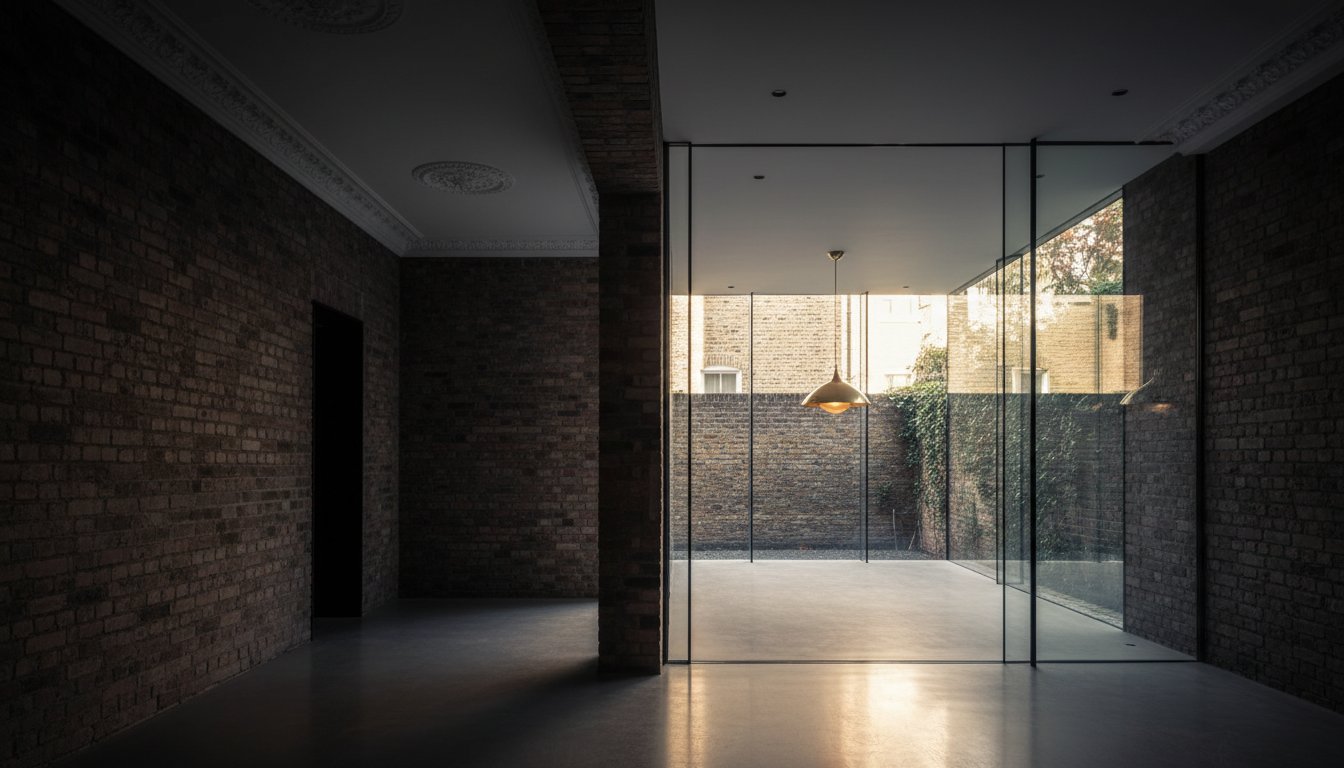
Listed Building Consent London: The 2026 Homeowner’s Guide
What if the strict regulations surrounding your heritage property weren’t a barrier, but a blueprint for extraordinary design? You likely recognize that owning a Grade II or Grade II* listed home in London is a prestigious responsibility, yet the prospect of securing listed building consent often brings more anxiety than inspiration. It’s natural to feel overwhelmed by the complexities of heritage law or the risk of unauthorized works, which can lead to significant legal repercussions under the Planning (Listed Buildings and Conservation Areas) Act 1990.
We believe that heritage and high-end modern living should exist in perfect harmony. This guide empowers you to master the 2026 planning landscape, helping you navigate the delicate balance between preservation and innovation with absolute confidence. We’ll examine the specific requirements for London boroughs, clarify how consent differs from standard planning permission, and outline the path to a seamless, high-value transformation that respects the past while embracing the future.
Key Takeaways
- Understand the legal frameworks protecting London’s architectural history and why these regulations are vital for preserving your property’s heritage and market value.
- Identify the critical distinctions between Grade I, II*, and II listings to better navigate the specific constraints and creative possibilities of your home.
- Master the dual-track application process by learning how to align listed building consent with planning permission for a stress-free transformation.
- Secure a competitive advantage by following our 2026 roadmap for engaging with London borough councils and conservation officers during the pre-application phase.
- Discover how visionary design can bridge the gap between historic fabric and modern functionality, unlocking the full potential of your bespoke London residence.
Understanding Listed Building Consent in London
Securing listed building consent isn’t just a box-ticking exercise; it’s a vital legal framework designed to protect the soul of North London’s architectural fabric. This mandate stems from the Planning (Listed Buildings and Conservation Areas) Act 1990, which requires formal approval for any work affecting a building’s special interest. For homeowners in boroughs like Camden or Islington, the process represents a partnership between modern lifestyle needs and historical preservation. Performing unauthorised work is a criminal offence that can lead to unlimited fines or even imprisonment. Local authorities maintain the power to issue enforcement notices, forcing owners to reverse costly alterations at their own expense. This rigorous oversight ensures that the special architectural or historic interest of your home remains protected during any transformation.
The value of a London heritage asset is intrinsically linked to its authenticity. Data from the 2023 Heritage Counts report indicates that historic buildings often command a significant price premium compared to non-listed properties. By obtaining the correct permissions, you aren’t just following the law; you’re safeguarding a high-end investment. We act as your steady hand, navigating these regulatory hurdles to ensure your project proceeds with confidence and creative clarity.
Why Listed Status Matters for London Homeowners
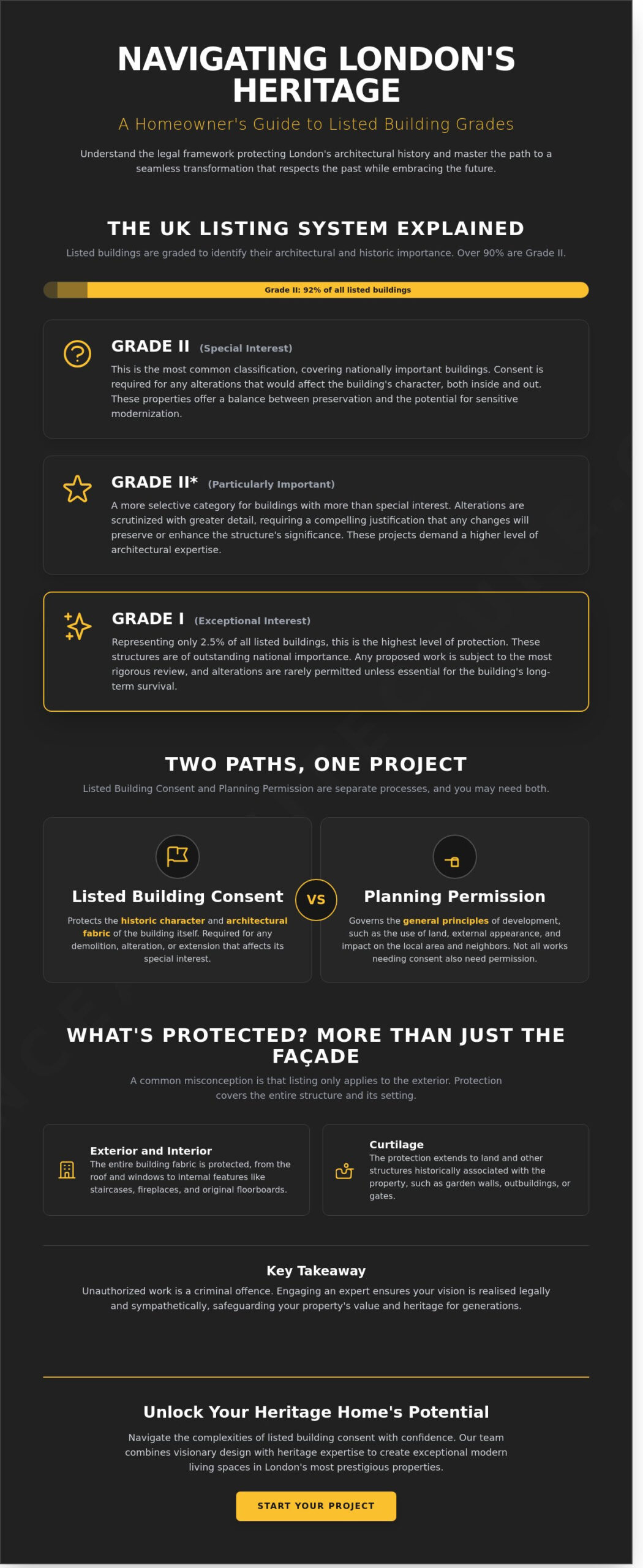
London’s identity is built upon its rows of Georgian, Victorian, and Edwardian terraces. These structures aren’t just homes; they’re historical documents that reflect centuries of craftsmanship. Historic England manages the National Heritage List for England, a database of over 400,000 protected sites across the country. You can explore The UK Listing System to understand how different grades, from Grade II to Grade I, dictate the level of protection applied. Each grade carries specific implications for what can be altered, making professional guidance essential from the outset.
For a North London homeowner, listed status impacts both the internal layout and the external appearance. Whether you’re planning a bespoke kitchen extension or a sensitive window restoration, every detail must respect the original design intent. Our approach focuses on unlocking potential within these constraints, delivering modern functionality without compromising the building’s historical narrative. This methodical process ensures a stress-free journey from initial vision to final execution.
The Scope of Protection: Internal vs. External
A frequent and costly mistake is the belief that listing only applies to the exterior facade. In reality, the protection covers the entire structure, including the interior and often the surrounding land. Original features like timber-framed windows, plaster cornices, marble fireplaces, and grand staircases are all protected elements. Even floorboards or internal partitions may require listed building consent for removal or modification. Preserving these details is what maintains the property’s unique character and long-term market appeal.
The curtilage of a listed building encompasses the land and ancillary structures historically associated with the main property, meaning that even detached garden walls or outbuildings often fall under the same protections as the primary residence. Understanding these boundaries is crucial for any comprehensive renovation strategy. We provide visionary expertise to help you identify which features are sacrosanct and where modern innovation can be seamlessly integrated. By respecting the building’s curtilage and interior heritage, we create spaces that are both historically significant and perfectly suited for contemporary life.
The UK Listing System: Grades I, II*, and II Explained
Understanding the hierarchy of heritage protection is the first step toward unlocking your home’s potential. In 2026, local authorities in North London continue to utilize three distinct categories to safeguard architectural integrity. This system ensures that our shared history remains visible while allowing for the evolution of modern living spaces. We approach every project with a blend of reverence for the past and a vision for the future, ensuring your property remains both a piece of history and a functional home.
- Grade I: These are buildings of exceptional interest. This category is rare, representing only 2.5% of all listed structures in the UK.
- Grade II*: This designation applies to particularly important buildings that demonstrate more than special interest.
- Grade II: This is the most common classification, covering approximately 92% of listed properties. It’s the standard designation for the majority of residential heritage homes across North London.
Navigating Grade II Listing in Residential Projects
Grade II status is the framework most homeowners encounter when planning an extension in areas like Highgate or Islington. This designation provides a layer of protection rather than a total prohibition of change. Planning officers often allow for sympathetic modernisations that respect the original structure’s rhythm, scale, and materiality. We’ve successfully delivered transformations where contemporary glass-linked extensions were paired with original Victorian brickwork. These bespoke solutions bridge the gap between 19th-century charm and 21st-century lifestyle requirements. Our team focuses on three core elements: Design, Planning, and Management. This structured approach ensures that your vision for a seamless living space aligns with local conservation goals.
Identifying Your Property’s Grade and Significance
Determining your property’s specific status is a straightforward process using the Planning Portal or the National Heritage List for England. Once the grade is confirmed, the application requires a document known as a Statement of Significance. This critical report identifies the architectural and historical features that justify the building’s protection. It’s a mandatory requirement for any Listed Building Consent guidance application. Securing listed building consent is a methodical process that rewards precision and professional insight.
Establishing these heritage values early prevents 15% to 20% of design revisions during the later stages of the planning process. If you’re considering a renovation, our experts can assist in unlocking your home’s potential through a detailed feasibility study. Knowing exactly what’s protected allows us to create a design that’s both ambitious and achievable, turning regulatory hurdles into creative opportunities.
Listed Building Consent vs. Planning Permission
Understanding the distinction between these two regulatory frameworks is essential for a successful renovation in North London. While they often operate in tandem, they serve entirely different legal purposes. Planning permission regulates the use of land, the appearance of a building, and its impact on the surrounding environment and neighbours. In contrast, listed building consent focuses specifically on protecting the architectural and historic interest of the structure itself. For most significant projects, homeowners must secure both approvals before any work commences on site.
This dual requirement ensures that modern living requirements don’t compromise the integrity of our built heritage. If you are unsure of your property’s specific status, you should consult the National Heritage List for England to identify the exact grade and description of your home. This official record dictates the level of scrutiny your proposal will face from the local planning authority and Historic England. Under the Planning (Listed Buildings and Conservation Areas) Act 1990, any work that affects the character of a building of special interest requires formal authorization, regardless of whether it changes the external appearance.
When Do You Need Both Applications?
Proposing house extensions in London almost always triggers the need for both applications. Planning officers assess how the extension affects the local streetscape and sunlight levels for neighbours. Simultaneously, the conservation officer examines how the new structure joins the original 18th or 19th-century masonry. Even internal changes that don’t require planning permission, such as removing a period partition wall or relocating a staircase, still require listed building consent. Conversely, “like-for-like” repairs using identical materials might bypass the planning system but often require a formal heritage consultation to ensure the methodology respects the building’s fabric.
The Impact on Permitted Development Rights
For unlisted homes, permitted development rights offer a streamlined path to expansion. However, these rights are significantly restricted for listed buildings. You cannot utilize standard permitted development side extension rules if your property is listed. Any enlargement requires a full planning application. In many North London boroughs like Islington or Camden, Article 4 Directions further remove these rights to preserve the character of conservation areas. This means even minor external changes, such as replacing a window or installing a small boiler flue, demand a rigorous application process. We manage these complexities by providing detailed heritage statements that justify every design choice, ensuring your vision aligns with statutory requirements.
Navigating the Application Process with London Councils
Securing listed building consent in 2026 requires a methodical and transparent approach to satisfy the rigorous standards of North London’s local authorities. The roadmap begins with pre-application advice, a crucial phase where we engage with the local Conservation Officer to identify potential constraints before the formal submission. This early dialogue often prevents expensive design revisions later in the timeline. Once the project parameters are defined, we move to step two: preparing a comprehensive Heritage Statement and a Design & Access Statement. These documents provide the historical context and justification for your project, ensuring the council understands the “why” behind every proposed change.
The third stage involves the submission of detailed architectural plans and technical drawings. These must be executed with surgical precision to show exactly how new interventions meet existing historic fabric. Finally, the application enters an 8-to-12 week consultation and decision-making window. During this time, the council invites feedback from the public and statutory consultees. Our role throughout this period is one of active advocacy, managing correspondence and ensuring the technical merits of your vision are clearly communicated to the decision-makers.
Working with Conservation Officers in North London
The Conservation Officer is a central figure in the planning permission Barnet process, acting as both a guardian of history and a professional evaluator of change. To gain their support, modern design concepts must be presented as sympathetic additions that respect the original craftsmanship of the building. We achieve this through successful site visits where we demonstrate a deep understanding of the property’s DNA. Our negotiation strategy focuses on partnership; we present bespoke solutions that solve modern living requirements while enhancing the building’s character, turning potential regulatory friction into a collaborative success.
Required Documentation for a Stress-Free Application
Precision is the foundation of a stress-free application. We utilise high-quality 3D visualisations to help officers see the finished result, removing the ambiguity that often leads to refusals. Technical accuracy in building regulation drawings is non-negotiable, as these documents prove that modern safety and thermal standards can be met without compromising structural integrity. By framing every alteration as a “heritage enhancement” or a “public benefit,” we create a narrative that justifies change. This expert documentation is how we unlock the potential of restricted spaces, ensuring your listed building consent application is both visionary and compliant.
Unlocking Potential: How Architects Maximise Heritage Homes
Owning a Grade II or Grade II* listed property in North London is a privilege that often feels like a regulatory challenge. We don’t view these restrictions as barriers; we see them as a framework for high-end innovation. Advance Architecture acts as your visionary partner, navigating the delicate balance between preserving 18th-century craftsmanship and integrating 21st-century luxury. Our goal is to create a seamless transition where the historic fabric remains respected, yet the lifestyle within the home is entirely transformed.
The value of a bespoke approach lies in its ability to overcome restrictive heritage conditions. Standard solutions rarely work for listed buildings. Instead, we use creative problem-solving to turn planning constraints into unique design features. Whether it’s a Georgian townhouse in Highgate or a Victorian villa in Hampstead, we ensure your home functions for modern life without losing the soul of its past.
Bespoke Design Solutions for Listed Extensions
Adding space to a heritage home requires a light touch and technical precision. One of our most effective concepts is the use of structural glass links. These transparent corridors physically separate the new extension from the original masonry, creating a clear visual distinction that conservation officers often favour. This method allows us to maximise natural light and create open-plan living areas while protecting the original structural integrity of the house.
This level of detail is exactly how residential architects in London add tangible value to your investment. We use reversible techniques and breathable materials to ensure the building’s longevity. By focusing on “light and volume,” we turn cramped, historic rooms into airy, functional spaces that feel significantly larger than their footprint suggests.
Realising Your Vision with Advance Architecture
Securing listed building consent is only the first step in a complex journey. Our “Design, Planning, and Management” model provides a steady hand through every phase of construction. Professional project management is essential for heritage projects because they require specialist trades, such as master stonemasons or experts in traditional lime mortar. We coordinate these artisans to ensure the finish meets our exacting standards.
Investing in sensitive modernisation isn’t just about aesthetics; it’s about securing your property’s future. A well-executed renovation can increase a heritage property’s market value by up to 15% or 20% compared to unmodernised versions. We handle the technical complexities and the regulatory hurdles to make the experience stress-free for you. Our team is ready to help you unlock the hidden opportunities within your historic home.
Ready to begin your transformation? Book your free consultation with our London heritage experts
Transform Your London Heritage Property With Confidence
Owning a piece of London’s architectural history is a rare privilege that requires a sophisticated approach to renovation. Successfully obtaining listed building consent depends on your ability to align visionary design with the strict conservation standards set by Historic England. Navigating the nuances between Grade I, II*, and II listings is the first step toward a seamless transformation that respects the past while embracing the future.
Advance Architecture offers a comprehensive Design, Planning, and Management service tailored to the complexities of heritage properties. Our team maintains a proven track record of successful applications with Barnet, Camden, and Islington councils, ensuring every detail meets local regulatory demands. We specialise in unlocking the hidden potential of historic spaces, providing the technical authority needed to handle even the most intricate structural requirements. By choosing a partner with deep expertise in London’s conservation areas, you turn a daunting regulatory journey into an inspiring creative process.
Realise the visionary potential of your listed home-book a free consultation today
We look forward to helping you create a bespoke living space that stands the test of time.
Frequently Asked Questions
How long does listed building consent take in London in 2026?
Most local authorities in North London, including Camden and Islington, aim to process listed building consent applications within 8 weeks. While these statutory timelines remain the standard for 2026, complex bespoke projects or those involving Historic England consultations can take up to 13 weeks. We manage this process through meticulous design, planning, and management to ensure your timeline remains as predictable and stress-free as possible.
Do I need listed building consent for internal painting or decorating?
You generally don’t need formal consent for routine internal painting or minor decorating that utilizes breathable, period-appropriate materials. However, if your vision involves stripping historic timber, removing original plasterwork, or applying modern non-breathable paints to sensitive masonry, the council requires an application. We help you navigate these nuances to ensure your interior transformation respects the building’s heritage while achieving a contemporary, high-end finish.
Can I install double glazing in a Grade II listed building?
Standard double glazing is typically refused, but you can often install ultra-slim vacuum glazing or high-quality secondary glazing to improve thermal efficiency. Local planning officers in 2026 prioritize energy performance provided the new units match original frame profiles exactly. Our team designs bespoke solutions that balance modern comfort with structural integrity, ensuring your home remains warm, quiet, and historically compliant.
What happens if I carry out work without listed building consent?
Carrying out unauthorized work is a criminal offense that can lead to unlimited fines or a prison sentence of up to 2 years. Local authorities also have the power to issue enforcement notices, requiring you to reverse all changes at your own expense. We provide the expert guidance needed to avoid these legal risks, securing the necessary listed building consent to protect your investment and your peace of mind.
Is there a fee for a listed building consent application?
There’s currently no government fee for submitting a standalone listed building consent application in England. If your project also requires full planning permission, you’ll need to pay the standard fee, which is £258 for most residential extensions under current 2024 and 2025 regulations. We streamline this process by coordinating your technical documents, ensuring a cost-effective and seamless experience from initial concept to final approval.
Can I extend a listed building using permitted development?
Permitted development rights are significantly restricted for listed properties, meaning almost any extension requires a full application for listed building consent. Even minor additions that would be allowed on standard homes need rigorous oversight to protect the building’s architectural significance. We specialize in unlocking potential through sensitive, visionary designs that respect these constraints while creating expansive, functional living spaces for modern life.
What is a Heritage Statement and why do I need one?
A Heritage Statement is a mandatory report that assesses the historical significance of your property and explains how your proposed changes impact that character. It’s a vital tool for convincing planning officers that your project is respectful, well-considered, and professional. Our experts craft detailed, persuasive statements that highlight the harmony between your lifestyle needs and the building’s historic fabric, facilitating a smoother approval process.
Can I appeal a decision if my listed building consent is refused?
You have the right to appeal to the Planning Inspectorate within 6 months of receiving a refusal notice. Data from the Planning Inspectorate suggests that roughly 25 percent of appeals are successful, though we prefer to achieve success through early engagement and high-quality design. We act as your steady hand during this process, refining your vision and providing the technical authority needed to challenge unfavorable decisions effectively.