

Navigating GOV.UK for Planning & Building: A 2026 London Homeowner’s Guide
What if the success of your London home extension depended entirely on a single 2026 regulatory update found within the gov.uk archives? For many homeowners, the prospect of deciphering complex government terminology feels like a barrier to creative progress. You understand that your home is your most significant asset, yet the fear of a planning rejection or an unexpected enforcement notice can make the journey feel precarious. It’s a common frustration to feel trapped between national standards and the unique demands of local London councils.
We are here to provide the steady hand you need to move from uncertainty to a visionary transformation. By mastering the latest building standards and the 2026 safety updates, you can unlock the true potential of your property with absolute confidence. This guide offers a comprehensive roadmap of the planning process, clarifying the distinction between gov.uk guidelines and specific local regulations. We will explore how to achieve a stress-free approval through meticulous design, strategic planning, and expert management.
Key Takeaways
- Master the complexities of the gov.uk Planning Portal to clearly distinguish between national policy frameworks and the unique legislative requirements of your specific London borough.
- Unlock your property’s hidden potential by identifying which London home extensions qualify under Permitted Development rights for a more streamlined and efficient transformation.
- Navigate the intricate landscape of London’s heritage constraints, including Article 4 Directions, to ensure your bespoke design respects local conservation standards.
- Gain clarity on the technical “Approved Documents” required for Building Regulations to ensure your project meets the highest safety and structural integrity standards.
- Partner with a visionary expert to transform the daunting planning process into a seamless, stress-free journey from initial concept to project completion.
Decoding the gov.uk Planning Portal for London Homeowners
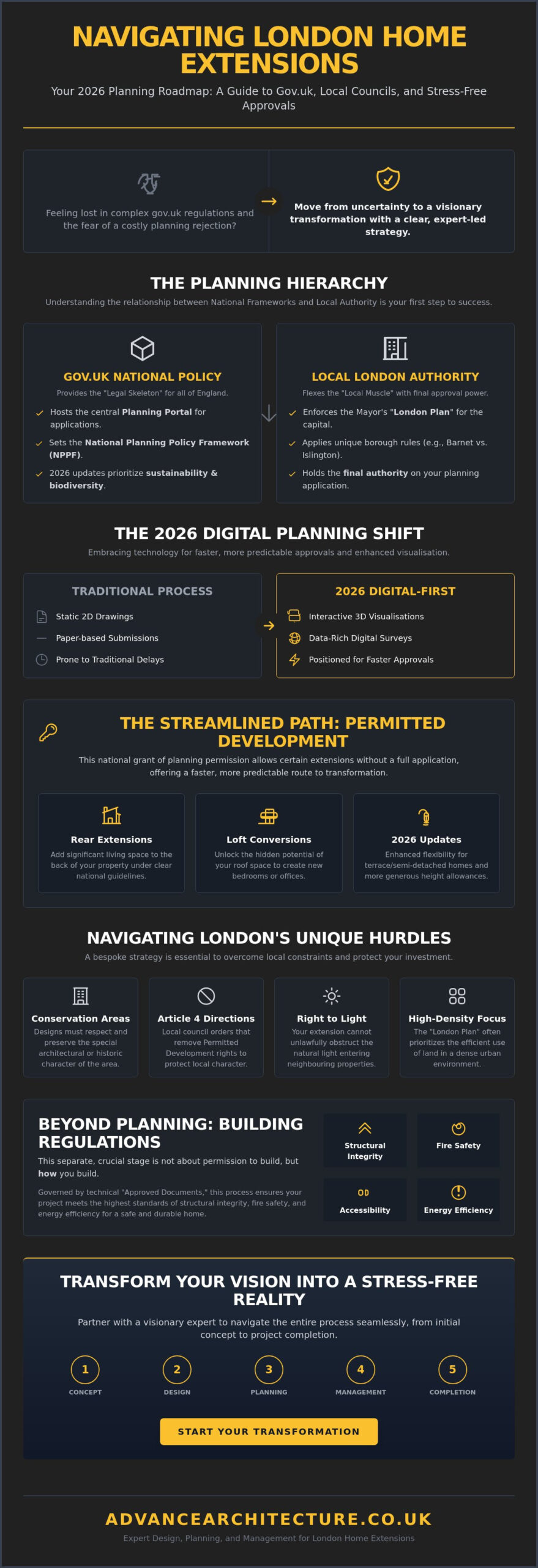
Transforming a London residence requires more than just a creative spark; it demands a clear understanding of the regulatory architecture governing our capital. The gov.uk website serves as the central repository for the National Planning Policy Framework (NPPF), setting the baseline for what’s permissible across England. While this provides the legal skeleton, the actual muscle of the UK Town and Country Planning System is flexed at the local level. Homeowners must use the Planning Portal to submit architectural designs, ensuring every technical detail aligns with both national standards and local nuances. By 2026, these regulations have pivoted sharply toward sustainable urban development, prioritizing projects that minimize carbon footprints and maximize biodiversity. Our role is to guide you through this maze, providing the Design, Planning, and Management expertise necessary to turn a complex application into a successful property transformation.
National Planning Policy vs. Local London Authority
The Mayor of London’s “London Plan” adds a layer of complexity to the general gov.uk guidelines, focusing on high-density optimization and heritage preservation. While national policy sets the stage, your local North London council holds the final authority over your application. In boroughs like Barnet, planners often scrutinize the impact on suburban character and garden grabbing. Conversely, Islington focuses heavily on conservation area constraints and the protection of light rights for neighboring properties. Success depends on a bespoke strategy that respects these localized hurdles while leveraging national permitted development rights. We focus on unlocking potential by balancing these competing demands, ensuring your vision meets the specific criteria of your local planning committee through meticulous preparation and visionary design.
The 2026 Digital Planning Transformation
The 2026 shift toward a data-rich planning system marks a significant evolution in how we realize property transformations. Government initiatives have fully digitized the application process, moving away from static 2D drawings toward interactive digital site surveys and 3D visualisations. These tools assist in securing faster approvals by providing planners with a precise, immersive view of the proposed extension’s impact on the streetscape. In this digital-first era, the importance of precise technical documentation cannot be overstated. High-resolution data sets and accurate structural modeling are now essential requirements for any homeowner seeking a seamless, stress-free journey from initial concept to completed construction. By embracing these technological advancements, we ensure your project is positioned for a rapid and favorable decision, maximizing your home’s value without the traditional delays of the paper-based past.
Permitted Development Rights: Unlocking Potential Without Full Planning
Permitted Development (PD) rights represent a legislative shortcut established within the gov.uk framework. These rights function as a national grant of planning permission, allowing you to perform specific types of work without the need for a full, traditional planning application. This system serves as a powerful tool for a stress-free property transformation. It removes the subjective hurdles often found in local council reviews, providing a clear, predictable path for your project. By 2026, updates to these rights have specifically targeted the densification of London. These changes offer enhanced flexibility for terrace and semi-detached properties to expand, acknowledging the unique spatial constraints of the capital.
The 2026 updates have refined how we approach urban extensions. New provisions now allow for more generous height allowances in specific residential zones, provided the materials match the existing dwelling. This evolution in the gov.uk legislation means that visionary designs which once required months of negotiation can now proceed with greater speed and certainty. It’s about maximizing the utility of your land while respecting the character of the streetscape.
Common PD Projects in North London
In high-demand areas like North London, rear extensions and loft conversions are the most frequent beneficiaries of PD rights. Current rules generally allow for single-storey rear extensions of up to 3 metres for terraced houses and 6 metres for semi-detached homes, though the “Prior Approval” scheme can extend these to 8 metres in some cases. Loft conversions remain a popular choice for unlocking potential, with volume allowances typically capped at 40 cubic metres for terraces and 50 cubic metres for semi-detached properties. You should always obtain a Lawful Development Certificate (LDC). This document provides absolute proof that your build was legal at the time of construction, which is vital for any future property sale or remortgage.
When Permitted Development is Not Enough
While PD rights are expansive, they aren’t universal. If your design ambition exceeds standard volume limits or involves complex roof alterations, you’ll likely require full planning permission. Properties in Conservation Areas or those subject to Article 4 directions often find their PD rights restricted or removed entirely to preserve local heritage. Proceeding without professional verification is a significant risk. If a build is later found to be non-compliant, local authorities can issue enforcement notices requiring the structure to be demolished. Advance Architecture ensures your project remains within legal boundaries by conducting a rigorous technical audit against the latest Permitted Development Rights Guidance. We manage the delicate balance between creative architectural expression and strict regulatory adherence, ensuring your investment is protected from the start.
Navigating London-Specific Planning Constraints and Conservation Areas
London’s architectural tapestry is a sophisticated blend of Georgian elegance, Victorian grit, and modern innovation. While the gov.uk portal offers a baseline for Permitted Development across England, London homeowners often encounter local restrictions known as Article 4 Directions. These legal mechanisms, frequently deployed by boroughs like Camden, Islington, and Westminster, override standard rights. They require you to submit a full planning application for even minor alterations that would be “automatic” elsewhere. This bespoke approach ensures that the unique character of London’s high-density neighborhoods remains intact.
Identifying your property’s status is the first step toward a successful transformation. In North London, over 25% of residential streets fall within designated Conservation Areas. You can verify this by checking your local council’s interactive planning map or searching the gov.uk database for heritage assets. Ignoring these constraints leads to enforcement notices and costly reversals. Our role is to provide a steady hand, ensuring your vision aligns with these local mandates from the very first sketch.
The Challenge of Conservation Area Consents
Living in a conservation zone requires a delicate balance between modern lifestyle needs and historical preservation. You aren’t just building a room; you’re contributing to a shared heritage. Success involves selecting materials that satisfy both the homeowner’s aesthetic and the local heritage officer’s requirements. For example, a 2024 project in Highgate required matching 19th-century London stock brick with lime mortar to ensure a seamless transition. While planning focuses on the external appearance, you must also secure Building Regulations Approval to confirm the technical performance of your new space.
- Material Harmony: Use of timber sash windows instead of uPVC.
- Scale and Massing: Ensuring extensions don’t overshadow neighboring historical gardens.
- Rooflines: Maintaining the rhythmic silhouette of the original terrace.
Listed Building Consent: A Special Category
For the 18,000 plus listed buildings across London, the scrutiny intensifies. Standard extension plans won’t pass the rigorous assessment required for Grade II or Grade II* properties. These assets require a Heritage Statement and detailed 1:20 joinery drawings to prove that the “special interest” of the building is protected. A specialist architect is essential here to negotiate with Historic England and local officers. We focus on unlocking potential through “reversible” interventions, ensuring that any contemporary addition respects the structural integrity and historical narrative of the original home. This methodical process turns a daunting regulatory hurdle into a refined design opportunity.
Building Regulations and Technical Standards: Beyond the Planning Stage
Securing planning permission is a significant milestone, yet it represents only the first half of the journey. While planning consent focuses on the external appearance and use of your property, Building Regulations govern the technical execution and safety of the build. Every London project must align with the “Approved Documents” found on gov.uk, which serve as the legal blueprint for structural integrity and environmental performance. These regulations ensure that your new space is not just beautiful, but also safe and sustainable.
For 2026 home extensions, the focus has shifted heavily toward carbon reduction and occupant safety. The gov.uk technical guidance now reflects the rigorous requirements of the Future Homes Standard, demanding higher levels of thermal efficiency than ever before. Specifically, Part L (Energy Efficiency) and Part B (Fire Safety) have seen substantial updates. Modern extensions must now incorporate superior insulation and advanced fire-suppression logic, especially in densely populated London boroughs where terraced properties present unique escape-route challenges. These aren’t mere suggestions; they’re mandatory standards that protect your family and your long-term investment.
Achieving Compliance Through Technical Design
Detailed professional architectural plans in London are the primary tool for navigating these complexities. We transition your project from a conceptual design to a set of comprehensive technical drawings. These plans address the 2026 thermal performance standards by specifying high-performance insulation and air-source heat pump compatibility. This methodical approach ensures that every structural calculation and material choice is validated before the first brick is laid, unlocking the full potential of your site while remaining fully compliant.
The Building Control Approval Process
Homeowners typically choose between a Full Plans Application and a Building Notice. We advise the Full Plans route for most London extensions. This involves submitting detailed specifications to a Building Control officer before construction starts, which minimises the risk of costly on-site corrections. The process follows a structured rhythm of inspections:
- Excavation and Foundations: Checking ground stability before pouring concrete.
- Damp Proofing: Ensuring the new structure remains dry and healthy.
- Structural Milestones: Inspecting steel beams and roof timbers.
- Final Completion: A thorough check of ventilation, fire safety, and glazing.
The process concludes with the issuance of a Final Completion Certificate. This document is vital. Without it, you’ll struggle to sell your home or secure building insurance. Our role is to act as your steady hand, managing the dialogue with inspectors to ensure a hassle-free certification. It’s about more than just passing a test; it’s about confirming that your home meets the highest modern British standards of craftsmanship and safety.
Transforming Your Vision: How a London Architect Navigates Government Regulations
Navigating the intricate web of extension rules requires more than just technical skill; it demands a visionary approach. While the gov.uk portal provides the raw data on permitted development and planning permission, translating those rules into a high-end living space is where Advance Architecture excels. We provide a stress-free experience by managing every detail, from initial sketches to the final certificate of lawfulness. Our process ensures that your project moves forward without the common delays that often plague self-managed applications. We act as your steady hand, balancing creative ambition with the rigid requirements of London’s unique building landscape.
The value of a partnership with a London-based expert lies in our deep understanding of local nuances. Every borough has its own interpretation of national guidelines, and our team knows how to present designs that resonate with local planners. We don’t just follow the rules; we use them as a framework to build something extraordinary. This proactive management style turns a complex regulatory journey into a structured path toward your dream home.
Unlocking Your Property’s Potential
Bespoke design is the key to moving beyond standard extensions that fail to add lasting value. We focus on high-end, tailored transformations that maximize every square millimetre of your footprint. By handling all liaison with local planning authorities, we remove the burden of bureaucracy from your shoulders. Our team integrates lifestyle improvements, such as optimized natural light and seamless indoor-outdoor flows, with the technical standards required by the gov.uk planning framework. This dual focus ensures your home isn’t just compliant; it’s exceptional.
- Comprehensive site analysis to identify constraints before they become issues.
- Direct negotiation with planning officers to smooth the approval path.
- Detailed technical drawings that exceed standard building regulations for 2026.
Starting Your Journey with a Free Consultation
Every successful London extension begins with a clear understanding of what’s possible. Professional feasibility studies are essential before you submit any documents to the government, as they identify potential hurdles before they become costly mistakes. By choosing the best architects in London, you’re investing in a partnership that prioritizes both your aesthetic vision and project security. We offer a free initial consultation to explore your property’s hidden opportunities and provide a roadmap for your transformation.
Our approach is rooted in reliability and modern British professionalism. We value the heritage of London’s architecture while championing contemporary innovation. Ready to realize your vision? Contact Advance Architecture today to book your session and take the first step toward a home that truly reflects your lifestyle. Let’s unlock the potential of your property together.
Realise Your London Home Vision
Unlocking the potential of your property requires more than a creative eye; it demands a surgical understanding of the evolving regulatory landscape. While the gov.uk planning portal provides the framework, navigating the nuances of Permitted Development and conservation area restrictions in 2026 remains a complex task. You’ve seen how balancing technical building regulations with visionary design is the only way to ensure a seamless transformation. Since 2009, Advance Architecture has acted as a steady hand for homeowners across Barnet and North London, translating intricate council policies into bespoke living spaces.
Our comprehensive Design, Planning, and Management service removes the friction from the process, turning daunting government guidelines into a clear roadmap for success. We’ve spent 17 years mastering the specific requirements of North London councils to ensure your project moves from concept to completion without unnecessary delays. Don’t let the weight of bureaucracy stifle your home’s possibilities. Trust a team that combines deep local expertise with a commitment to functional elegance and architectural excellence.
Book Your Free Design Consultation with Advance Architecture Today
Frequently Asked Questions
How do I check if my London house has Permitted Development rights on gov.uk?
You can verify your Permitted Development rights by searching your local council’s planning portal through the main gov.uk gateway. While most detached and semi-detached houses enjoy these rights, flats and maisonettes are excluded by default. In London, approximately 15% of conservation areas are subject to Article 4 directions which remove these rights entirely. We recommend obtaining a Lawful Development Certificate to provide legal certainty before you begin any construction work.
Does gov.uk planning permission expire if I don’t start my extension?
Standard planning permission typically expires three years from the date of the decision notice if the development hasn’t commenced. This timeframe is a statutory requirement under Section 91 of the Town and Country Planning Act 1990. If your three-year window closes, you’ll need to submit a fresh application through the gov.uk Planning Portal. We ensure our project timelines are meticulously managed to avoid these costly delays and keep your home transformation on track.
What is the difference between gov.uk Building Regulations and Planning Permission?
Planning permission focuses on the aesthetic impact and use of your extension within the London skyline, whereas Building Regulations ensure the structural safety and energy performance of the build. You must comply with both sets of rules to avoid legal issues or fines. While the gov.uk site provides the regulatory framework for both, they require separate applications and distinct inspection processes. Our team integrates these requirements into one seamless workflow to ensure your home is both beautiful and compliant.
Can I build a two-storey extension in London under Permitted Development?
You can build a two-storey rear extension under Permitted Development provided it doesn’t exceed three metres in depth or sit within seven metres of the rear boundary. These rules are very specific and require the exterior materials to match the existing house exactly to maintain visual harmony. Many London terrace homes cannot meet these criteria due to garden size constraints. We specialize in unlocking potential through bespoke designs that navigate these rigid limitations while maximizing your available living space.
How much does it cost to submit a planning application via the gov.uk portal?
A standard householder planning application for an extension currently costs £258 when submitted through the gov.uk Planning Portal. There’s also a mandatory service charge of £70 inclusive of VAT for using the online platform for your submission. These fees are set at a national level and apply to the majority of residential projects across London boroughs. We handle the entire submission process for you, ensuring every document is precise to avoid the expense of unnecessary re-applications.
What happens if I build an extension in London without following gov.uk rules?
Building without the necessary approvals can result in an enforcement notice from your local council, which may force you to demolish the entire structure at your own expense. Local authorities have a four-year window to take action against unauthorized building work under current UK legislation. This creates significant stress during property valuations and can halt a home sale entirely. We provide a steady hand to ensure every brick laid adheres to the latest regulations, protecting your long-term investment.
How have the 2026 energy efficiency rules on gov.uk affected extension costs?
The 2026 Future Homes Standard mandates a 75% reduction in carbon emissions for new extensions compared to 2021 standards. This shift has increased initial material costs by approximately 15% due to new requirements for triple glazing and advanced heat pump technology. While the upfront investment is higher, these gov.uk rules significantly lower long-term energy bills for London homeowners. Our visionary experts design these high-performance features into your home to ensure it remains future-proof and environmentally sustainable.
Do I need an architect to submit plans to the gov.uk planning portal?
There’s no legal requirement to use an architect for your gov.uk submission, but professional technical drawings are essential for a successful outcome. London planning departments reject over 20% of applications due to insufficient detail or technical errors in the submitted plans. A bespoke architectural service ensures your design is optimized for both planning approval and structural integrity. We manage the complexities of the portal on your behalf, providing a hassle-free journey from the initial concept to final completion.