
Edwardian House Renovation in London: The Architect’s Guide to Timeless Transformation
What if the drafty, compartmentalised rooms of your period property are actually the blueprint for London’s most sophisticated open-plan living? It’s a common dilemma for homeowners who admire the red-brick elegance of the early 1900s but struggle with the reality of cold corners and restrictive layouts. You likely want to preserve that historical soul while craving the fluid, light-filled spaces of a contemporary home. According to the 2023 English Housing Survey, pre-1919 homes represent roughly 20% of the UK’s housing stock, yet they face the steepest climb toward modern energy standards. Navigating an edwardian house renovation London project requires more than just a vision; it demands a technical mastery of heritage architecture and local planning nuances.
Our approach to interior design honors Edwardian heritage while embracing modern luxury. We create bespoke solutions that integrate period features, like ornate cornicing and ceiling roses, with contemporary elements like open-plan kitchen diners and smart home technology. To explore more about creating high-end, sustainable living environments, you can find out more about Residential Interior Design and see how these principles are applied in premium contexts. This commitment to quality and order defines our comprehensive architectural service.
We’re here to help you unlock the full potential of your home by turning structural challenges into bespoke design opportunities that significantly increase your property’s market value. This guide provides expert insights on securing planning permission in conservation areas, optimizing thermal performance, and managing a stress-free construction phase. You’ll learn how to blend original features with visionary extensions to create a seamless, high-end sanctuary tailored to your modern lifestyle.
Key Takeaways
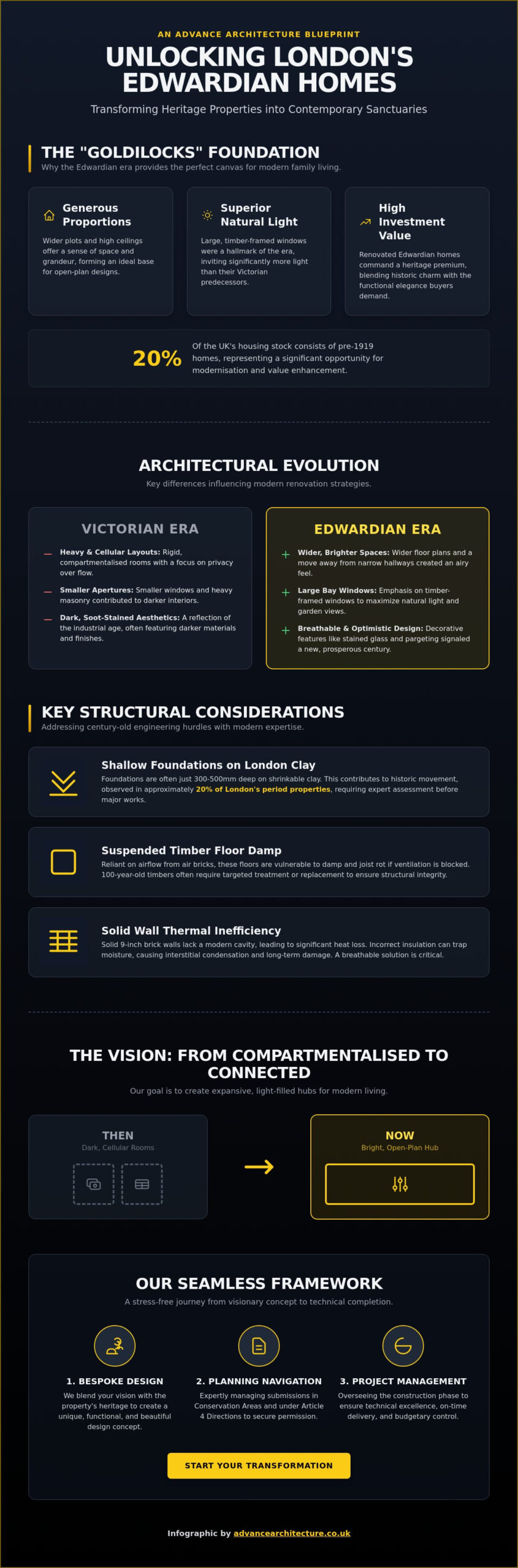
- Discover why the Edwardian era’s generous proportions and superior natural light provide the “goldilocks” foundation for a contemporary family home in the capital.
- Identify critical structural considerations, from London clay subsidence to suspended floor damp, to ensure your period property remains sound for the next century.
- Navigate the complexities of Conservation Areas and Article 4 Directions to secure a bespoke extension that respects heritage while maximizing your property’s value.
- Learn how a strategic edwardian house renovation London can transform dark, compartmentalised kitchens into expansive, light-filled hubs for modern living.
- Explore our “Design, Planning, and Management” framework designed to provide a seamless, stress-free journey from initial visionary concept to technical completion.
Understanding the Edwardian Property Landscape in London
The Edwardian era, spanning 1901 to 1910, represents a pivotal shift in London’s residential history. These homes are frequently described as the “goldilocks” of the capital’s property market. They offer a perfect middle ground between the heavy, cellular rooms of the Victorian age and the more utilitarian builds that followed. For homeowners considering an edwardian house renovation London provides a rich, varied canvas. You’ll find these properties predominantly in North London boroughs like Barnet, Haringey, and Enfield. Their wider plots and larger windows invite an abundance of natural light that Victorian predecessors often lacked. Our philosophy centers on unlocking potential within these high-ceilinged, airy spaces to create homes that feel both historic and contemporary.
Success in these projects requires a steady hand and a deep understanding of the Edwardian architectural style. These buildings weren’t just homes; they were symbols of a new, optimistic century. They moved away from the dark, soot-stained aesthetics of the 1800s toward something more breathable. This inherent “breathability” makes them ideal for modern families who crave open-plan living without sacrificing the character of a period property. We approach every project as a partnership, ensuring the structural integrity of the original build is respected while we implement visionary changes.
Edwardian vs. Victorian: Why Renovations Differ
Renovating an Edwardian home requires a different technical lens than a Victorian one. While Victorians focused on heavy masonry and smaller apertures, Edwardian builders embraced timber-framed windows and wider floor plans. This shift allowed for the early concepts of open-plan living to take root. Identifying original features is the first step in any bespoke design. You’ll often find vibrant stained glass, decorative exterior pargeting, and ornate fireplaces. We focus on these details to ensure your edwardian house renovation London maintains its soul. It’s about enhancing the flow of the space, moving from the rigid cellular rooms of the past toward a seamless, modern layout.
The Investment Value of an Edwardian Renovation
Bespoke architectural design is the most reliable way to maximize ROI in the competitive London market. In sought-after enclaves like Muswell Hill and Hampstead Garden Suburb, there’s a significant heritage premium attached to well-preserved facades. Buyers in these areas look for a specific blend of historic charm and functional elegance. We help you balance modern lifestyle needs, such as high-performance glazing and integrated technology, with the preservation of period character. Our structured process covers design, planning, and management, making the journey toward your dream home stress-free. By optimizing every square foot, we ensure your property remains a valuable asset for decades to come.
Technical and Structural Challenges of Edwardian Renovations
Edwardian properties are celebrated for their generous proportions and refined aesthetics, yet they present specific engineering hurdles that require a sophisticated approach. Most London homes from this era sit on shallow foundations, often resting just 300mm to 500mm below the surface on the capital’s shrinkable clay. This geological reality means that approximately 20% of period properties in the city show signs of historic movement. When you begin an edwardian house renovation London, addressing these footings is the first step toward a stable, long-term transformation.
Suspended timber floors are another area requiring expert scrutiny. These structures rely on consistent airflow through external air bricks to prevent moisture buildup. If these vents are obstructed by modern landscaping or debris, the resulting damp can lead to significant rot in the joists. It is common to find that 100-year-old timbers require targeted replacement or specialist chemical treatment to ensure they remain viable. Beyond the floorboards, the thermal efficiency gap in solid brick walls poses a challenge. These 9-inch masonry walls lack the cavity found in modern builds, making them prone to heat loss and interstitial condensation if insulated incorrectly.
Modernising the Building Envelope
Upgrading the thermal performance of an Edwardian home is a delicate balancing act. Unlike modern structures, period masonry must breathe to remain healthy. Applying non-breathable internal insulation can trap moisture, leading to mould and structural decay. We typically recommend breathable wood fibre boards or lime-based plasters to improve U-values while protecting the building’s fabric. For windows, the choice between slimline double glazing and high-quality secondary glazing often depends on local restrictions. In London’s 600+ conservation areas, maintaining the original profile of sash windows is essential for securing planning permission and preserving the property’s character.
Structural Integrity and Load-Bearing Walls
The contemporary desire for open-plan living often requires the removal of internal load-bearing walls. This process demands precise steelwork integration to support the upper floors and the complex Edwardian roof structures. These roofs, while aesthetically striking with their steep gables, weren’t designed for the heavy floor loads of a modern loft conversion. We use advanced structural modelling to design bespoke solutions that distribute weight safely across the existing frame. Detailed technical drawings are non-negotiable; they serve as the blueprint that ensures building control approval and a stress-free construction phase. Unlocking the potential of these historic spaces requires a steady hand and a deep understanding of period engineering to ensure the home remains as sturdy as it is beautiful.
Navigating London Planning and Conservation Constraints
Securing approval for an edwardian house renovation London requires more than just an aesthetic vision; it demands a strategic understanding of local policy. London boroughs are fiercely protective of their architectural heritage. If your property sits within a Conservation Area, the council’s primary goal is to preserve or enhance the character of the neighborhood. This objective often translates to stricter controls on masonry types, window profiles, and even the color of your front door. It’s a delicate process that requires a steady, expert hand to manage.
Many Edwardian enclaves in boroughs like Barnet or Camden are subject to Article 4 Directions. These legal mechanisms strip away your Permitted Development rights, meaning minor external changes that are usually “automatic” instead require full planning permission. We mitigate this uncertainty through Pre-application Advice. In 2024, Camden’s pre-app service provides a formal platform to discuss design concepts with officers before a full submission. This proactive step identifies potential hurdles early, saving months of delays and thousands of pounds in wasted fees. If you’ve purchased a property with a history of failed applications, we perform a forensic design review. We analyze the previous officer’s report, identify the specific points of friction, and redesign the scheme to align with the council’s vision while still unlocking your home’s hidden potential.
Listed Building Consent for Edwardian Homes
If your home is Grade II listed, it’s recognized as having special architectural interest, which places the entire structure under statutory protection. You’ll need Listed Building Consent for any internal or external alterations. Success here depends on the balance of modern lifestyle needs and heritage preservation. We often propose “subservient” extensions that use high-quality, contemporary materials to create a clear distinction between the original Edwardian fabric and the new addition. This transparent approach, often involving structural glass or bespoke metalwork, is frequently favored by heritage officers as it respects the building’s historical narrative.
Permitted Development Rights in London
Even with rigorous local constraints, many homeowners can still achieve significant transformations without a full planning application. In 2026, Permitted Development (PD) remains a powerful tool for edwardian house renovation London, allowing for rear extensions and loft conversions within specific volume limits. For instance, terraced homes generally allow for a 40-cubic-meter increase in roof space, while semi-detached properties allow for 50 cubic meters. However, these rights are often restricted or removed in Conservation Areas. To see how these rules apply to your specific postcode, explore our Permitted Development in London guide for a comprehensive breakdown of the latest 2026 regulations.
Modernising the Layout: Extensions and Spacial Optimization
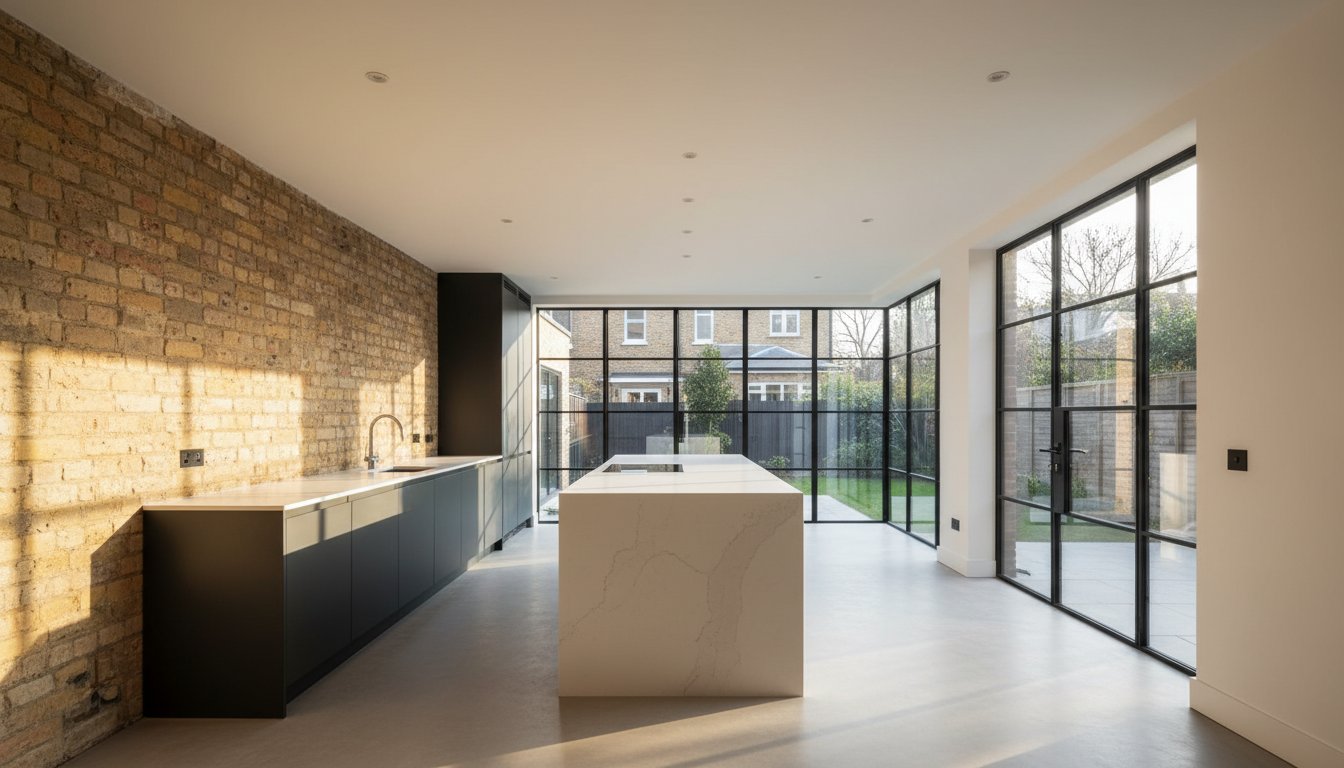
Edwardian properties often suffer from a disconnect between the grand, formal reception rooms at the front and the cramped, utility-focused sculleries at the rear. A successful edwardian house renovation London requires a fundamental shift in how space is allocated to suit 21st-century living. We focus on transforming these dark, isolated kitchens into expansive, light-filled family hubs that act as the heart of the home. By utilizing advanced 3D visualisation, we allow homeowners to walk through their digital floorplan before construction begins. This immersive technology ensures the scale of a new extension feels perfectly balanced against the original 1901 to 1910 proportions, removing the guesswork from the design phase.
Maximizing the footprint of a London home often involves looking both outward and upward. We design bespoke solutions that respect the heritage of the building while unlocking significant square footage. Whether it is a kitchen side-return or a deep basement excavation for a cinema room, the goal is to create a sense of cohesion. Our approach treats the transition between the old and new as a deliberate design choice, ensuring the property’s historic character isn’t lost in the pursuit of modern functionality.
The Classic Rear Extension
The most effective way to modernise an Edwardian layout is through an “invisible” extension that enhances the property’s flow. We often specify glass-to-glass corners and slim-profile Crittall-style doors to create a contemporary aesthetic that echoes the period’s original emphasis on natural light. Achieving a seamless level threshold between the original hallway and the new garden room is essential for a high-end finish. For a detailed look at planning requirements and design styles, consult our House Extensions London guide.
Loft Conversions for Edwardian Homes
Edwardian houses are prized for their high roof pitches, which frequently provide 3 to 4 metres of head height. This vertical volume is ideal for creating luxurious master suites or guest accommodation featuring walk-in dressing rooms. These 120-year-old structures require specific structural attention, including floor reinforcement and strategic steel placement to satisfy current building regulations. You can find more information on technical specifications in our Loft Conversions in London guide.
If you are ready to start unlocking the potential of your historic home, book a consultation with our design team to explore your bespoke renovation options.
The Advance Architecture Approach to Edwardian Transformations
Undertaking an edwardian house renovation London project involves more than just aesthetic updates. It requires a rigorous “Design, Planning, and Management” framework to ensure the process remains stress-free and predictable. We act as the bridge between your creative aspirations and the strict technical requirements of UK building regulations. Our team ensures that every structural modification, from removing load-bearing walls to installing high-performance glazing, meets safety standards without compromising the home’s historic character.
Hiring experienced residential architects in London is an investment that pays dividends in both property value and daily enjoyment. While some homeowners view architectural fees as an added expense, our involvement typically prevents costly onsite errors and ensures that every square metre is optimized. We focus on maintaining the quality of bespoke joinery and high-end finishes through dedicated project management, ensuring the final result matches the precision of the initial blueprints.
From Feasibility to Completion
The journey begins with a comprehensive site survey and feasibility study. This stage is vital for identifying potential constraints early, such as conservation area restrictions or complex structural issues common in properties built between 1901 and 1910. We produce detailed technical drawings that builders can follow with absolute certainty, reducing the risk of delays or budget overruns.
- Detailed site analysis to unlock hidden spatial opportunities.
- Full coordination of planning applications with local London councils.
- Rigorous contractor liaison to maintain build quality and timelines.
We manage the intricate relationship between the client, the local council, and the contractor. This steady hand allows you to focus on the excitement of the transformation while we handle the logistical complexities of the construction site.
Realise Your Vision with Bespoke Solutions
Our approach to interior design honors Edwardian heritage while embracing modern luxury. We create bespoke solutions that integrate period features, like ornate cornicing and ceiling roses, with contemporary elements like open-plan kitchen diners and smart home technology. This commitment to quality and order defines our comprehensive architectural service.
Every edwardian house renovation London we lead is a partnership. We take the time to understand how you live, ensuring the final design reflects your personality and requirements. Whether you are looking to add a loft conversion or a wrap-around extension, our goal is to maximize your property’s potential through visionary design and technical excellence.
Ready to begin your transformation? Book a free initial consultation for your London project today and let us help you create a home that stands the test of time.
Begin Your Bespoke Transformation
Successfully executing an edwardian house renovation London requires a sophisticated blend of technical precision and creative foresight. You’ve seen how modern spatial optimization can breathe new life into period proportions, provided you navigate the specific planning constraints of your borough with care. Since 2009, Advance Architecture has served as a steady hand for London homeowners, specializing in the delicate requirements of Conservation Areas and the intricacies of Listed Building Consent.
Our comprehensive service manages every detail from the first sketch through to construction management, ensuring your project remains stress-free and architecturally sound. We don’t just design buildings; we focus on unlocking the hidden potential within your home’s historic fabric to create a bespoke environment that perfectly reflects your lifestyle. Your journey toward a timeless transformation starts with expert guidance and a clear roadmap for success. Let’s build something extraordinary together.
Realise your vision with a free initial consultation from Advance Architecture
Frequently Asked Questions
Do I need planning permission for an Edwardian house renovation in London?
Planning permission is required for most external alterations, though many internal changes fall under Permitted Development. If you’re planning an edwardian house renovation London project involving a rear extension, you’ll likely need a full planning application or a Lawful Development Certificate. Roughly 75% of London’s Edwardian homes are subject to specific local authority constraints. We manage the entire application process to ensure your project meets the 2015 General Permitted Development Order requirements.
How much does it cost to renovate an Edwardian house in London?
A high-quality renovation typically costs between £2,500 and £4,500 per square metre in the current London market. For a standard four-bedroom Edwardian terrace, total project budgets often range from £200,000 to over £500,000 depending on the specification level. These figures include structural work, high-end finishes, and professional fees. We provide a detailed cost breakdown during the design phase to help you allocate your budget effectively across every room.
Can I extend my Edwardian house if it’s in a Conservation Area?
You can certainly extend an Edwardian house in a Conservation Area, provided the design respects the local character. Local councils like Richmond or Islington apply Article 4 directions to roughly 20% of their historic streets, which limits certain Permitted Development rights. Our team specialises in creating bespoke glass extensions or brickwork additions that satisfy strict heritage officers. We focus on sensitive architectural solutions that balance modern living with preserved historical integrity.
What are the most common structural problems in Edwardian properties?
The most frequent structural issues include shallow foundations, wall tie corrosion, and damp caused by breached lime mortar. Edwardian properties often feature “suspended” timber floors that require adequate ventilation to prevent dry rot. Approximately 40% of London homes from this era show signs of minor subsidence due to the city’s clay soil. We conduct thorough structural surveys early in the process to identify these risks and implement permanent engineering solutions.
How can I make my Edwardian home more energy-efficient?
Improving energy efficiency involves a multi-layered approach starting with breathable wood fibre insulation and high-performance glazing. Upgrading an Edwardian home can improve its EPC rating from a typical ‘E’ to a ‘B’, potentially reducing annual energy bills by 30%. We often integrate air source heat pumps and underfloor heating systems into our designs. These modern upgrades unlock the property’s potential while ensuring the building fabric remains healthy and well-ventilated.
Is it better to restore or replace original Edwardian sash windows?
Restoring original frames is often preferable for heritage value, but replacing them with bespoke slimline double glazing offers superior thermal performance. Modern vacuum-sealed units can achieve U-values as low as 1.1, which is a 60% improvement over original single glazing. If your home isn’t Grade II listed, high-quality timber replacements are a visionary investment. This choice ensures your edwardian house renovation London maintains its period charm while providing contemporary comfort.
How long does a full Edwardian house renovation typically take?
A comprehensive renovation usually takes between 8 and 14 months from the initial design consultation to completion. The architectural design and planning phase typically requires 4 months, while the construction phase lasts approximately 6 to 10 months. These timelines vary based on the project’s complexity and the specific requirements of London planning departments. We provide a structured project schedule to ensure a stress-free experience throughout the transformation of your home.
Do I need a specialist architect for a period property renovation?
Hiring a specialist architect is essential for navigating the unique challenges of period properties and London’s complex planning landscape. Experts understand how to blend Edwardian proportions with modern open-plan layouts while satisfying building regulations. We act as your visionary partner, managing every detail from structural integrity to bespoke interior finishes. This professional oversight minimizes risk and ensures your renovation is delivered with technical precision and aesthetic excellence.