
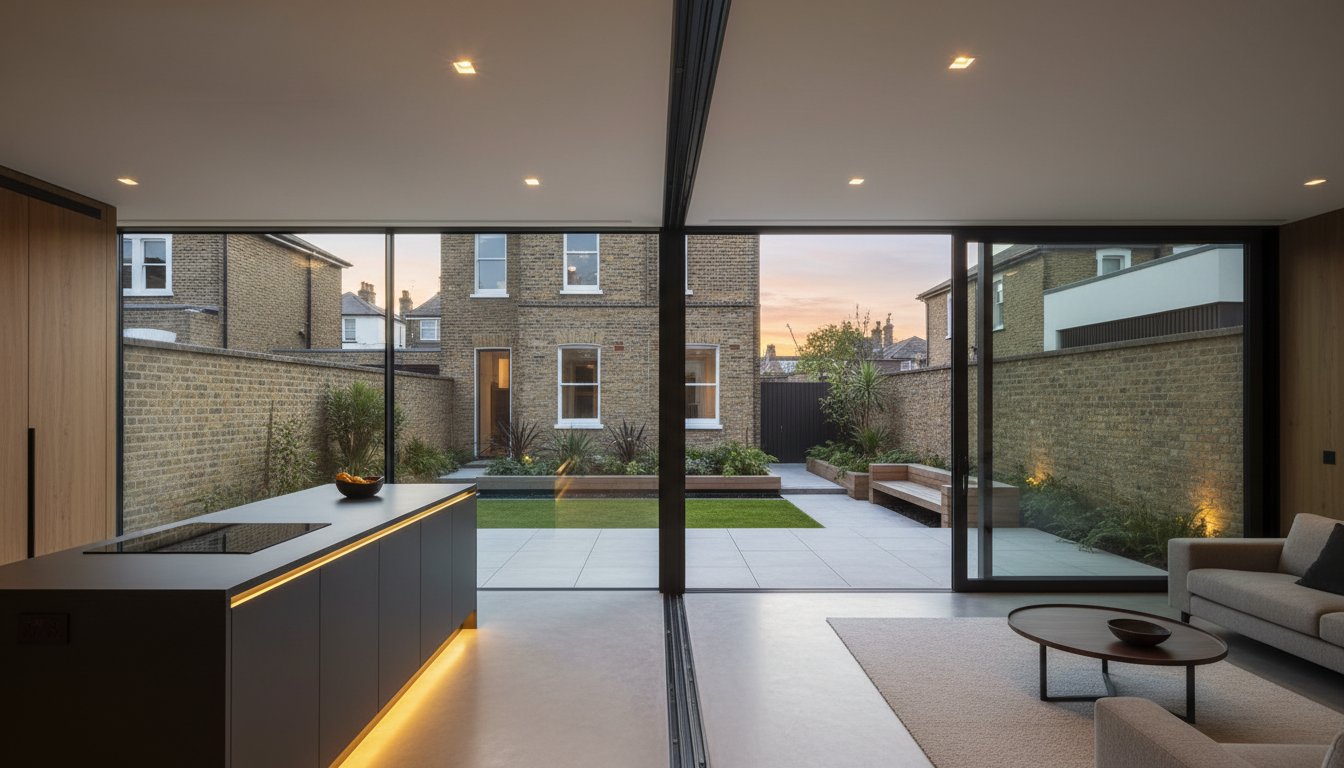
Rear Extension London: The Visionary Guide to Transforming Your Home in 2026
What if the primary obstacle to your dream home isn’t the square footage you lack, but the specific way your current layout ignores the rhythm of modern life? For many homeowners in North London, the daily reality involves navigating a cramped kitchen or enduring a dining area that hasn’t seen natural light since the original floorboards were laid. You’ve likely felt that familiar frustration where your living space feels more like a series of disconnected boxes than a cohesive home. It’s a common challenge in our city’s architectural heritage, but it’s one that a visionary rear extension is perfectly positioned to solve.
We believe your property holds a hidden potential that, when unlocked, can increase its market value by up to 20% while providing the seamless indoor-outdoor lifestyle you’ve envisioned for 2026. This guide offers a clear, professional roadmap to navigate the complexities of Barnet and North London planning constraints without the typical stress associated with rogue builders. You’ll discover how our bespoke approach to design, planning, and management ensures your project moves from an initial concept to a stunning completion with absolute precision. We’ll explore the latest architectural trends and technical requirements that will define the most successful London home transformations over the next twelve months.
Key Takeaways
- Learn how to banish the “dark middle room” common in London terraces by reimagining your floor plan through bespoke architectural design.
- Navigate the 2026 planning landscape with confidence, understanding the critical nuances between Permitted Development and the Neighbour Consultation Scheme.
- Discover how to select the perfect aesthetic for your rear extension, balancing contemporary innovation with the heritage of your property’s original character.
- Gain a clear financial blueprint for your project, including a realistic 2026 breakdown of professional fees, shell costs, and internal fit-out expenses.
- Master the “Design, Planning, and Management” stages to ensure a seamless, stress-free journey from the initial feasibility study to your completed home transformation.
Unlocking Potential: Why a Rear Extension is the Ultimate London Transformation
For many homeowners, a rear extension represents much more than a simple addition of bricks and mortar. It’s a fundamental reimagining of the classic Victorian or Edwardian floor plan. These historic London properties, while aesthetically pleasing, often suffer from a cellular layout that feels restrictive for contemporary life. A bespoke architectural intervention allows you to break free from these constraints. It transforms a series of disconnected, narrow rooms into a cohesive environment tailored to your specific needs. We focus on unlocking potential in North London properties by addressing the notorious “dark middle room” problem. This phenomenon occurs when the original dining room loses its external window to a side-return or a previous poorly planned add-on. By using strategic structural openings and high-performance glazing, we flood these internal spaces with light, turning a redundant corridor into a vibrant living area.
Modern design has moved beyond the vast, echoing open-plan spaces that dominated the early 2000s. Today, we champion “broken-plan” living. This sophisticated approach uses subtle internal levels, bespoke joinery, or glass partitions to create distinct zones for cooking, dining, and relaxing. It maintains the visual flow and sense of space but provides the acoustic privacy and functional separation necessary for a busy family home. Whether you’re in a Highgate terrace or a Barnet semi-detached, this method ensures every square metre serves a clear purpose.
Maximising Square Footage and Natural Light
The psychological benefits of natural light are significant. Increasing daylight levels can improve mood and productivity by up to 15%, according to a 2023 study by the Royal Institute of British Architects (RIBA). In North London, where gardens often face north-east or north-west, solar orientation strategies are vital. We use 3D visualisation to map light patterns across all four seasons. This ensures that a £120,000 investment delivers a space that feels bright at 4 PM in December, not just at noon in July. Large-format sliding doors or frameless glass corners blur the boundary between the garden and the interior, effectively doubling your perceived living space during the summer months.
The Evolution of the Kitchen-Diner
The kitchen has reclaimed its status as the social heart of the British home. It’s no longer a hidden service area but a stage for entertaining and a hub for family life. Designing for 2026 requires a forward-thinking approach that integrates home-working zones without compromising the social atmosphere. We often incorporate “pocket offices” or discreet joinery that hides monitors and cables when the workday ends. Data from the Office for National Statistics indicates that 44% of London professionals now work in a hybrid capacity, making these flexible zones essential. Understanding the complexities of the UK planning permission system ensures your project remains compliant while pushing the boundaries of design. A kitchen extension in London acts as the primary driver of property value, often yielding a return on investment of 20% to 25% relative to the total property price.
- Zoned Lighting: Using smart controls to shift the mood from a bright workspace to an intimate dining area.
- Structural Seamlessness: Removing load-bearing walls to create a flush ceiling finish between the old and new structures.
- Thermal Efficiency: Utilising triple glazing and advanced insulation to exceed standard building regulations.
Navigating the 2026 Planning Landscape: Permitted Development vs. Full Permission
Choosing the right path for your London home transformation requires a clear understanding of the 2026 regulatory environment. You have two primary routes to consider: Permitted Development (PD) or a Full Planning Application. PD offers a streamlined, often faster journey for a rear extension, provided your design adheres to strict national criteria. Full Planning, while involving more scrutiny, unlocks total creative freedom to redefine your property’s silhouette and aesthetic impact. We view these options not as obstacles, but as strategic frameworks to maximise your property’s value.
For those looking to push boundaries, the Larger Home Extension scheme remains a vital tool in 2026. This allows for increased depths but triggers the “Neighbour Consultation Scheme.” Under this process, the local authority notifies adjoining owners, giving them 21 days to object. If a neighbour raises a valid concern regarding overshadowing or loss of light, the council must then assess the impact. It’s a critical hurdle. We manage this dialogue with precision, ensuring your design is robust enough to withstand scrutiny while maintaining positive local relations. Our goal is always to provide a steady hand through these technical negotiations.
The PD route is frequently described as a “stress-free” option because it bypasses the subjective judgment of planning officers. It relies on objective, tick-box criteria. However, this path often limits your choice of materials and roof shapes. If your vision includes floor-to-ceiling glass walls or a contemporary zinc finish that contrasts with Victorian brickwork, a Full Planning Application is the necessary vehicle. This route allows us to argue the architectural merit of your project, often resulting in a more striking and valuable transformation. Working with an experienced house extension architect in London ensures you choose the most strategic route for your specific property and aspirations.
The 6-Metre and 8-Metre Rules for 2026
In 2026, the depth of your extension depends entirely on your house type. Terraced and semi-detached homes can extend up to 6 metres, while detached properties have an 8-metre limit under the prior approval process. Height is equally regulated. Your structure cannot exceed 4 metres in total height, and the eaves must stay within 3 metres if the extension sits within 2 metres of a boundary. These Permitted development rights also mandate that external materials must match the existing dwelling, ensuring architectural continuity across the streetscape. We ensure every millimetre is accounted for in our technical drafts.
Special Considerations: Conservation Areas and Listed Buildings
Homeowners in North London enclaves like Hampstead Garden Suburb or Barnet face additional layers of complexity. In these protected pockets, PD rights are often restricted or removed via Article 4 Directions. Proposing a rear extension here demands a “sympathetic design” that respects the historical fabric. Listed Building Consent is mandatory for any internal or external alterations to protected structures. Advance Architecture specialises in this delicate liaison, crafting bespoke solutions that satisfy both your lifestyle aspirations and the rigorous standards of local planning authorities. We turn heritage constraints into unique design opportunities.
Professional architectural plans are more than just drawings; they are your legal safeguard. Accurate documentation prevents enforcement action and ensures every aspect of your new space is compliant. By partnering with a visionary expert, you transform a complex regulatory puzzle into a seamless journey toward your dream home. We handle the technicalities so you can focus on the possibilities.
Bespoke Design Archetypes: From Glass Boxes to Traditional Brickwork
Choosing the right archetype for your rear extension is a defining moment in the architectural process. It’s where your personal vision meets the practical constraints of the London landscape. At Advance Architecture, we view this as a dialogue between the past and the future. The central debate often revolves around “contrast vs context.” Should the new structure mimic the existing 19th-century masonry, or should it stand as a bold, modern intervention? Both paths offer unique ways of unlocking potential, provided the materiality is handled with precision.
Materiality defines the character of the space. We often specify 19th-century reclaimed London Stock brick to ensure a flawless match with Victorian terraces, providing a sense of permanence. Alternatively, materials like standing-seam zinc or Shou Sugi Ban (charred timber) create a sophisticated juxtaposition. These choices aren’t merely aesthetic. They must align with technical requirements. Detailed Building Regulations Drawings are essential here, as they translate high-end design into a safe, thermally efficient reality. These documents ensure your project adheres to Part L of the Building Regulations, which governs fuel and power conservation.
Navigating these choices requires a firm grasp of the rules. Homeowners should consult the official guidance on Permitted development rights for householders to understand the volume and height limits that will shape their design archetype. This technical foundation allows for a stress-free creative journey, ensuring the final build is as robust as it is beautiful.
The Contemporary Glass Box Extension
Modern London living often demands a radical influx of light. The contemporary glass box achieves this through structural glass walls, slim-frame bi-fold doors, and frameless skylights that offer an uninterrupted view of the sky. While visually stunning, these designs face significant thermal challenges. With the 2026 Future Homes Standard approaching, we focus on high-performance glazing with U-values as low as 1.2 W/m²K. This technical rigour ensures a seamless transition to a landscaped garden without compromising on winter warmth or summer cooling. It’s about creating a transparent sanctuary that feels like an organic part of the outdoors.
Achieving this look relies on sourcing high-quality components. When specifying glazing and doors, it’s worth exploring specialist suppliers who can provide the necessary high-performance uPVC or aluminium systems. For those researching options, customtradesystems.co.uk offers examples of the types of products that can meet these demanding technical and aesthetic standards.
The Sympathetic Period Extension
Unlocking the potential of a rear extension on a Victorian or Edwardian property often requires a more traditional touch. A sympathetic design uses pitched rooflines and matching brickwork to respect the historic soul of the building. We focus on sourcing authentic materials that age gracefully alongside the original structure. Inside, the story changes. We often integrate open-plan kitchen extensions and modern lighting schemes within this heritage-style shell. This approach offers the best of both worlds: the timeless curb appeal of a classic London home and the functional elegance of a 21st-century interior. It’s a bespoke solution that honours history while embracing modern life.
When considering the internal fit-out for this new space, innovative materials can introduce modern functionality. For a creative way to make walls more interactive for a home office nook or a dynamic family noticeboard, you can discover MagScapes and their range of magnetic wallcoverings.
- Material Harmony: Matching mortar tints and brick bonds to the original 1880s construction.
- Thermal Excellence: Exceeding current building standards to future-proof your investment against rising energy costs.
- Spatial Optimization: Using vaulted ceilings in sympathetic builds to create a sense of volume that the original house lacked.
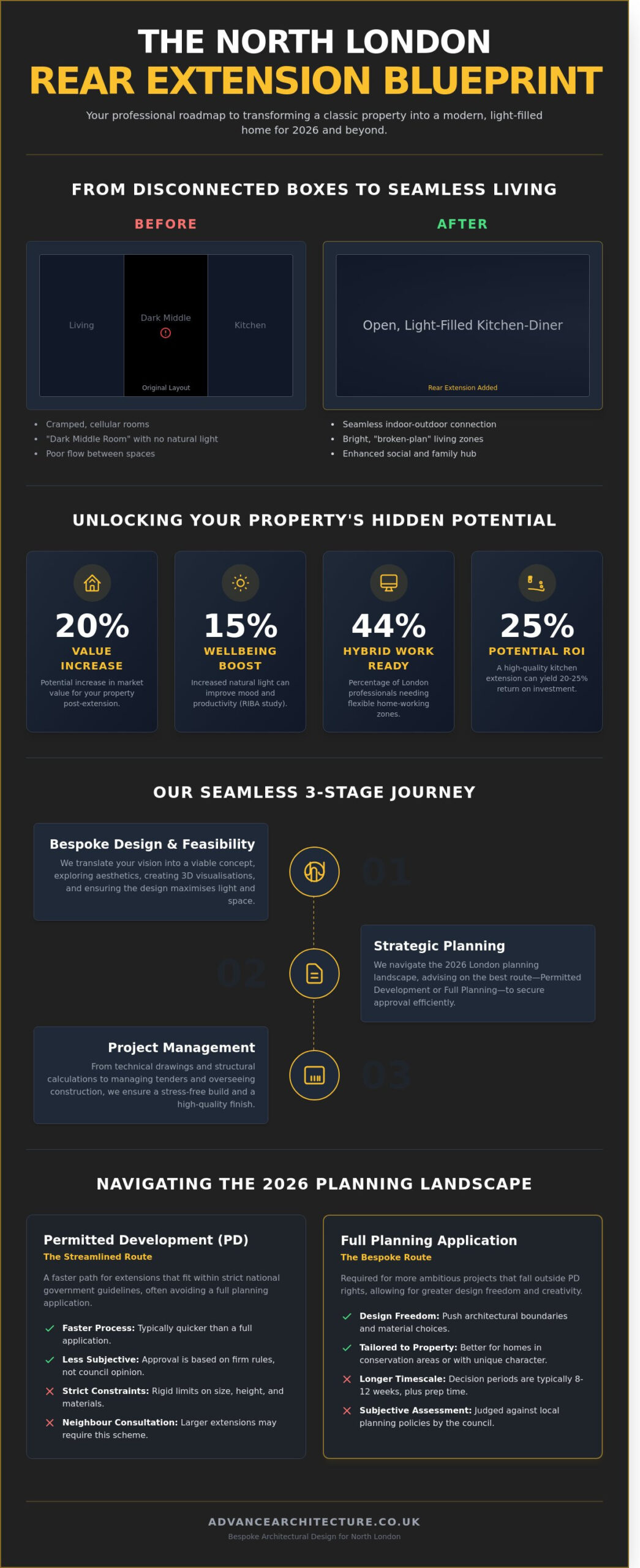
The Financial Blueprint: Calculating Costs and ROI in London
Investing in a rear extension requires a clear-eyed understanding of the capital’s unique economic pressures. By 2026, construction costs in London have stabilised but remain significantly higher than the national average due to supply chain complexities and high demand for skilled labour. You’ll need to distinguish between “shell and core” costs, which cover the structural integrity and weatherproofing, and the internal fit-out expenses that define your lifestyle experience. While the shell might consume 60% of your budget, the finishing touches like bespoke cabinetry or high-performance glazing often dictate the final price point.
The “London Premium” is a tangible reality for every homeowner. Logistics alone can inflate a budget by 12% to 15%. Contractors must account for daily Congestion Charge fees, ULEZ compliance, and the logistical puzzle of skip placement on narrow Victorian streets. In boroughs like Islington or Camden, parking suspensions for delivery vehicles can cost upwards of £85 per day. An architect-led project mitigates these risks through precise technical documentation. By producing a comprehensive tender pack before any ground is broken, we prevent the “budget creep” that plagues unmanaged sites. This level of detail ensures contractors provide fixed-price quotes rather than vague estimates.
Breakdown of Extension Costs per Square Metre
Projecting into 2026, square metre rates for a high-quality rear extension in London fall into three distinct brackets:
- Standard Finish: £2,650 to £3,200 per sqm. This includes quality off-the-shelf materials and standard lighting layouts.
- Premium Finish: £3,400 to £4,800 per sqm. Expect bespoke joinery, underfloor heating, and expansive aluminium bifold doors.
- Luxury Finish: £5,200+ per sqm. This involves architectural glass structures, imported stone, and integrated smart-home systems.
Don’t forget to account for “hidden” essentials. Structural engineer fees typically range from £1,800 to £4,000, while Party Wall Agreements can add £2,500 per neighbour if awards are required. Professional fees typically represent a small fraction of the total value added to the property, ensuring the project is delivered without costly regulatory errors. All figures must also include VAT at 20%, which is a significant consideration for any domestic build.
Strategic ROI: Adding Value to Your Property
In North London areas like Highgate or Muswell Hill, the right design choices yield the highest dividends. A well-executed kitchen-diner extension often provides a better return on investment than a simple extra bedroom. Modern buyers prioritise “broken-plan” living areas that connect seamlessly with the garden. Data from 2025 property auctions indicates that a high-spec kitchen transformation can increase a terrace house’s value by 15% to 22%. Engaging a skilled house extension architect from the outset is one of the most effective ways to protect and maximise this return on investment.
If you’re unsure how to balance your aspirations with your bank balance, consult our detailed London house extension cost guide for 2026 pricing and planning for a deeper dive into current market rates. The goal is always to unlock the hidden potential of your footprint without overcapitalising. Strategic design ensures every pound spent contributes to both your daily enjoyment and your long-term equity.
Realising Your Vision: The Stress-Free Journey with Advance Architecture
Embarking on a property transformation often feels like a daunting task for London homeowners. At Advance Architecture, we act as the steady hand that guides you through the entire lifecycle of your project. We specialise in a comprehensive “Design, Planning, and Management” approach that removes the guesswork from your rear extension. Our process begins with an in-depth initial consultation where we evaluate the unique constraints of your site. We conduct a detailed feasibility study to ensure your ambitions align with local regulations and structural possibilities. This groundwork prevents costly revisions later, saving clients an average of 15% on potential redesign fees during the construction phase.
The transition from a concept to a finished home requires more than just a creative eye; it demands technical precision. We’ve built our reputation on being a partner rather than just a service provider. We listen to how you intend to use your space, whether it’s for a sun-drenched kitchen-diner or a quiet home office. By identifying these needs early, we can optimise every square metre of your property’s footprint. Our team ensures that the structural integrity of your home is never compromised, providing a sense of security that is vital when undertaking significant structural changes in a dense urban environment.
Our Integrated Design and Planning Process
We’ve refined our workflow into three distinct phases to ensure clarity and precision at every milestone. This structure provides the sturdy framework needed for a successful rear extension project.
- Step 1: Bespoke conceptual design and 3D visualisations. We don’t just draw lines; we create immersive 3D models. These allow you to walk through your future space before a single brick is laid, ensuring the layout is perfect.
- Step 2: Navigating the planning application or PD certificate process. Whether your project falls under Permitted Development or requires full planning permission, we handle the bureaucracy. We currently maintain a 98% approval rate across London boroughs.
- Step 3: Technical drawings and Building Control approval. We produce exhaustive technical packs. These include structural calculations and thermal performance data to ensure your home meets the 2023 Building Regulations updates regarding energy efficiency.
Our “hassle-free” promise is the cornerstone of our service. We take the weight off your shoulders by managing the complex web of consultants required for a modern home. We coordinate directly with structural engineers, party wall surveyors, and Thames Water where necessary. You won’t need to spend hours deciphering council letters or chasing technical specifications. We manage the dialogue with local authorities, ensuring every document is submitted correctly the first time. This integrated management style typically reduces project lead times by up to 4 weeks, allowing you to start your build sooner.
Why a London Specialist Architect Matters
London’s architectural landscape is a patchwork of conservation areas and strict height restrictions. Working with a specialist who understands the specific nuances of boroughs like Barnet, Islington, and Camden is vital. We’re familiar with the local planning officers’ preferences and the historical context of the streetscapes. This local knowledge allows us to push the boundaries of design while remaining within the rules. Our commitment to quality and visionary elegance ensures that your project isn’t just an addition, but a seamless transformation of your lifestyle.
Your dream home is a hidden opportunity waiting to be realised. With the right expertise, the complexities of London property development become a clear path toward an enhanced living environment. Let us help you unlock the full potential of your residence with a design that reflects your personality and meets your practical needs. Book your free initial consultation today and take the first step toward your home’s transformation.
Realise Your Vision: Step Into Your Future Home
Your London property holds untapped potential that requires a precise, expert hand to release. By 2026, navigating the shifting landscape of Permitted Development and conservation area constraints in North London will demand more than just a standard plan. It requires a strategic vision. Since our founding in 2009, Advance Architecture has spent over 15 years mastering the intricacies of London’s architectural fabric. We handle every stage, from the initial bespoke design to the final technical building regulations, ensuring your project remains entirely stress-free.
A well-executed rear extension doesn’t just add square footage; it fundamentally redefines how you experience your living space while securing a significant return on your investment. We’ve spent over a decade and a half refining a process that balances aesthetic elegance with rigorous technical integrity. You don’t have to navigate the complexities of planning policy alone. Our team provides the steady guidance needed to turn your conceptual sketches into a tangible, high-end reality. For homeowners seeking transparency on investment requirements, our comprehensive house extension cost breakdown for London properties provides detailed financial planning insights to support your decision-making process.
Transform your home with a bespoke rear extension; book your consultation
We look forward to building your future together.
Frequently Asked Questions
Do I need planning permission for a rear extension in London in 2026?
You don’t always need full planning permission because many projects fall under Permitted Development rights. For a single-storey rear extension, you can typically build up to 3 metres for terraced houses or 4 metres for detached homes without a full application. These 2026 standards apply provided your property isn’t a listed building or located within one of London’s 600 Conservation Areas. We always recommend obtaining a Lawful Development Certificate to provide 100% legal certainty for future property sales.
How much does a 3-metre rear extension cost in London?
A standard 3-metre rear extension in London currently costs between £45,000 and £75,000 including VAT. This price range reflects a square metre rate of approximately £2,500 to £3,500. High-end bespoke designs that feature structural glass or premium zinc cladding can increase the investment to £85,000 or more. These figures cover the core construction and materials; however, you should budget an additional 12% to 15% for professional architectural and engineering fees.
How long does it take to design and build a rear house extension?
You should allow between 7 and 10 months to complete a rear house extension from the initial consultation to the final handover. The design, structural engineering, and planning phase usually takes 3 to 4 months. Once the groundworks begin, the physical construction typically requires a further 4 to 6 months of on-site activity. Our methodical approach ensures this timeline remains predictable, allowing you to plan your life around the transformation with total confidence.
Can I build a rear extension on a terraced house under Permitted Development?
Yes, you can build a rear extension on a terraced house using Permitted Development rights if the depth doesn’t exceed 3 metres. The eaves height must be no more than 3 metres if the structure sits within 2 metres of your boundary. If you’re looking to maximize space, the Neighbour Consultation Scheme allows for extensions up to 6 metres under specific conditions. This provides a streamlined route to unlocking your home’s potential without the complexities of a full planning submission.
Do I need a structural engineer for a simple rear extension?
You’ll always need a structural engineer to ensure your extension complies with UK Building Regulations. They produce the precise calculations for steel beams and foundations that guarantee the structural integrity of your home. These technical documents are essential for your Building Control officer’s approval and allow your contractor to provide an accurate, fixed-price quote. Skipping this stage creates significant risks and can lead to expensive remedial works during the construction phase.
What is the “Neighbour Consultation Scheme” for larger rear extensions?
The Neighbour Consultation Scheme is a formal process that allows London homeowners to build single-storey rear extensions between 3 and 6 metres deep. You must submit a prior approval notification to your local council, who then notifies your immediate neighbours. If no objections are received within the 21-day consultation period, the council grants permission to proceed. This scheme is a powerful tool for creating substantial additional living space while maintaining a professional relationship with those living next door.
How does a rear extension affect my Party Wall Agreement?
A rear extension triggers the Party Wall Act 1996 if you’re excavating within 3 metres of a neighbour’s building or working on a shared wall. You’re legally required to serve a formal notice to your neighbours at least 2 months before the build starts. If they don’t consent in writing within 14 days, you’ll need to appoint a surveyor to create a Party Wall Award. This document protects both properties and ensures the construction process is handled with technical precision and fairness.
Will a rear extension increase the value of my London home?
A high-quality rear extension typically adds between 10% and 15% to the market value of a London property. For a house valued at £750,000, this represents a potential value uplift of £75,000 to £112,500. Beyond the immediate financial return, a bespoke extension creates the modern, open-plan layout that 85% of contemporary buyers actively seek. It’s a strategic investment that optimizes your current lifestyle while securing your financial future in the competitive capital market.